
Dear melomaniac, once again I find myself swept away by discovery, stepping into the fabulous universe of Klaus Schulze—a pioneer of electronic music whose records lay the foundation for “kosmische musik,” that very special genre invented in Berlin.
It was about a month ago that I stumbled upon his marvelous album, “Timewind.” Since then, I’ve been listening to it on repeat, letting myself be carried off to distant realms—the journey he faithfully proposes each and every time. I was already familiar with the German krautrock scene and its special branch known as the “Berlin School,” represented by major acts like Tangerine Dream and Ash Ra Tempel. Yet, to my shame, I hadn’t actually listened to Klaus Schulze until now.
With the little time I have for listening sessions, after years of waiting, I finally arrived at this album—patiently biding its time in a quiet corner of my Qobuz favorites list, discreetly marked with a red “heart.” I intended to simply skim through it, as I’m always in a rush to have the chance of listening to all the albums I’ve ever flagged as favorites.
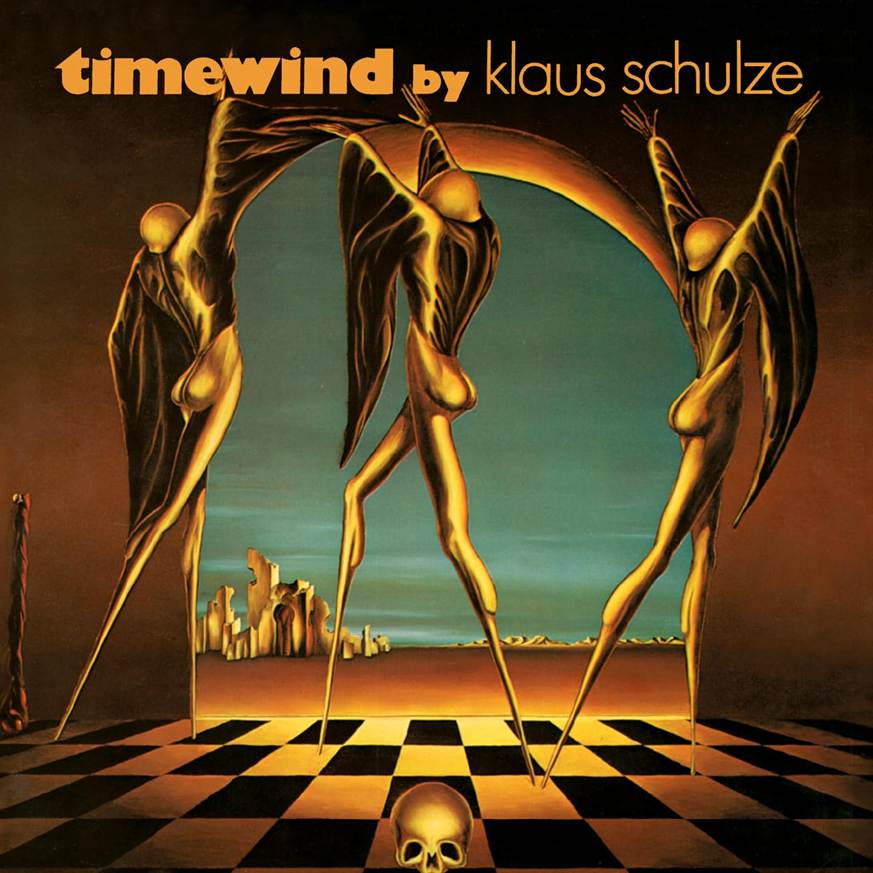
But I didn’t rush at all, because when I played “Timewind” for the first time, I was instantly transported into a vast universe. It felt as if the walls of my house were dissolved, as if my audio system disappeared, and all I could hear was the cosmos: vast, full of transitions and mysterious speeds. “Timewind” placed me in a powerful trance as I listened, without interruption, to its two tracks, each around 30 minutes long. In fact, most of Schulze’s early records are arranged this way—two tracks, each about half an hour, just long enough to fit both sides of a vinyl record.
The piece that left me speechless for a full half hour was “Bayreuth Return,” the album’s opening track. When you press play, you’re greeted only by analog synthesizers; the entire composition unfolds as a magnificent progression—a fabulous crescendo—from a place of cosmic calm to the very edge of the universe. You travel these light years at a fantastic musical speed, embarking on an exponential journey from silence to absolute, carried along by the cosmic winds so majestically conjured by Schulze.
The way an album like this was made back in the day was utterly different from modern times. Today electronic music albums are crafted with heavy post-processing, mixing, remixing, layering, and digital editing. But during the pioneering era of this genre, artists didn’t have those modern tools to “assemble” the elements of a melody. Tangerine Dream, Jean-Michel Jarre, Brian Eno—none of them could rely on anything but recording the album live, from start to finish.
This is how Schulze recorded this album too. In fact, we could call it a “live” album, captured in the studio. Picture young Klaus, just 27 years old, concocting this record in 1976 with only a handful of analog synthesizers at his disposal: ARP 2600, ARP Odyssey, EMS Synthi A, Elka String Synthesizer and Farfisa Professional Duo Organ. His only option was to lock himself in the studio and perform these tracks live, in real time. Fascinating, isn’t it?
Be warned, though—Bayreuth Return isn’t easy to understand or decode. So let me suggest a listening procedure that, at least for me, works every time. Before you start, prepare your surroundings: dim the lights or, better yet, listen in total darkness. If you’re using a stereo system, sit right in the “sweet spot” between the speakers—it’s essential for this kind of music. If you’re listening with headphones, likewise, make it dark, get comfortable in an armchair, and—most importantly in either case—close your eyes once you start.
Listen carefully, ideally with your soul and not just your ears, and allow yourself to be swept along by the slow progression. You’ll notice that the minutes will pass unnoticed; you won’t even realize when the full 30 minutes and 30 seconds of the piece have gone by. Be ready for the moment at 25:45—here the track unleashes all its energy, culminating in a solar explosion, something that will remain with you forever. Recently, I had the pleasure of sharing this listening experience with several friends, who offered a variety of reactions. My dear friend Sebi, for instance, was so transported by the music that after listening, he told me he finally understood what holography means. Another good friend, Adi, after listening—completely changed by the experience, as if he’d just come back from an ayahuasca journey—could only say, “I can’t explain it!”.
He had traveled, detached from the room, from his body, and from me, venturing far in that half hour. Then, as the cosmic winds at the end brought him back, he truly couldn’t explain where he’d been or what had happened. That is the magic of this album and of Klaus Schulze.
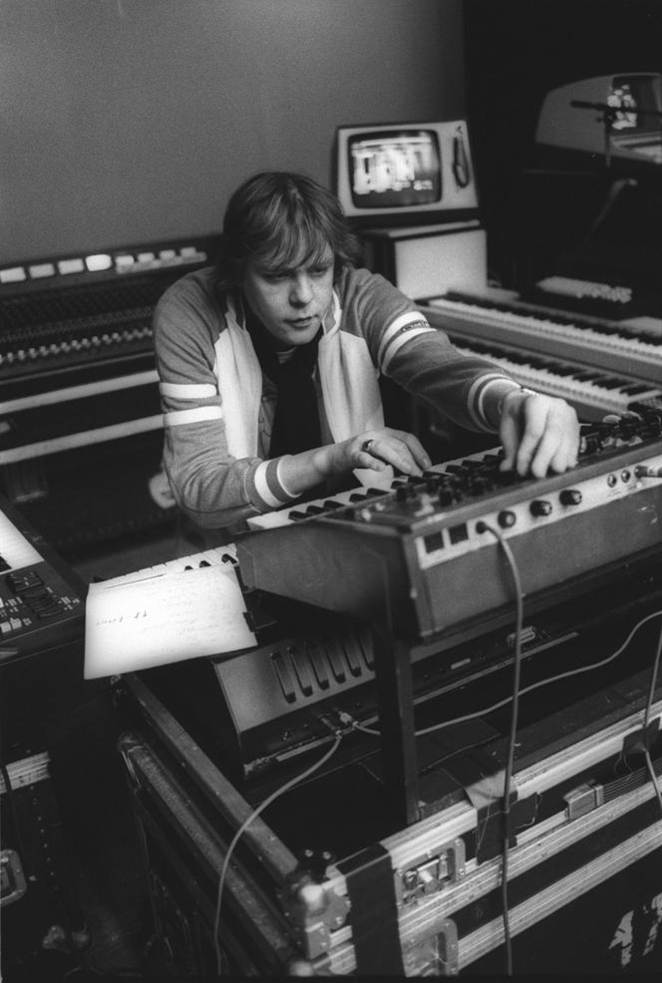
Let’s continue with a few words about Klaus Schulze. He was born in 1947 in Berlin, to a ballerina mother and a writer father. After finishing high school, he studied at the Polytechnic University of Berlin, then played drums in several local bands that would later become famous—Tangerine Dream and Ash Ra Tempel. Through these groups, he met Edgar Froese from Tangerine Dream and Manuel Göttsching from Ash Ra Tempel, both of whom he would collaborate with throughout his life.
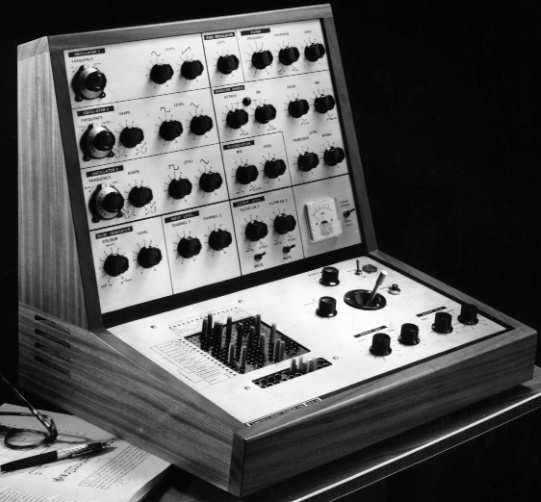
Schulze did not stay long in other bands. After only a few years, in 1972, he dedicated himself fully to a solo career, releasing his debut album “Irrlicht”, curiously produced without any synthesizer. He followed up with another album called “Cyborg,” at which point he began using the EMS VCS 3 synthesizer, which would become iconic in the pioneering world of electronic music:
From this moment on, Schulze’s career took off, especially after the release of Timewind in 1975. This album acted as his calling card, fully defining his style at that time. In general, Schulze set himself apart from other electronic music artists of the era by developing a more organic and introspective sound.
Schulze also recorded under the pseudonym Richard Wahnfried—a tribute to his boundless admiration for Richard Wagner, whose first name he borrowed. The surname “Wahnfried” translates from German as “peace after madness,” a phrase Wagner often used and even used it as a name for his villa in Bayreuth, a town in northern Bavaria.
Probably now you realize that the track I mentioned earlier, “Bayreuth Return,” is also connected to Wagner, carrying the name of the city where the composer lived. This connection continues with the second track on Timewind, “Wahnfried 1883,” which pays homage to Wagner by marking the year of his death and the place of his final rest.
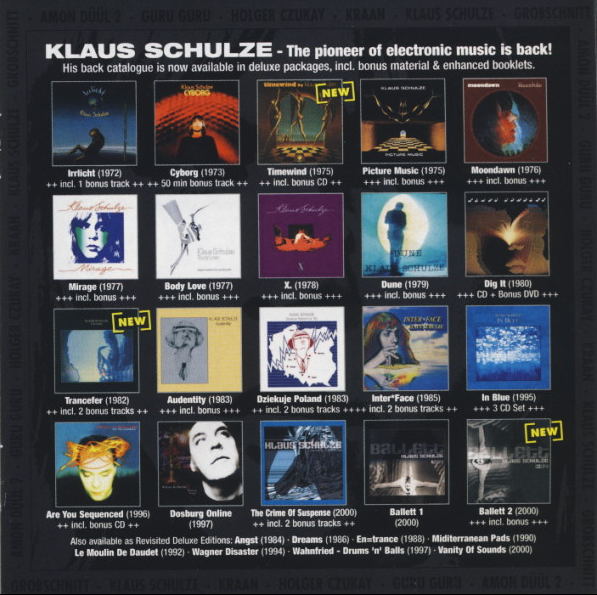
Klaus never stopped releasing albums. If you look at his discography, you’ll see that from 1972 to 2022, scarcely a year went by without a new record—and sometimes he put out several in one year. His level of productivity was exceptional, with more than 40 albums released between 1972 and 2022—the year he passed away at the age of 74. Below, I’ve included some of his most important albums:
Because I mentioned earlier “kosmische musik” and the Berlin School of electronic music, I feel compelled to tell you more about these two. Across the wider world, this school is known as the Berlin School of Electronic Music, an artistic movement born in West Berlin during the 1970s. It played a major role in shaping ambient, sequencer-driven, and experimental electronic music. The main figures of this school included Tangerine Dream, Manuel Göttsching / Ashra, Conrad Schnitzler, Peter Baumann, Christopher Franke, and of course, Klaus Schulze. Essentially, the “Berlin School” refers to this ‘circle’ of musicians, while “kosmische musik” (also called cosmic rock) is the style of music they created—a subgenre of krautrock that Kraftwerk so brilliantly brought into the spotlight.
Returning to our album, Timewind, I will investigate the origins of its cover art, as its surreal quality immediately caught my eye. My hunch was correct—the cover was created by the Swiss surrealist painter Urs Amann. While Amann did not have a purely surrealist style, his work often drew from Dalí-like references but enriched by a stark perspective reminiscent of De Chirico. The album cover subtly highlights electronic and mechanical motifs, while also suggesting a fusion with Schulze’s organic musical improvisations—the combination is truly magical. Urs Amann and Klaus Schulze were close friends and collaborators; Amann designed covers for many of Schulze’s albums—Moondawn, Body Love, X, and Dune. In an interview, Schulze once said that Amann’s images “speak the same language as my sounds—but through color and form.”
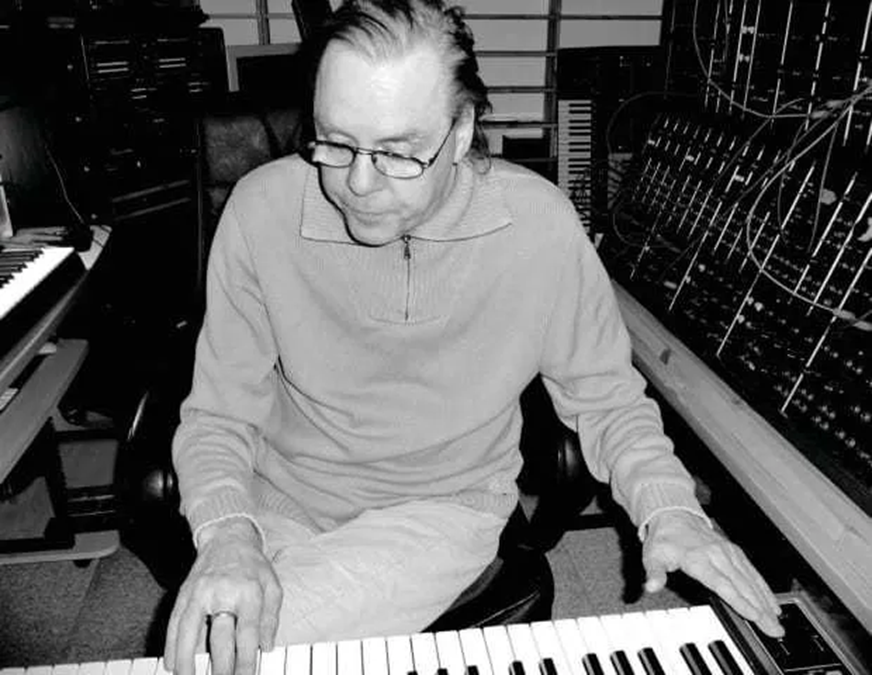
Above I included a photograph of Schulze in his later years—I chose this black-and-white image on purpose, so you can more easily compare it with the earlier photo, when Schulze was young. Do you notice that his posture and connection with music remain the same?
We’re looking at an artist who, for 40 years, from 1972 until 2002, released at least one album every year. Both fascinating and amazing. Somehow a lesser-known artist, somewhat bypassed by massive commercial success, yet he maintained his niche and his role throughout this time—and most importantly, he left us a colossal legacy of over 60 studio albums. If we count compilations and live albums, the total surpasses 130 releases.
Reaching the end of this article, I can’t finish without addressing the name of this special record, “Timewind,” that subtle play of words which reveals what’s at the heart of the track “Bayreuth Return.” When you hear it, you might be tempted to think airplanes are soaring overhead, but they aren’t planes—it’s the “breath of cosmic time,” so beautifully evoked by 27-year-old Klaus Schulze. Alone and locked away in a Berlin studio, he recorded this ageless album, giving us the chance to travel through the cosmos at any moment from our own listening chair.
Silviu TUDOR
An article written in my sweet spot,
and this is what I’ve heard.