Dear reader, this week I will catch your attention with a review of a pair of French speakers, particularly interesting in terms of their design, but also remarkable when it comes to their technical characteristics. The speaker brand Apertura comes from Nantes, France, and curious as always, I received their model called Armonia Evolution, with which I was about to spend two wonderful weeks, before writing this review for you.
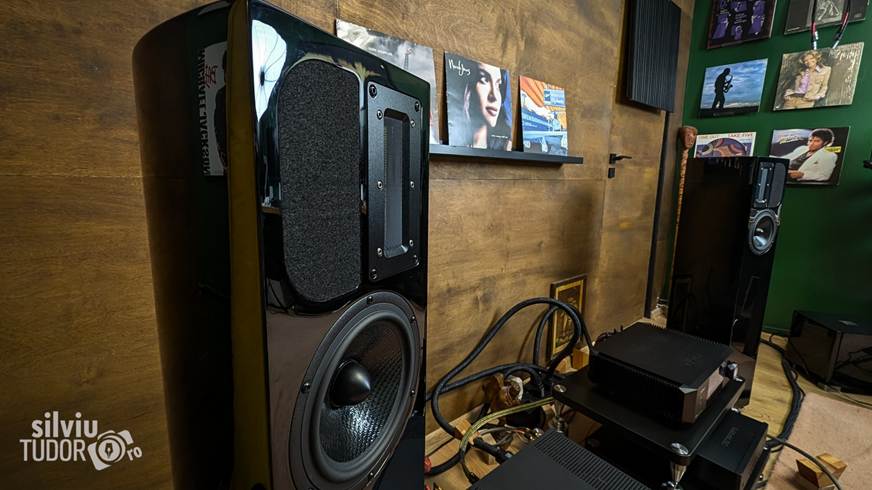
Within the Apertura range, Armonia Evolution sits somewhere in the middle, preceded by Swing, Sensa and Stela series, its more budget-oriented siblings. Armonia Evolution is therefore a particularly interesting model, as it represents Apertura’s entry into the High-End segment, with increasingly exclusive models above it: Forté, Edena Evolution, Adamante and the fascinating Enigma MKII.
APERTURA – COMPANY PROFILE
Before diving deeper into these speakers, let us take a moment to look at the history and philosophy behind the Apertura brand. The company was founded in 1978 by Christian Yvon, with its factory located near the city of Nantes. Christian Yvon has extensive experience in the audio field, having previously collaborated with well-known brands such as Focal, Sonus Faber, JMLab and Goldmund. However, I would rather let him introduce himself, below you will find a video from the 2014 Munich High End show:
What an interesting man, and truly passionate about what he does! Apertura’s motto is “nothing more, nothing less”, their goal, as Christian explains in the video above, is to create speakers that reproduce reality as faithfully as possible. Over time, Apertura has introduced proprietary technologies, one worth mentioning here is the DRIM crossover architecture, which allows the implementation of variable transition slopes (6, 12 or 24 dB per octave), with a strong focus on phase coherence and distortion minimization. Another aspect that immediately stands out is the distinctive cabinet design, featuring non-parallel walls and rigid laminated structures meant to reduce vibrations and internal resonances. I can say that once you see an Apertura speaker, you simply cannot forget it. Apertura does not look conventional.
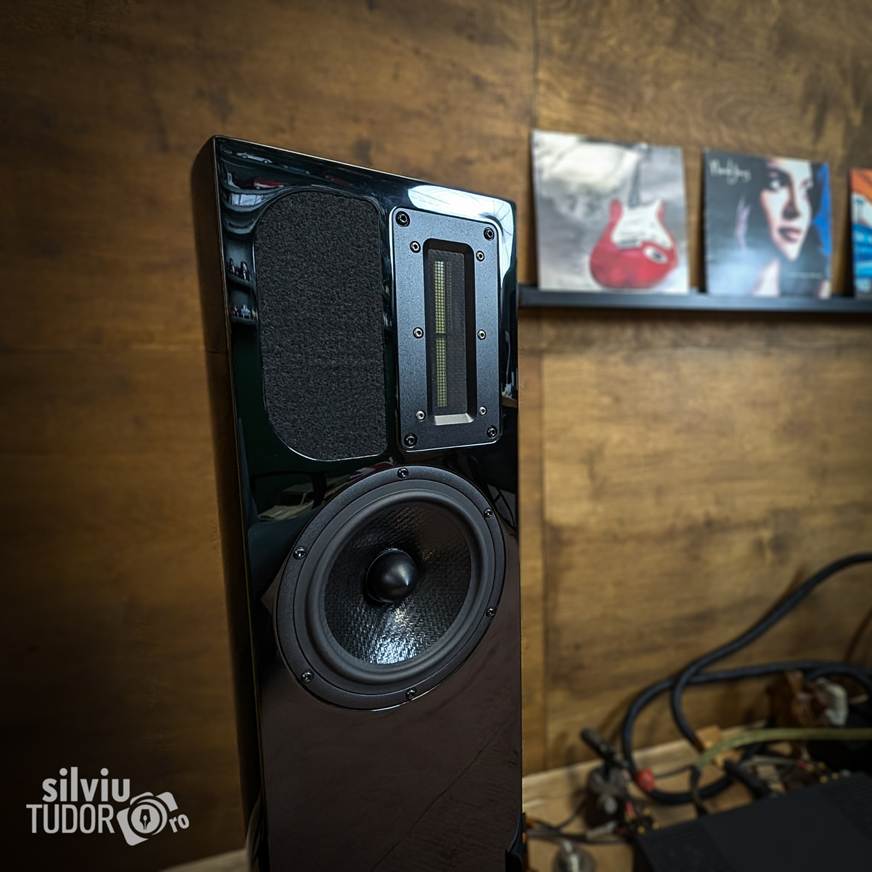
The speakers are hand-assembled in France, using SEAS drivers, Fountek ribbon tweeters, Jantzen coils, Mundorf and Jantzen components, and OFC wiring. The wooden cabinets are manufactured in Asia. Below is an image of the Apertura factory in Nantes, even this one features an unconventional design:

UNBOXING AND FIRST IMPRESSIONS
Apertura Armonia Evolution are not particularly large speakers, measuring 292 x 291 x 1069 mm with their stands, with a weight of 22 kg per unit. Each speaker is packed in three cardboard boxes, one inside the other, the first packaging of this kind I have come across. So, after you go through this cardboard puzzle, you discover the two speakers along with their accessories: textile gloves for handling, aluminum stands and the 10 spikes.
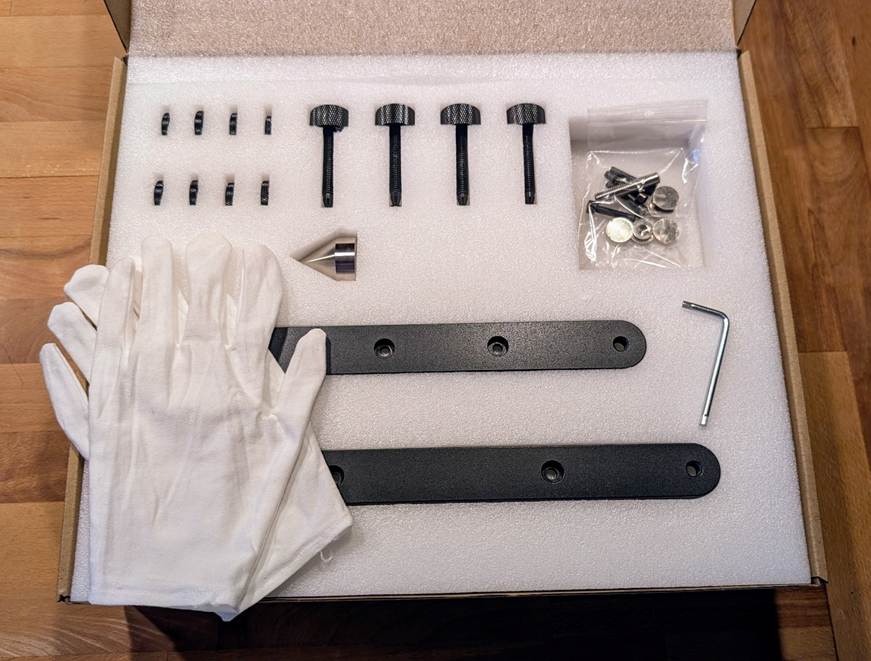
Yes, you heard that right, 10, five for each speaker, another interesting detail. This special spike technology is referred to by Apertura as “mechanical grounding”. I will come back in a moment to explain, but until then, I will leave you with an image below showing the construction details of these cabinets:
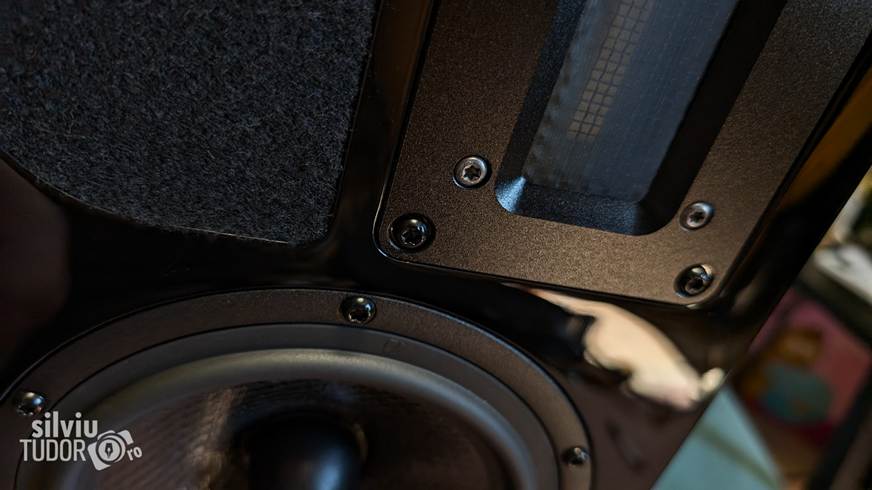
As you can see from the image above, Armonia Evolution displays a very high level of build quality, being among the best-finished speakers that have passed through my room. My pair came in Piano Black High Gloss, but the American Walnut High Gloss and Rosewood High Gloss finishes are just as impressive. I can honestly tell you that the real wood veneer finishes are absolutely spectacular. Below, I will leave you with an image showing all the available finish options:

TECHNICAL DETAILS
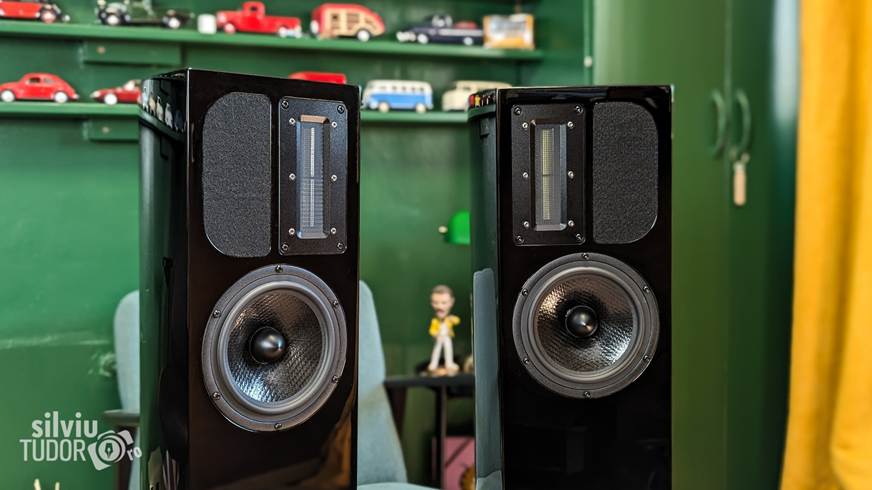
Armonia Evolution is equipped with a Fountek ribbon tweeter that uses a flat metallized polymer diaphragm. The mid-bass driver is made by SEAS and measures 18 cm, incorporating isotactic matrix technology and featuring a woven polypropylene composite cone.
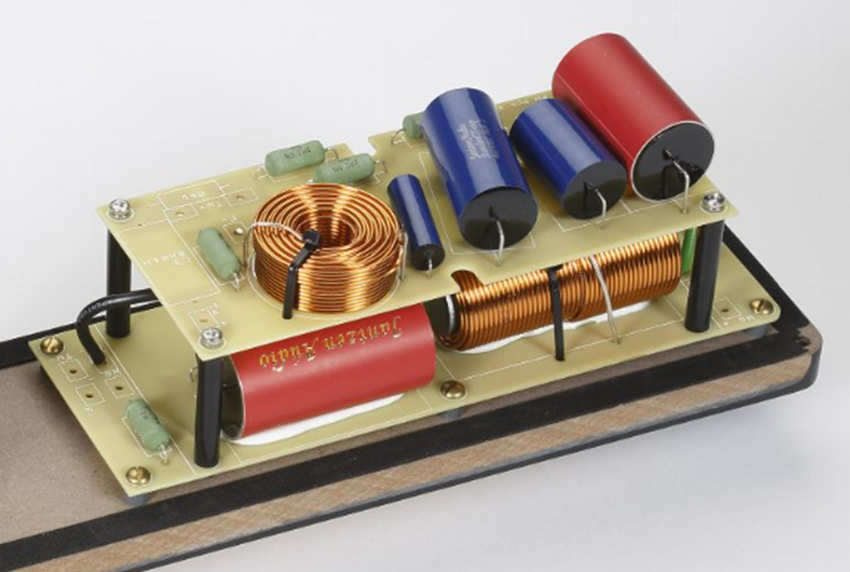
In the image above you can see the crossover inside the Armonia Evolution, built using Apertura’s proprietary DRIM architecture, with a triple attenuation slope and phase control across the entire bandwidth. You can also notice two completely separate boards, one dedicated to the low-pass section and one to the high-pass section. The capacitors used are Jantzen. Each set of drivers, tweeter and mid/woofer, is individually measured, and the crossover values are adjusted according to these measurements. The internal wiring is also hand-done on a printed circuit board made of 140 µm copper. The connectors are WBT, made from pure copper and silver-plated.
This Apertura model is the first in the range to use the brand’s distinctive cabinet structure, featuring two curved sides of different lengths and no parallel front and rear panels. The enclosure is also built using a laminated structure based on multiple thin layers pressed together under high pressure. Such a process creates controlled break-up modes and limits the propagation of vibrations. The internal framework includes multiple cavities for structural rigidity and for creating very specific areas where damping materials can be applied.
The full specifications of the Armonia Evolution are as follows:
• Frequency response: 37–30,000 Hz / ±3 dB
• Sensitivity: 87 dB / 2.83 V / 1 m
• Impedance: 8 Ω
• Loading: bass-reflex
• Drivers: 18 cm isotactic matrix mid-woofer, 8 × 120 mm ribbon tweeter
• Crossover frequency: 2.8 kHz
• Terminals: single-wire binding posts (spade or banana)
• Dimensions: 205 × 291 × 1030 mm (w × d × h), with stands: 292 × 291 × 1069 mm
• Weight: 22.2 kg net – 22 kg packaged
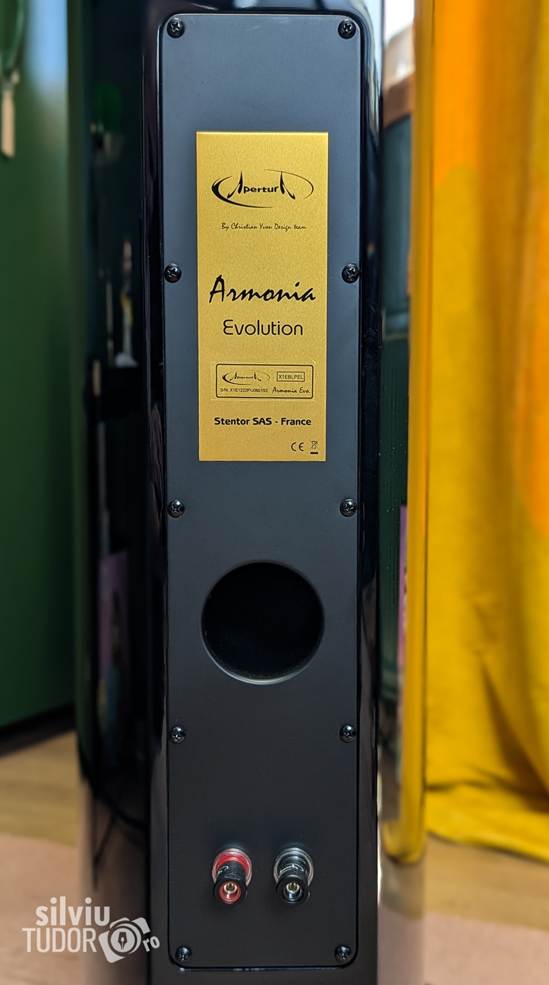
Below I will leave you with an image of the rear panel of the speaker, where you can see the model information plate, as well as the two speaker terminals, the high and low sections being separated internally:
POSITIONING
Returning to the spike situation, as I mentioned earlier, each speaker comes with five spikes, Apertura’s approach to floor coupling being one of the most unusual I have encountered so far. The entire weight of the speaker is supported by a central spike, while the four outer ones serve only to stabilize and balance the speaker. Below, I will leave you with an image of these feet:
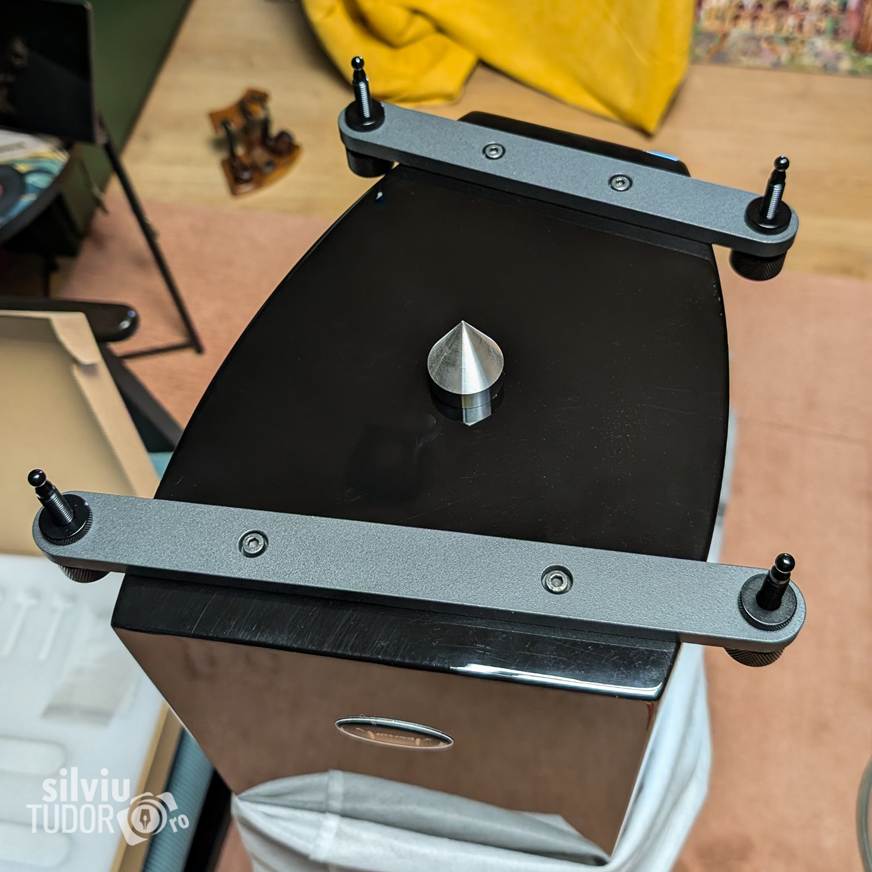
The installation process is straightforward, first you need to mount the aluminum bars that hold the spikes and then install the five spikes according to the manual. Make sure you use the correct bars and spikes for each speaker, as they are different for the left and right units, you will find guidance on the accessory boxes.
In the package you will also find five aluminum counter-spikes, which I recommend using if you have hard surfaces such as wood flooring, tiles or similar flooring. In these cases, you will be a happy user, as positioning becomes easier, the counter-spikes allowing the speakers to slide smoothly across these surfaces. If you have carpet or rug, then the counter-spikes cannot be used and positioning will be more difficult, ideally done by lifting and repositioning the speakers.
Also, given this proprietary spike system, I recommend using only the spikes and counter-spikes included in the package. It makes little sense to place these speakers on isolation systems such as Gaia, as their sound will be altered, and the same applies to aftermarket counter-spikes, the sound will no longer reflect the intention of Apertura’s engineers. A few paragraphs later, in today’s “Audiophile Hint”, I will go into more detail about counter-spikes and the results of my tests with Armonia Evolution.
Until then, it is essential to ensure that the speaker’s weight rests on the central spike and not on the outer ones, this has a major impact on the sound, the speaker performs best in this configuration. I want to emphasize this central spike aspect; my tests have shown that the correct sound of Armonia Evolution only emerges when the weight is properly supported by this central point.
Please be patient when positioning Armonia Evolution, these speakers are not easy to position. Their bass is shaped in relation to the rear wall, moving them too far away and the bass will lose body, move them too close and the soundstage will lose integrity and depth. You need to work step by step and find the ideal setup for your room, millimeter by millimeter, that is how sensitive they are to positioning.
As for toe-in, I recommend not aiming them too directly toward the listening position, a slight toe-in of around 10 degrees is enough, start from there and experiment. Also keep in mind that if your room is smaller than 15 square meters, Armonia Evolution may not be the right choice, they deliver a very large sound and can create too much acoustic pressure in such a space. They are certainly not near-field speakers. However, if you still want to try them in a smaller room, I would follow the manual’s recommendation, adjust the outer spikes, 5 mm lower at the back and 5 mm higher at the front, this setup works best in smaller spaces. If your listening distance is at least 2.5 meters, then position them level. Apertura recommends an equilateral triangle of at least 2.5 meters from the listening position, this is the starting point I suggest.
HOW DOES ARMONIA EVOLUTION SOUND?
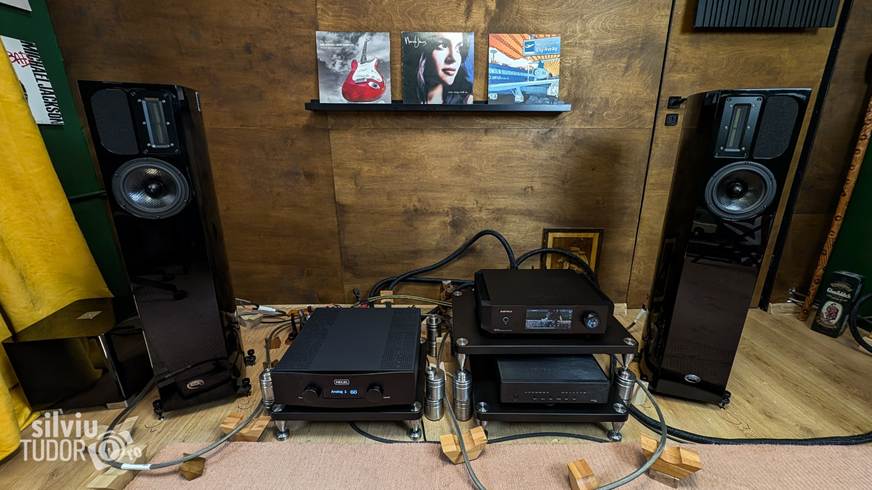
I now arrive at the most important part of this review, my conclusions about the sound of Armonia Evolution. These speakers are highly resolving, with a strong focus on soundstage, you can easily pinpoint where each musician is placed within a recording. They also deliver a very interesting sense of holography, somewhat reminiscent of Bowers & Wilkins, while the midrange is extremely accurate, faithfully reproducing the recording.
The soundstage these speakers can create is fascinating, in my listening room they managed to produce a very large sound that clearly extended beyond the physical boundaries of the room. The Armonia sound is highly holographic and immersive. The bass is tight and controlled, an audiophile type of bass that will not satisfy those looking for special effects, like the kind you hear when Neo jumps from one building to another in The Matrix, with that big, rounded, lingering low end. Armonia Evolution is not meant for that.
Their sound is faithful, balanced, audiophile and highly resolving, with a particular emphasis on the finesse and refinement of the high frequencies. This is their key strength, one I want to highlight, Armonia Evolution is a speaker designed for true lovers of audiophile sound.
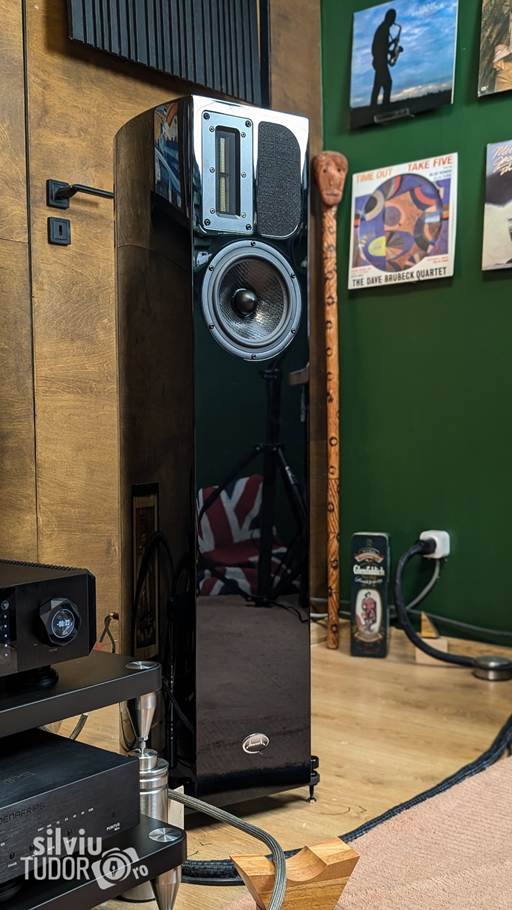
Let’s move further with my tests and findings, as I reveal them to you, I will also offer more insight into the sound of Armonia Evolution.
WHAT MUSIC DID I LISTEN TO WITH APERTURA ARMONIA EVOLUTION?
Given the holographic and expansive sound delivered by Apertura Armonia Evolution, I chose a record to match, one that would help me better understand them, “Recurring Dreams”, an album released by Tangerine Dream in 2019.
Recurring Dreams is one of the band’s more recent albums. Interestingly, it is not made up entirely of new and original material, but rather, it feels like a tribute brought by the current members of the band to Edgar Froese, the founder of Tangerine Dream back in the 60s and the only member who remained constantly involved in the project from its beginnings until the end of his life.

In 2019, when it was released, I immediately started listening to Recurring Dreams, in my usual way, the way I like to listen to music, in the evening, with all the lights turned off, a cup of tea in hand or a glass of Beaulieu rum. As soon as I pressed play on Recurring Dreams, I was struck by a highly resolving sound, something that older Tangerine Dream albums do not necessarily offer, RD benefiting from the depth of modern production. Musically, however, I was once again surprised to hear familiar themes from Tangerine Dream, themes I knew so well.
The newer Tangerine Dream albums have a particular way of presenting themselves, with a magical aura, a large and special soundstage, and plenty of holographic effects, as if the universe itself were playing. Recurring Dreams fully embodies all of this, it feels like a book of holographic miracles.
Fortunately, as I had hoped, Armonia Evolution delivered all of this beautifully, projecting those holographic miracles into my listening room and creating that magical bubble of sound that I look for when listening to albums like this. Recurring Dreams was the perfect test for these speakers.
WHAT ELECTRONICS WORK BEST WITH APERTURA SPEAKERS?
This was followed by a period in which I tested multiple amplification solutions with Armonia Evolution, as I wanted to understand, first of all, which integrated amplifier would drive them best. In the AVstore showroom I had already listened to Edena Evolution driven by an Aesthetix pairing, the Atlas power amplifier and the Calypso preamplifier, and I was already impressed by how well Aesthetix matched with Apertura. This time, however, I felt that Armonia Evolution would be more accessible when paired with an integrated amplifier, so I decided to spend enough time to find out which model would suit them best. My listening room was therefore filled with amplifiers for two weeks, with multiple options from Moon, Hegel, Chord Electronics and Aesthetix, and in the following paragraphs I will tell you the results I obtained with each of them.
The first on my list was my well-known Moon 340i X, which I have had in my personal collection for some time, and which has always helped me with its chameleonic qualities, pairing well with almost any speaker. It drove the Armonia Evolution without any issues, however, given that the 340i X has a slightly lean tonal balance, and Armonia Evolution also tends in that direction, the combined sound is not perfectly balanced, being, to my taste, a bit too open. That does not mean that some of you will not enjoy this extra-open presentation.
Next on the list was the younger and more “refined” sibling of the 340i X, Moon 641. It retained all the characteristics described above, following the same Moon sound philosophy, but offered an even larger soundstage than the 340i X and a much better grip on the speakers, driving them with more control. If you enjoy the sound that Moon and Apertura create together, I do not believe the price difference between 340i X and 641 is strictly necessary, the former is more than capable.
I continued the tests with Chord Electronics Ultima Integrated. It is quite difficult to explain, but I simply felt that it was not a good match with Armonia Evolution. I have heard Chord in many systems and have always appreciated their decisive and authoritative sound, but in this case, the synergy just was not there.
I also tried the Aesthetix integrated amplifier, Mimas. It worked well with Armonia Evolution, but it pushed the sound into a zone that was too relaxed for my taste. Armonia is very fast and resolving, while Mimas is more laid-back and gentle, each leaning toward opposite extremes, which does not quite meet in a balanced point. As with the Moon pairing, this is a matter of taste, you might very well enjoy what Mimas does with Armonia Evolution. In my opinion, Aesthetix is an excellent match for Apertura speakers, but it truly shines when using separate components, a power amplifier and a preamplifier.
The last on the list was the Hegel H400, which impressed me the most. I know the H400 as a slightly darker, authoritative amplifier, not particularly bright. It was obvious from the very first note that it paired beautifully with Armonia Evolution. Hegel H400 brought out bass from these speakers that I did not even imagine was there, making it more rounded and authoritative, yet still well controlled. Hegel brings a special kind of magic, with impressive depth and excellent resolution in the highs, which complements Armonia Evolution perfectly. I truly enjoyed the combination of Hegel H400 and Apertura Armonia Evolution, I consider it the winning pairing of these tests.
My conclusion regarding the matching of Apertura speakers is that they need electronics with a slightly darker tonal balance, something with more weight and authority, but focused on quality rather than sheer power. This is why synergy with Hegel is something worth remembering.
AN AUDIOPHILE HINT – SPIKES AND COUNTER-SPIKES
I now arrive at the audiophile hint of this review, where I will talk about counter-spikes, why they matter so much, and try to help you choose the right ones for your setup. Even though I had read beforehand that Armonia Evolution comes with everything it needs, I could not leave things to chance and, in the spirit of testing, I immediately prepared several sets of counter-spikes to replace the ones included in the box.
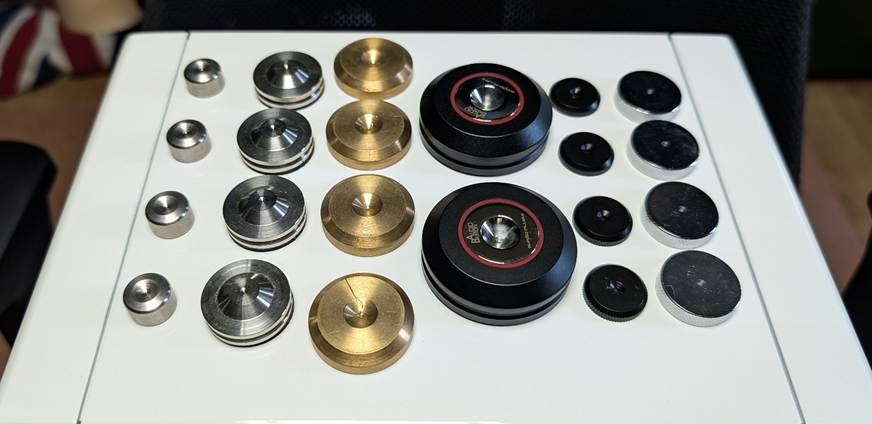
First, a small clarification regarding counter-spikes, what they are, what they do and what they are useful for. Counter-spikes, as their name suggests, are placed under the spikes of a speaker and offer a form of “protection”, preventing the floor from being scratched and allowing the speakers to be moved more easily. These counter-spikes come in many shapes and variations, they can be made of stainless steel, brass, aluminum, steel, or other combinations and sizes.
Some time ago, I moved away from decoupling solutions such as IsoAcoustics Gaia to coupling solutions using spikes. The most important aspect to understand is this, Gaia decouples while spikes couple, each approach bringing its own advantages and disadvantages. Ideally, you should try both in your room and decide which one suits you best. Today, however, we will assume that we have chosen coupling, meaning spikes, and we will analyze what should be placed under them.
Honestly, based on all my experience, I have never obtained good results without placing something under the spikes. Left directly on the floor, they tend to create a metallic kind of sound, they simply do not perform well. Perhaps in combination with a thick carpet it might work, but when dealing with a hard and flat surface, something must be placed underneath.
This is where counter-spikes come into play, and most of the time they are overlooked, considered unimportant. Nothing could be further from the truth. Counter-spikes have a surprisingly large impact on sound, sometimes providing exactly what is missing in terms of focus or timbre, or helping to resolve unwanted resonances.
If you look at the image above showing different types of counter-spikes, I can tell you that they are all part of my personal collection, and whenever I receive new speakers for review, I spend hours in the first days trying to understand which ones work best with that particular speaker, choosing between decoupling and coupling, and testing all these counter-spikes. I must admit that every time I go through this process, I am amazed by how much these counter-spikes can change the sound.
When it comes to Armonia Evolution, the surprise was even greater, because, quite unexpectedly, the best counter-spike solution turned out to be the one included in the box, small, nothing extraordinary, made of aluminum.
Realizing that the best floor coupling solution for Armonia Evolution is actually the one provided in the package, I understood something more about this French speaker manufacturer. These people truly test everything carefully and are convinced that they are offering their customers the correct and universal solution.
I would not have expected the solution from the box to be the right one, because in all the years I have been testing and writing about different speakers, the included solution was never the best, requiring additional time and money to find the proper setup.
However, quite unexpectedly, once I installed the included counter-spikes and found the correct positioning, along with the proper balance on the central spike, the sound of Armonia Evolution simply fell into place and sounded incredible. Bravo, Apertura, you did an excellent job, I wish all manufacturers pay this level of attention.
So, for those of you preparing to purchase Apertura speakers, do not worry about testing other spikes, counter-spikes or decoupling solutions, just use what comes in the box. For everyone else who does not own Apertura speakers, if you choose a spike-based setup, take the time to test different counter-spike options, they might be the missing piece, the final touch that completes your system.
TIPS & TRICKS
- It is essential to position Armonia Evolution correctly, allowing its weight to rest on the central spike, do not over-adjust the outer spikes, they are not meant to support weight, only to stabilize the speaker.
- A 10-degree toe-in is a good starting point, you can go up to 20 degrees if you want more focus, or down to 5 degrees if you prefer a wider soundstage. Experiment within these ranges, millimeter by millimeter.
- If your room is small, tilt the speaker slightly, 5 mm lower at the back and 5 mm higher at the front, using the outer spikes for balance.
- Pair them with electronics that have a warm and authoritative sound, avoid components with a thin tonal balance.
THE BRIGHT SIDE
- Pure audiophile sound, refined highs, superb midrange, tight and controlled bass.
- Excellent holography and a three-dimensional soundstage.
- They come with a perfectly designed spike and counter-spike system, no need to invest time or money in aftermarket solutions.
- Outstanding finishes, the real wood veneer options are absolutely beautiful.
THE DARK SIDE
- They are difficult to position, very difficult, I would say. Patience is required.
- Not suitable for rooms smaller than 15–20 sqm, these are not near-field speakers.
- If you are a bass-head, these speakers are not for you, Armonia Evolution is designed for audiophiles, with tight and highly controlled bass. If you want powerful bass, you can find it with other brands such as KEF or Klipsch.
CONCLUSION
I spent two wonderful weeks with Armonia Evolution, during which I enjoyed the Apertura sound in my own home, a sound that brought me many hours of listening pleasure, revisiting my favorite records. I discovered new details and nuances in these albums, things I had not heard before. This tells me that Armonia Evolution offers an impressive level of resolution.
If I had been able to listen to Armonia Evolution in a near-field setup, the way I personally prefer, they would have been the perfect speakers for me. Unfortunately, these are not speakers for small rooms or near-field listening, they need a large, open space in which they can fully express themselves. Their voice is big, and it would be a shame to confine it within a small environment.
To conclude, I want to say that I remain impressed by this French speaker brand, by their philosophy, by the way their products are built, by the level of detail and the overall build quality. Bon travail mon cher Apertura, bravo Christian Yvon, on voit bien que tes enceintes sont construites par des audiophiles, chapeau bas!
WHERE TO BUY: If you are making your purchase from Romania, please go directly to avstore.ro, if you are outside this area, please go to apertura-audio.com for purchase information.
Silviu TUDOR
An article written in my sweet spot,
and this is what I’ve heard.