Dear reader, in this article I will write about my experience with the recently launched Phantom Ultimate 108 dB, the flagship model from the French manufacturer Devialet. Phantom Ultimate was released only a few months ago and has sparked a lot of curiosity among audio gear enthusiasts, as well as among those who already own previous Phantom models. I was very curious to hear how a pair of Phantom speakers would sound in my listening room, given that I had heard them many times in showrooms and at friends’ places and already knew the tremendous hype surrounding them.
However, it should be noted that Devialet Phantom are active speakers, a solution that audiophiles usually do not favor. For some time I was curious about a few aspects: how do Phantom behave in an audiophile’s listening room? Do Phantom have true audiophile qualities? How do they perform in stereo? Can they stand at the level of a High-End system? Therefore, I put my audiophile magnifying glass on the Phantom Ultimate 108 dB and, given that there are already many general presentation articles about Phantom, I chose to write this review from the perspective of an audiophile: are the Phantom Ultimate 108 dB the right speakers for serious audiophile listening?
WHO ARE DEVIALET?
Before moving further with my review, I will say a few words about Devialet, this French audio equipment company founded in 2007 in Paris. Below I leave you a photograph of Devialet’s main showroom in Paris, located on Rue Réaumur, inside a Belle Époque building from the 19th century:

Devialet was born from the ambition to reinvent high-end sound through pure engineering and avant-garde design. The project took shape around the inventor and engineer Pierre-Emmanuel Calmel, who laid the foundations of the ADH (Analog Digital Hybrid) amplification concept, alongside Quentin Sannié and Emmanuel Nardin, forming the core from which Devialet grew. Initially, the company built its reputation around the Expert amplifiers, with D-Premier being one of the early defining products. Later on, Devialet surprised the audio market with the Phantom series – active speakers that quickly became legendary thanks to the way they combine enormous acoustic pressure, visceral bass and a design that is impossible to mistake. Today, Devialet continues to develop both its own products, Phantom, amplifiers, soundbars and headphones, as well as advanced audio technologies, remaining one of the most interesting examples of “haute couture” in modern Hi-Fi, just as the French know how to do best.
UNBOXING AND FIRST IMPRESSIONS
For this review I received a set of two Phantom Ultimate 108 dB, as I wanted to write the article from an audiophile perspective, therefore in stereo. Of course, Phantom can also function on its own, but the stereo mode can only be achieved, naturally, with two units.
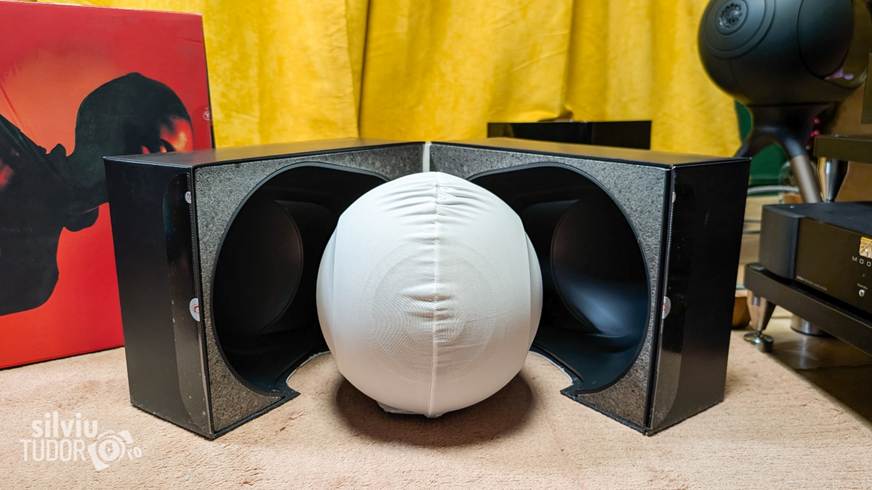
In the image below you can observe the “birth” of one of the two Phantoms. Even the packaging is remarkable, something I had never encountered before. The box has a special design, perfectly “wrapping” the Phantom. Inside the box you will find the speaker covered in textile material, as well as a smaller box with accessories, where you get the user manual and a power cable. The power cable has an IEC connector on one end; however it has an unusual shape that fits perfectly with the curved back of the speaker.
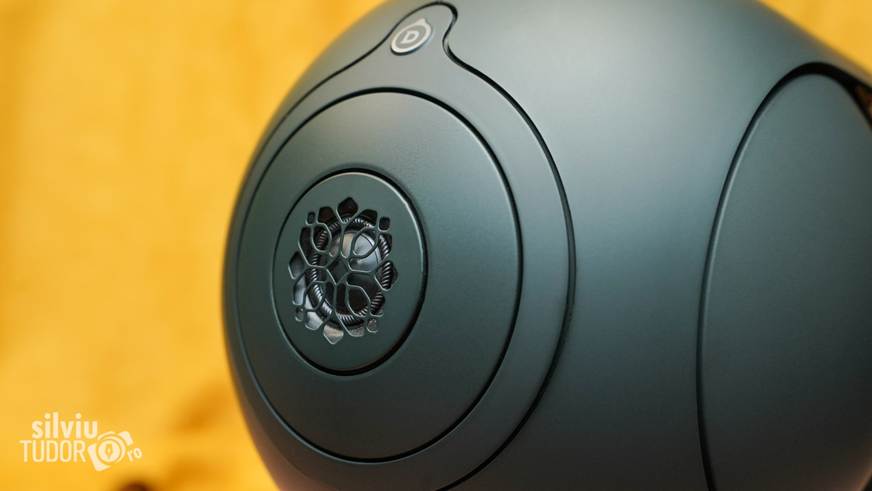
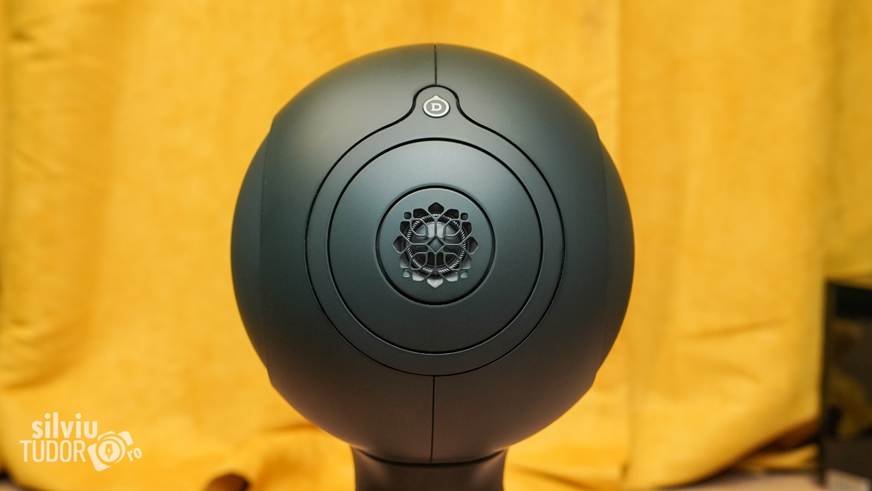
After removing the textile cover, you remain amazed by the extraordinary level of detail of this speaker, practically every joint, every edge is perfect, as if you were looking at an alien cocoon rather than a High-End speaker. It is impossible not to be struck by the design of these speakers, completely different from anything currently on the market. No matter how far away you spot a Phantom speaker, you will recognize it immediately, it is a true statement of modernity, both in terms of design and the technology inside. A close-up on one of the details of the Phantom Ultimate 108 dB:
While researching for this article, I discovered a true myriad of accessories available for Phantom – transport cases that wrap the speaker perfectly, stands of various sizes that beautifully complement this extraterrestrial design, remote controls just as impressive as the speakers themselves, as well as packages called “Devialet Care”, which extend the warranty for as many years as you wish.
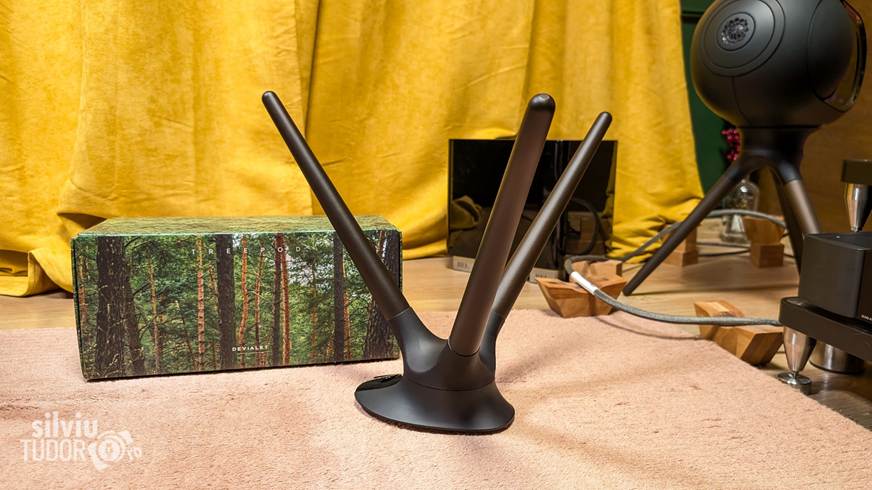
In the image above you can see the stands I had available; they are called Treepod and they complement the design of the Phantom Ultimate 108 dB perfectly. They are made from the same material and in the same color as the speaker, while the legs are crafted from solid wood. At first, I was quite surprised by their low height, which raises the speakers only about 35 cm off the floor, however I was about to be amazed at the first listening session. I will tell you more about this a few paragraphs later.
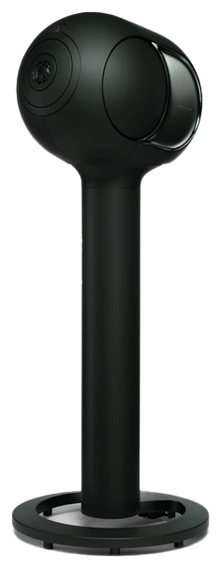
There is also a tall stand that raises the speaker to ear level, called “Tree”, designed specifically for the Phantom Ultimate. Make sure to order it in the exact color and size of your speaker (98 dB or 108 dB).
There is also a wall mount, as you can see in the image above. It is called Gecko and can be ordered in the color and size of your speaker (98 dB or 108 dB).
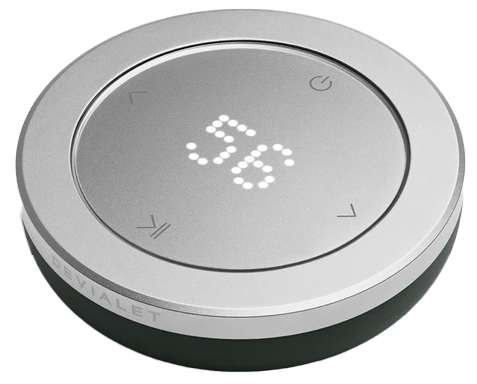
A new remote control was also created specifically for the Ultimate series, called exactly that: Remote Phantom Ultimate. It operates completely wirelessly and can be ordered in the same color as your speaker.
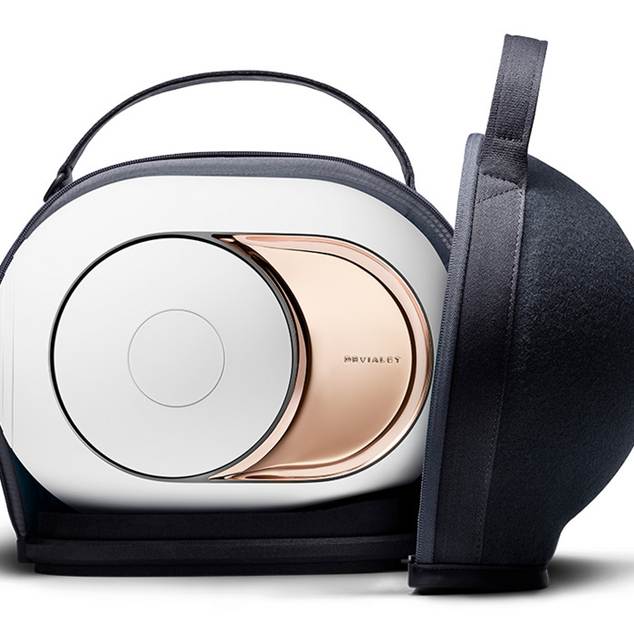
Another interesting accessory is the transport case, which wraps the Phantom Ultimate perfectly, like a cocoon, in fact, that is also its name: Cocoon. It is made from a robust composite, lined with natural wool felt and finished with natural leather, crafted in authentic French workshops.
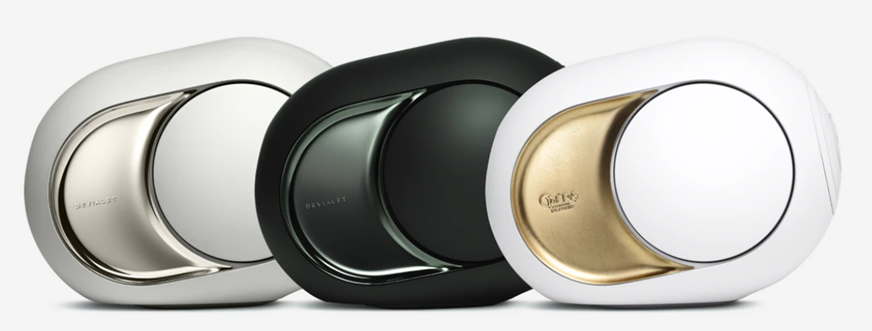
As final details for this chapter, let me clarify that the Devialet Phantom Ultimate is available in two versions, 98 dB and 108 dB, as well as in three color options: Opéra de Paris (Gold Leaf), Light Pearl and Deep Forest, as you can see in the image above. Looking at all these accessories and options, it felt as if I were configuring a Rolls-Royce, that is how special and luxurious these products from Devialet are.
TECHNICAL DETAILS
However, the fascination does not end on the outside. Inside, Phantom contains modern and captivating technological solutions. Devialet Phantom Ultimate 108 dB is, technically speaking, an ultra-integrated active speaker in which amplification, digital-to-analog conversion, DSP and the drivers function as a single organism. At its heart lies the Devialet ADH (Analog Digital Hybrid) architecture, a hybrid solution where an analog stage provides naturalness and finesse, while a digital stage delivers control, speed and power, everything orchestrated by an extremely precise DSP. Inside we find a set of proprietary drivers: an ultra-fast tweeter and two large-excursion side woofers responsible for that physical bass, almost “impossible” for such a small enclosure. The woofers operate in a synchronized push-push configuration and are controlled in real time to keep distortion under control even at high volume. Phantom Ultimate features a fully active crossover and intelligent processing that optimizes phase, dynamics and impact, delivering a remarkable soundstage and headroom rarely encountered in an active speaker.
The total amplification power of the Devialet ADH system is 1100 W, with a maximum sound level of 108 dB SPL @ 1 m, and a frequency response of 14 Hz – 35 kHz (+/- 6 dB). It is worth noting that these values are extraordinary for such a small active enclosure. The weight of a single unit is 11.1 kg and the dimensions are 246 mm x 342 mm x 255 mm (without stand). The proprietary technologies included by Devialet in Phantom Ultimate are numerous: ADH® next-gen, SAM®, HBI®, AVL™, DAC Magic Wire®, Devialet ASIC and Devialet Operating System (DOS 3). The processor that makes these software technologies possible is an NXP i.MX 8M Nano SoC, 4 x 1.5 GHz.
To detail these proprietary technologies a bit, I will begin with SAM®. This is a DSP that adapts in real time to both transient and steady-state signals, allowing the speaker to reproduce phase and amplitude with extremely high precision. AVL™ is an adaptive volume level system that uses real-time dynamic equalization to deliver a smoother and more balanced listening experience. HBI® brings a bass that you can literally feel in your bones (Heart Bass Implosion), making frequencies down to 14 Hz possible. ADH® next-gen is a new version of the Analog Digital Hybrid technology, a hybrid amplification technology invented by Devialet.
However, the truly fascinating technology comes from the drivers themselves: 1x aluminium-dome tweeter, 1x midrange driver also using aluminium-dome technology and 2x ABS-dome woofers, all of them new-generation drivers and improved versions of the previous ones. The enclosure itself is just as fascinating. When you first pick up a Phantom Ultimate, you feel how compact it is, it is almost like lifting a bodybuilder. Phantom Ultimate feels dense, muscular, every centimeter of its enclosure filled with something. That is why it is remarkable that the sound remains stable up to 108 dB: the speaker does not fall apart, the sound does not go into clipping, it remains efficient even at this volume.
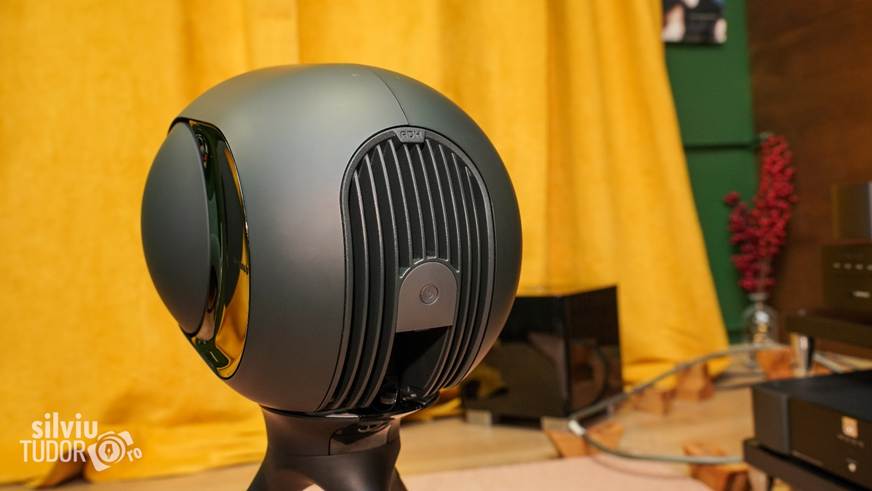
In the image above you can see the rear side of the Phantom Ultimate 108 dB. Here you will notice a massive heatsink that covers the entire back, as well as a recessed cavity where the only physical ports of the Ultimate can be found: an IEC power input, an RJ45 port for network connectivity and an optical port that can be used to connect a television or another optical audio source. It is worth noting that there are no HDMI-ARC or analog inputs. This speaker is designed primarily for wireless use and is compatible with AirPlay, Google Cast, Spotify Connect, Tidal Connect, UPnP, Roon Ready (RAAT) and Bluetooth 5.3 (SBC and AAC codecs).
INITIAL SETUP – CONNECTIVITY AND POSITIONING
Now that I have gone through the myriad of accessories available for Phantom Ultimate, as well as their technical capabilities, all that remains is to tell you about my experience with these fascinating speakers. From the very moment of unboxing I had the feeling that I was dealing with something different, unlike many of the pieces of equipment that have passed under the magnifying glass of my reviews so far.
Somehow, I quickly formed the impression that Phantom has an extraterrestrial character. During the time I spent with them, listening to them and photographing them, I would not have been surprised if they had suddenly started talking or moving around the room.
The initial setup was extremely fast, the packaging is designed in such a way that you can place them in position immediately. The Treepod stands were assembled very quickly, instantly clicking into place with the speaker and locking firmly.
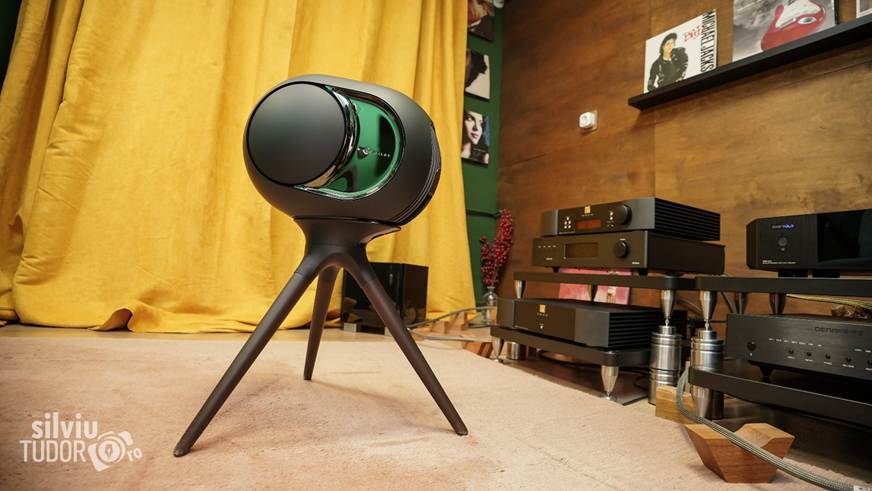
Initially I was a bit “upset”, because I had received the two speakers together with the small floor stands that raise the Phantoms to about 35–40 cm from the floor, something that is unusual for an ideal audiophile setup, where we know that tweeters perform best at ear level. Even so, I read a bit more about it and it was explained that they would still sound good in this configuration, even at only 40 cm from the floor. I told myself that I had to give it a try. I cannot wait to tell you how it went.
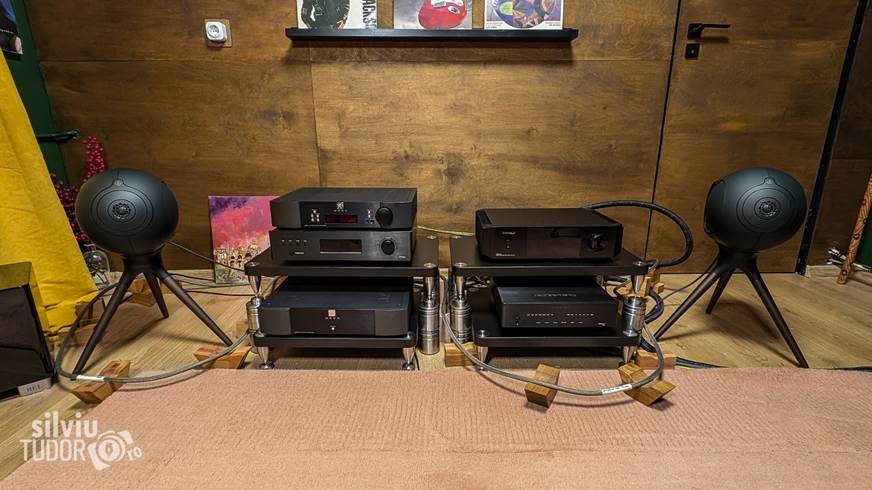
As written in the manual, Devialet recommends placing the Phantom speakers at a minimum distance of 30 cm from the rear wall and keeping a horizontal distance of 1.5–2.5 meters between the speakers, forming an equilateral triangle of the same dimension with the listening position. They should also be slightly angled toward the listening position. Said and done, I followed all these recommendations. As you can see from the image below, I positioned the Phantom Ultimate in the place of my own speakers, leaving all my equipment in place, but unplugged, preamplifiers, power amplifiers, DACs and streamers. They were no longer needed and could rest quietly, Phantom Ultimate does not need them.
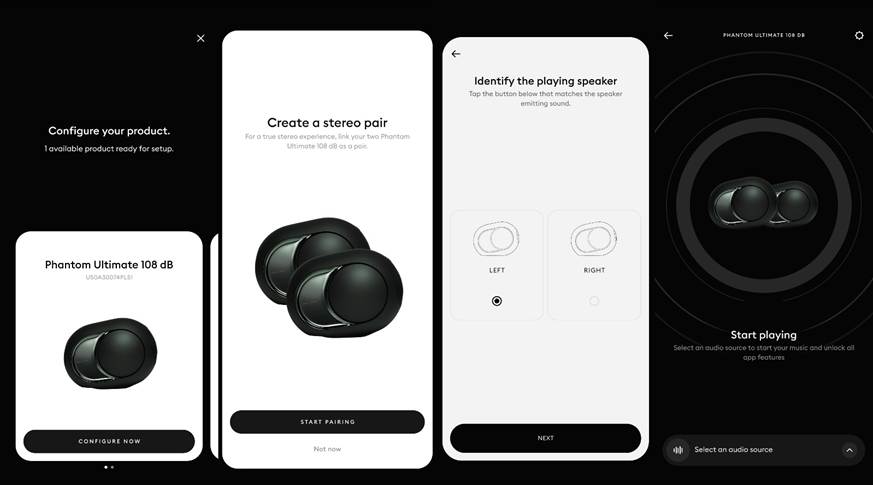
On the software side, everything was very quick. I installed the app, was immediately guided through the setup and update steps, configured the two speakers, and the application created the stereo pair. In total, it was probably about 4–5 steps and around 5 minutes. Everything went smoothly, without any issues. In the series of screenshots below you can see all these actions, from the initial configuration to the creation of the stereo pair, and finally the completed setup.
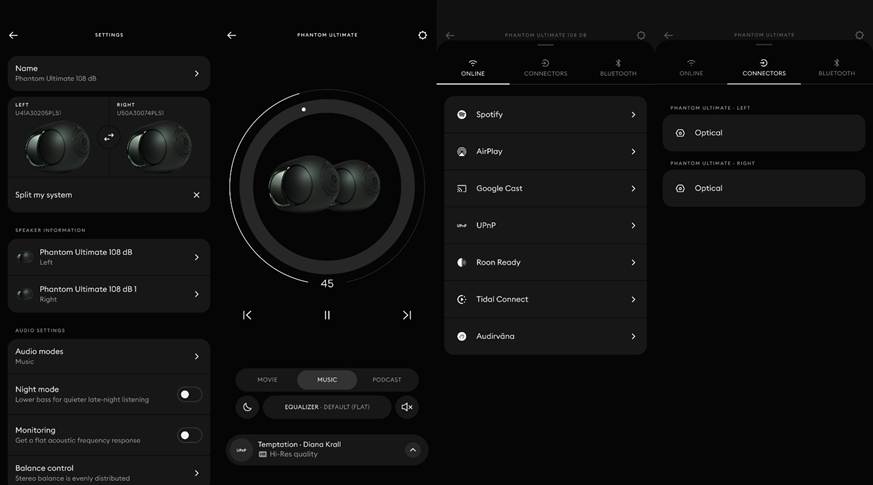
In the screenshots below you can see how the application generally looks: the homepage window, the system’s playback screen, with the sound modes “Movie”, “Music” and “Podcast”. You can also see the music and playback services I mentioned earlier, as well as the optical physical inputs, two in this case, one for each speaker.
I continue below with the EQ section. Even though I would have liked to find a more complex, parametric EQ, I only encountered a simple, linear one. However, it is worth noting that it does its job very well and, alongside a few useful presets, it allows you to shape the sound the way you want. Below you can see the configuration that worked best in my room. Also, part of the EQ category is “Night Mode”, a mode that softens the bass and the voices, allowing you to listen comfortably without disturbing those around you.
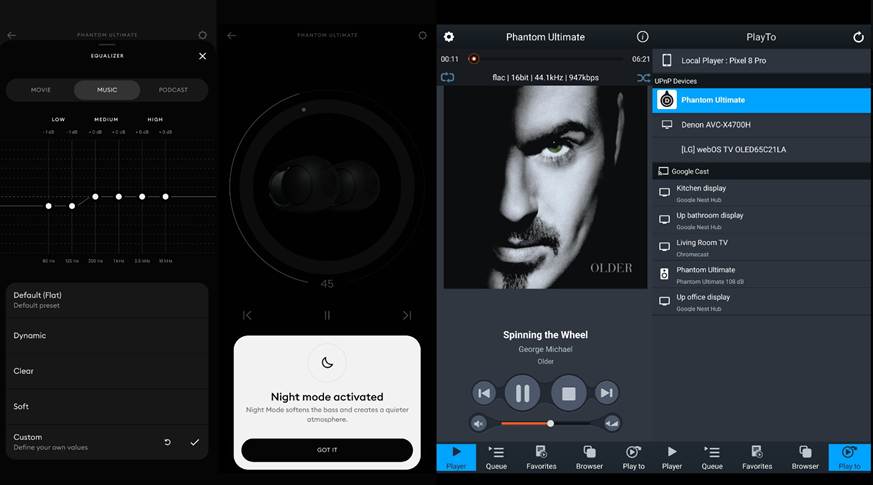
Finally, I played music via UPnP using the mConnect app, which you can see in the set of images above. It discovers the Phantom Ultimate stereo pair without any issues and allows you to play high-resolution music, superior to Spotify in terms of quality. As a Qobuz user, I was able to use this exclusive platform with Phantom Ultimate. I must admit that I would have liked to see Qobuz Connect implemented, or even playback capabilities directly inside the Devialet app, but for now these are not available, only Tidal Connect and Spotify Connect are implemented, alongside the other wireless music playback methods.
WHAT MUSIC DID I LISTEN TO ON DEVIALET PHANTOM ULTIMATE 108 dB?
As you can see in the series of screenshots above, I chose George Michael’s album Older to thoroughly test the Phantom Ultimate. Older is a very special album, with a distinctive sound and deeply audiophile qualities that only become truly evident on a resolving system.

I have listened to this album many times and have always let myself be absorbed by the maturity of its fascinating tracks, “Jesus to a Child”, “Spinning the Wheel” and even “Older”. Without knowing exactly how old the artist was when he released the album, and judging by the emotional depth of the record, I had assumed that he must have been well past his 40s when it came out. However, while researching the background of this album, I was very surprised to discover that he was only 33 years old when he released it.
One track from this album that I enjoy very much is “Spinning the Wheel”, an extremely well-crafted piece that, on a properly set-up system, will present a real challenge to its ability to reproduce low frequencies. In “Spinning the Wheel”, Michael expresses his fear for a lover who lives recklessly and exposes himself to the danger of AIDS. From a sonic perspective, the mix is absolutely fascinating, featuring an extraordinary bass sweep that I have not heard on any other recording. This is not a track that can be properly reproduced on just any system, it will seriously test the capabilities of your audio setup. “Spinning the Wheel” was the result of the collaboration between George and producer Johnny Douglas, who was directly responsible for this track as well as “Fastlove”, also from this album. Their collaboration proved to be a defining one and played a fundamental role in the stylistic shift that George Michael underwent starting with this record.
HOW DOES DEVIALET PHANTOM ULTIMATE 108 dB SOUND?
Moving on to the serious part, perhaps the most important chapter of this review, I can honestly tell you that I was completely stunned by how these speakers sound. In the following lines I will share the feedback of an audiophile, treating the Phantom speakers very seriously and putting them through some of the toughest tests.
Devialet Phantom carries a certain stigma among audiophiles. It is the kind of product that challenges audiophile conventions, breaking many of the unwritten rules of this rather exclusive community. These are speakers that you cannot “tune” very much. You cannot change the cables because there are no cables. You cannot endlessly experiment with positioning because positioning does not matter quite that much. You cannot intervene too much in the settings because there are not many settings available. And you cannot really add external equipment to alter their sound because there are very few external ports. These are speakers that force you to use them as they are, something that contradicts the audiophile mindset, which is usually built around tweaking, modifying, optimizing and applying all sorts of magical solutions. That is probably why Phantom speakers are so popular among “normal” listeners, non-audiophiles, because they offer fabulous sound quality without requiring much effort to achieve it.
And here it is, I have said it. This is the true strength of these speakers, you do not have to work very hard to get a fabulous sound from them. They sound “WOW” the moment you take them out of the box. Position them as Devialet recommends and they will sound good in almost any room, thanks to their architecture and to the DSP that works in real time, adapting itself to your space.
Phantom Ultimate is a remarkable product. It is difficult for me to explain just how good they sound, but if we look again at the photograph above, with piles of disconnected equipment sitting in the middle of the room and these two self-sufficient speakers operating perfectly without them, well, that says a lot. In practice, all you need is an empty room and they will sound good. Fascinating!
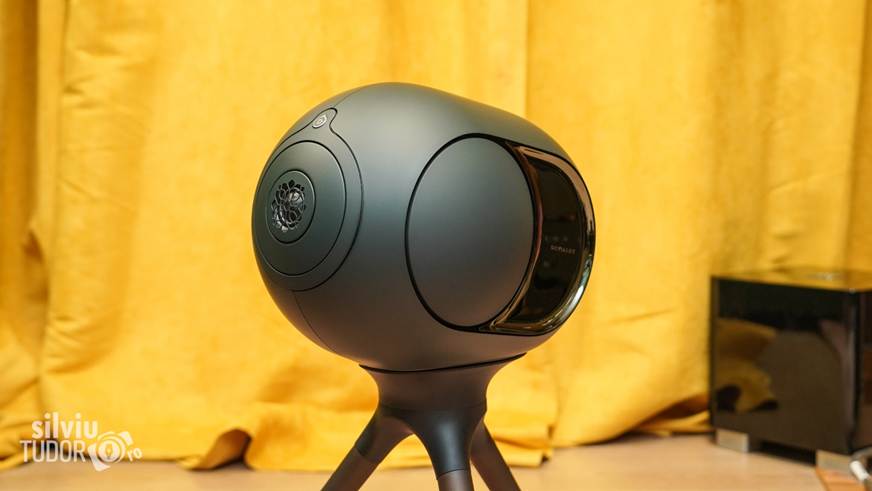
After placing them in position, I applied the settings I mentioned in the previous paragraph, sat down in the armchair, opened mConnect and pressed play on shuffle on my test playlist. The first track selected by the player was “Spinning the Wheel” by George Michael, a track I have been using for years to analyze audio systems.
Immediately I heard something I could hardly believe. Absolutely all the frequencies were present, and what impressed me most was the soundstage, completely three-dimensional and, contrary to my initial fear, the fact that the speakers were only 40 cm off the floor did not matter at all. The music filled the entire room and George Michael’s voice seemed to come from the middle of the room, above my head. Somehow, from down there on the floor, Phantom Ultimate managed to project the soundstage perfectly into my room.
Many times during the listening session I would close my eyes so that I would no longer see the small speakers sitting on the floor in front of me. And when I did that, my brain immediately formed the impression that there should be two massive speakers in front of me and a huge room, similar to what I had experienced at various audio shows. But my brain quickly adjusted when I opened my eyes again, because it saw the small speakers sitting there on the floor in front of me, and it seemed to whisper, “Silviu, how is this even possible?”
I was also very impressed by the bass performance of these speakers. Again, referring to “Spinning the Wheel”, this track is difficult to reproduce correctly. It has a bass line that is hard to control, and it stresses both the amplifier and the drivers. Yet I can tell you that Phantom Ultimate are among those speakers that reproduced this bass line perfectly, without any lack, attenuation or instability. The bass was visceral but controlled, very deep yet clean, soft and authoritative at the same time, characteristics that are very difficult to obtain simultaneously from a single audio system.
Initially I noticed the absence of a subwoofer output, and I was preparing to note this under “The Dark Side” section at the end of the review. But then I realized something interesting. These speakers do not have a subwoofer output because they simply do not need a subwoofer. While listening to them, I noticed that their bass is complete and complex, just as complete as in an audiophile system equipped with subwoofers. In practice, Phantom Ultimate do not need subwoofers at all. In the end, I actually ended up listing the absence of a subwoofer output under “The Bright Side” section, as an advantage rather than a disadvantage.
From that point on, I wanted to run an experiment and push them as far as possible, to see how and if they scale. The results were at least interesting. The first thing I wanted to analyze was positioning, and I noticed that it does not matter nearly as much as with conventional speakers. What does matter is placing them at least 30 cm away from the rear wall. If you move them closer, they become a bit more boomy. Apart from that, toe-in, the distance between the speakers, these things matter very little compared to a traditional loudspeaker system. I also noticed that their sweet spot is larger than that of a conventional speaker setup. The sense of soundstage remains even if you stand up from the listening position and move somewhere else in the room.
Another tendency was to try to make them scale through the network. Initially I listened to them over Wi-Fi and then I wanted to switch them to Ethernet. I first tried with a classic audiophile cable, with Telegärtner connectors and thick, rigid Cat 7 cable, but unfortunately this cable did not fit into the small “cavity” with ports on the back of the speakers. So, I resorted to a non-audiophile Cat 7 cable that did fit there, but I honestly have to say that I did not hear a major difference compared to Wi-Fi.
The next test was to try changing the power cable. However, it was impossible to insert an audiophile power cable into that same “cavity”, because such cables usually have rather large IEC connectors that simply do not fit on the back of the Devialet speaker. Therefore, I had to settle for the stock cable. Even so, I did not leave it alone. I tried reversing the plug in the outlet to see how the sound would scale with the electrical phase reversed. Well, I barely noticed any difference. I can almost hear the audiophiles reading this saying “wow”.
What do all these tests tell us? They tell us that the way these speakers are built, both physically and in terms of software and technical implementation, is truly “wow”. Managing to build a device that sounds almost the same on Ethernet and on Wi-Fi, and that is not very sensitive to the orientation of the power plug in the outlet, meaning independent of the electrical phase, that really is impressive. These tests prove that we are dealing with speakers that deliver an audiophile sound, yet without requiring the kind of effort that audiophiles usually put into making a system sound good. Fascinating.
The way these speakers sound remains impressive: they sound big, they sound bold, round, with plenty of color in the presentation. The soundstage is three-dimensional, large, tall and perfectly coherent, even though the speakers are not positioned at ear level.
THE AUDIOPHILE HINT – ARE ACTIVE SPEAKERS A SOLUTION FOR AUDIOPHILES?
Arriving at today’s audiophile hint, I raise a question: are active speakers a solution for audiophiles? The short answer is “yes”, but it depends very much on which ones. Not all active speakers have an audiophile sound, not all active speakers offer an audiophile soundstage, and not all active speakers possess true audiophile qualities.
However, there are certain models that deliver all the characteristics an audiophile is looking for: an impressive and accurate soundstage, very well-controlled bass, crystal-clear voices separated from the rest of the audio information, a holographic sensation – that feeling that the elements of the sound detach and acquire a three-dimensional character – and, not least, a general sense that the sound is alive, as if the musicians were performing right there in your room. These are the elements that form the foundation of an audiophile system.
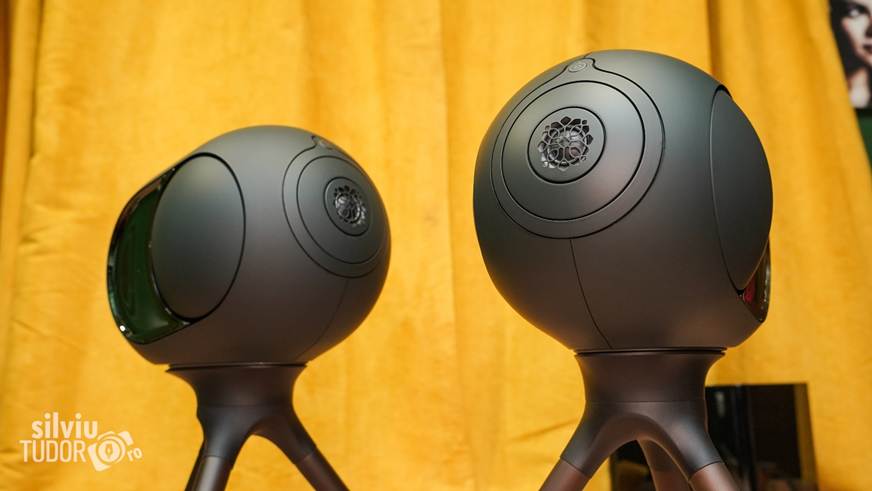
Of course, the main prerequisite for an audiophile system built around active speakers would be to have two of them. For example, Devialet also sells its Phantom speakers individually, but you will never obtain a true soundstage and depth with a single speaker.
When it comes to active speakers with real audiophile qualities, I would clearly place Devialet Phantom at the top of the list. I would also add the LS series from KEF, as well as Cabasse and Bang & Olufsen. In the case of other brands and active speaker solutions that are very popular and much more affordable, such as Edifier for example, the sound is very good, but it does not truly step into the High-End audiophile universe.
Therefore, active speakers can indeed be audiophile. These top models possess the characteristics audiophiles look for, with the added advantage that they free you from tweaking and bring you closer to music. If your soul is oriented more toward music itself, then a great set of active speakers, such as Phantom Ultimate, will bring you closer to the music and significantly calm the urge to constantly tweak and improve your system. However, if you are one of those audiophiles with a permanent “itch”, always eager to optimize the system and unable to go a day without running another test or tweak, then active speakers, even very good ones like the ones reviewed here, are not the solution for you. You will interpret the simplification they bring as a drawback and, over time, it may start to feel like a limitation.
TIPS & TRICKS
- Follow Devialet’s positioning advice 100% – at least 30 cm from the rear wall, an equilateral triangle of 1.5–2.5 m and a slight toe-in toward the listening position.
- Do not bother with audiophile tweaking – Ethernet or power cables, use the Phantom exactly as they are, they will sound perfect.
THE BRIGHT SIDE
- Positioning is astonishingly easy.
- Minimal break-in.
- Wi-Fi sounds just as good as Ethernet.
- Excellent wireless integration: Tidal, Spotify, Google Cast and AirPlay.
- Million-dollar design and finishing.
- A myriad of accessories and related solutions.
- The bass is so good that subwoofers are not necessary.
THE DARK SIDE
- A few additional ports would have been welcome, especially an HDMI-ARC port.
- I would have liked to see at least internet radio inside the Devialet app.
- Lack of Qobuz Connect.
CONCLUSION
I begin my conclusion about the Devialet Phantom Ultimate 108 dB by congratulating the design team, led by Emmanuel Nardin, for creating, in my view, one of the most remarkable products of modern times. I place Phantom alongside the Eames Lounge Chair, the Citroën DS, the Apple iPhone and the Piaggio Vespa, some of the most extraordinary examples of industrial design of the last century. The design and concept of the Devialet Phantom Ultimate 108 dB are truly revolutionary and remarkable, and Devialet and Emmanuel deserve all the praise.
I continue with the sound of Phantom Ultimate. It is truly impressive, truly audiophile. I absolutely loved Phantom Ultimate during the few weeks I spent with them. Little by little, these speakers distanced me from the usual audiophile fever and from the constant “itch” to tweak and optimize something in the system. Is that a bad thing? Is it a good thing? I can only say that I listened to far more music during the period when I had Devialet Phantom Ultimate 108 dB in for review.
Still, who are these speakers for? I have seen them in many beautiful homes with contemporary design, used by people who appreciate exceptional design, who have an eye for beauty and who most likely also have an Eames chair somewhere in their living room.
However, this review was meant to clarify whether Phantom Ultimate 108 dB are speakers that can truly satisfy audiophiles. I can tell you quite clearly that Phantom Ultimate 108 dB has an audiophile sound and can successfully replace many traditional audiophile systems. If you are an audiophile for whom tweaking has become a burden, or an audiophile tired of constant optimization, or tired of cables, or an audiophile looking for a simple and efficient secondary system, or perhaps an audiophile who simply wants to listen to more music, then the Phantom Ultimate are exactly what you are looking for. Phantom Ultimate are the most remarkable active speakers that have crossed my listening room so far.
WHERE TO BUY: If you are making your purchase from Romania, please go directly to avstore.ro, if you are outside this area, please go to devialet.com for purchase information.
Silviu TUDOR
An article written in my sweet spot,
and this is what I’ve heard.