Dear reader, I am very happy to let you know that this review is the first in a series of articles I am writing for the Romanian audio distributor EAUDIO.RO. For today we decided to start with their most successful speaker brand, Vienna Acoustics – a brand that was under my radar for a very long time, I cannot tell how curious I was about these speakers, and, finally, I got the chance to relinquish this thirst. So, without further ado, let’s jump in and see what Vienna Acoustics have to offer.
VIENNA ACOUSTICS
Firstly, a little overview about this Viennese speaker manufacturer. As the name suggests, Vienna Acoustics’ speakers come directly from the Austrian capital, one of the most musical and all together amazing cities of the world. I’ve been there many times and each time I had the same conclusion: Vienna is my preferred city. Why? Hmm. Hard to pick that one thing that makes Vienna… Vienna, but nevertheless is the most balanced city I’ve been in: it’s a metropolis, but it still retains that “small-town” effect. The Viennese are just great people – not too cold like their western counterparts, nor too loud like their eastern neighbors; as Vienna itself, the Viennese are also in a deep state of balance, they are swinging on a big invisible and musical swing, always laughing, always happy, always civil and always carrying a great taste. Of course I cannot forget their Sachertorte, that is also very deep routed in my heart. You see, dear reader? I was under the impression I will tell you the story of Vienna Acoustics, and I completely left “acoustics” out and told you what I keep in my heart about this city. Yes, without any doubt, with its amazing Schönbrunn Palace, Zoo and Park, Technical Museum, Mariahilferstrasse, and, nevertheless, its great music scene, all starting at Musikverein, Vienna remains one of the greatest places in central Europe. Please see below this photograph I took of Vienna from its 170m Danube Tower:

Going back to the real subject of this introduction, Vienna Acoustics, their passion for speaker design was born in this musical town of Vienna, a city that simply breathes music and sits at the beginning of music, being the primordial place where classical music was born. Wow, that’s a tough one to beat, isn’t it? Vienna Acoustics was founded in 1989 by Peter Gansterer, you will find him in the same position as Chief Designer even today. In Peter’s words: “A great loudspeaker is a synthesis of the arts. It’s an organic whole, whose sound derives from the harmony of countless sound-determinating parameters in combination, mirroring the composition of the truly harmonic high-end system of which it is a vital component”. So, it is clear that speakers that are made in Vienna with Vienna’s greatest music halls in mind will be something to have keep an eye out for.
Vienna Acoustics’ series that today’s speakers are included in is called Concert Grand Series and contain many types of speakers: Beethoven Concert Grand Reference, Beethoven Baby Grand Reference, Waltz Grand, Maestro Grand Reference, Theatro Grand and, finally, today’s speakers, the Haydn SE Signature bookshelf speakers. These come in four finishes: Piano White, Piano Black, Premium Rosewood and Cherry. For my review I have had the first three finishes available for testing. Here is a picture:

EAUDIO – COMPANY PROFILE
I got the chance of meeting the two guys from Eaudio a few years back when they were just thinking of starting a High-End distribution business based in Bucharest. Now, a few years later, we reunited and I discovered they succeeded to make Eaudio a thing, of course, with great sacrifice and hard work, but nevertheless they have managed to bring important brands to this part of Europe: Tsakiridis Devices – an Athenian manufacturer specialized in tube amplifiers, Albedo Silver – a polish manufacturer of High-End cables, Pilium – a Greek company specialized in audio components, heavily used by Magico, Estelon and Alsyvox in their reference setups, Audionet – a German High-End company that builds audio components and is the only brand that has a device listed in the Smithsonian National Gallery, Ludic – a Dutch brand specialized in audio accessories, Lampizator – a legendary polish brand building tube DAC’s, and, of course, Vienna Acoustics – an Austrian company that produces speakers.
I cannot tell you how many sellers like Eaudio have helped me over the years, paradoxically, to save money, preventing me from throwing away money on equipment I did not need or that was not suitable for my system. Sorin and Răzvan from Eaudio are willing to provide gear for testing before the actual sale, and, in my opinion, that is amazingly important. So, do not hesitate to contact them and ask them for products for testing. Below is a picture of these two guys taken at this year’s High End Munich 2025 show:

UNBOXING AND FIRST IMPRESSION
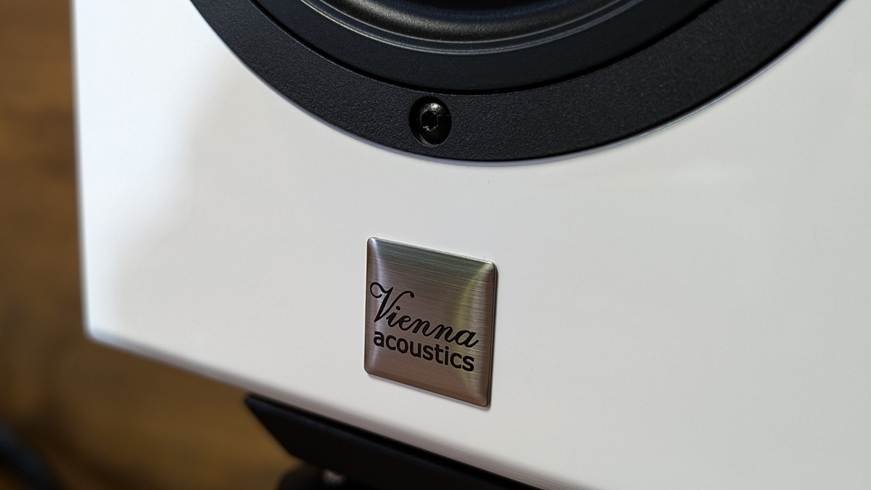
Going back to our Haydn SE Signatures, it all started with an unboxing. I was impressed by how well these were packaged, in simple but sturdy packaging, the speakers being protected without issues. I’ve noticed also the packaging materials were not in excess, just the basics. That makes me very happy each time, the excess of plastic is not something I usually appreciate. Getting the Haydn SE Signature out of the box I was amazed by their attention to detail, superb finishes and slick looks. The “piano” finish on the black and on the white versions looks amazing, the matte Rosewood looks a million also. Here is a picture up close, it will back my words up:
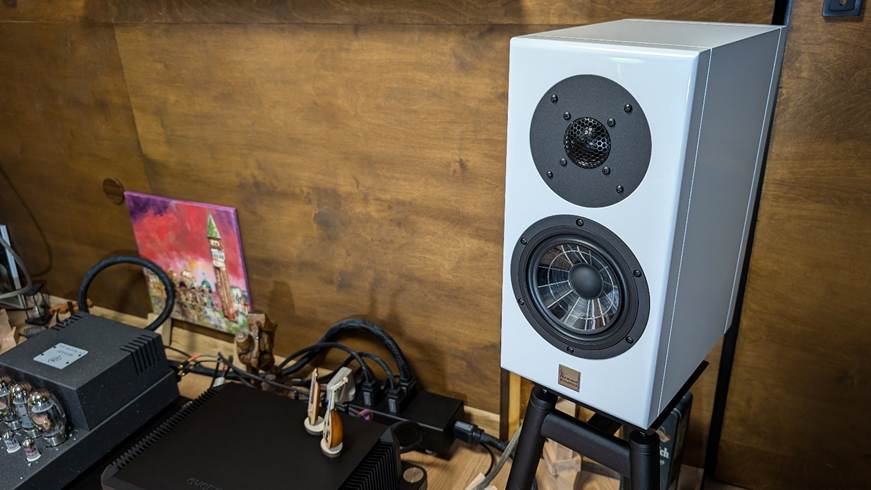
The speakers looked amazing, I loved the Piano White version, they looked amazing against the brownish backdrop of my room:
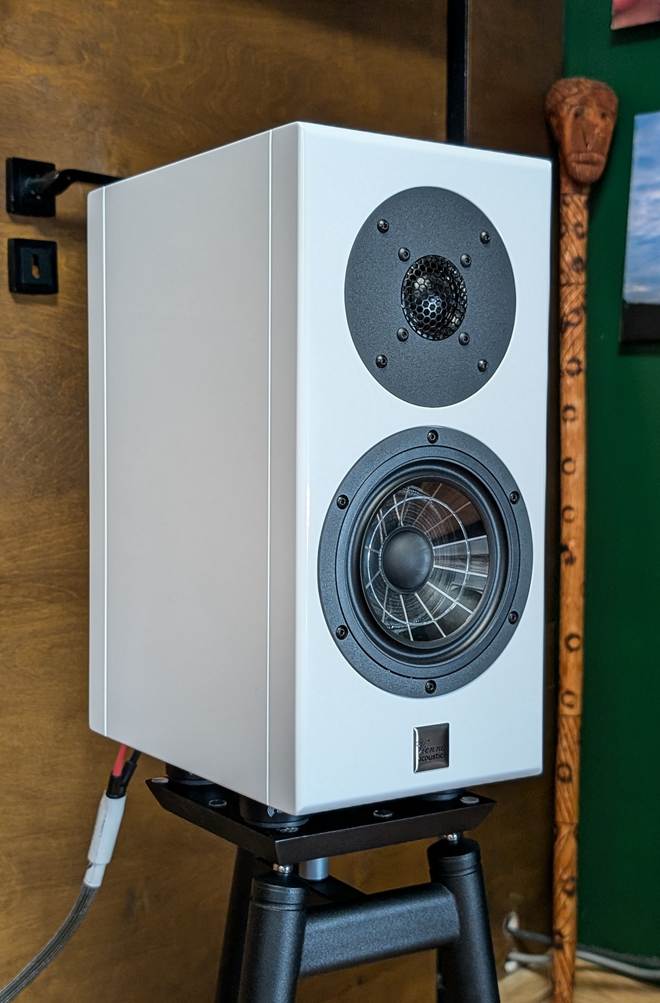
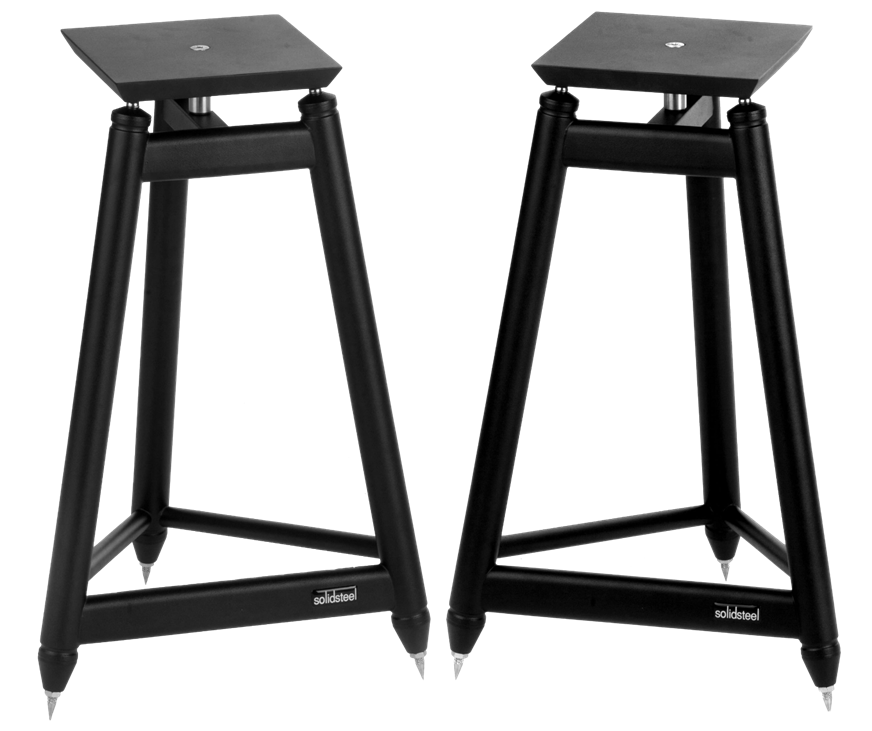
As you may have noticed in the picture above, for these speakers I used stands from the Italian brand Solidsteel. Their “tripod” like stands is being produced all the way from the 90s and they are just right for these Haydns. The stands are called Solidsteel SS-6 Series Vintage and they can be purchased in Romania also from Eaudio alongside these amazing Haydn SE Signature. It’s worth mentioning that Vienna Acoustics do not produce a special type of stand for these bookshelves, so after market ones are to be used. I tried other stands from other brands while I was testing these speakers, but these Solidsteels were the best. Further down the article I will be talking about counterspikes in today’s “The Audiophile Hint”, make sure not to miss that as I have tested a lot of counterspikes and I have many things to tell you.
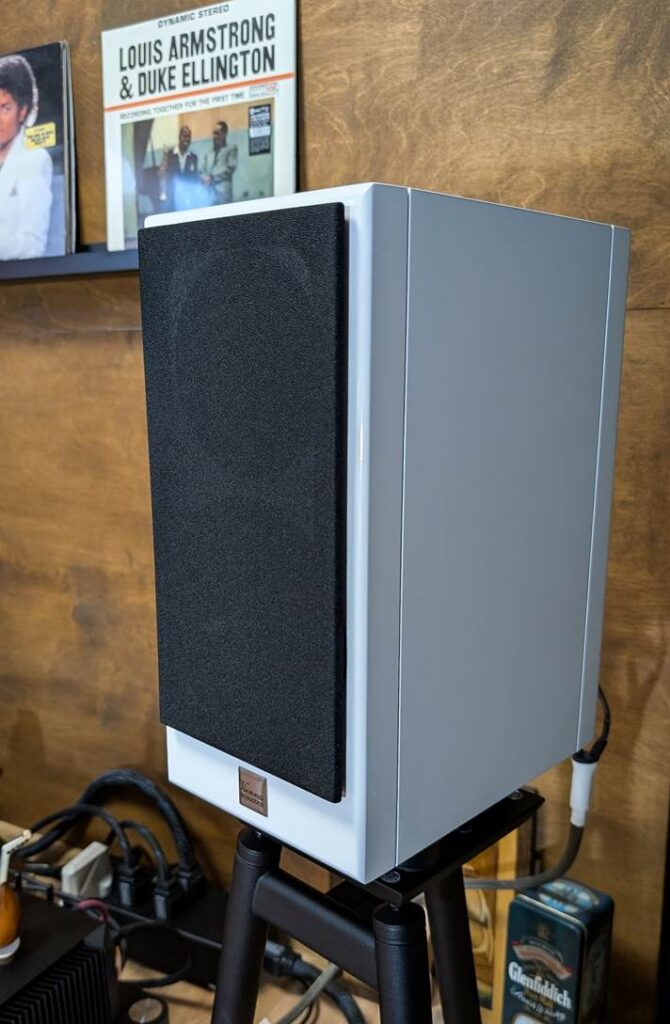
In the package you will also find magnetic speaker covers, here is how the speakers look with these grilles on:
TECHNICAL DETAILS
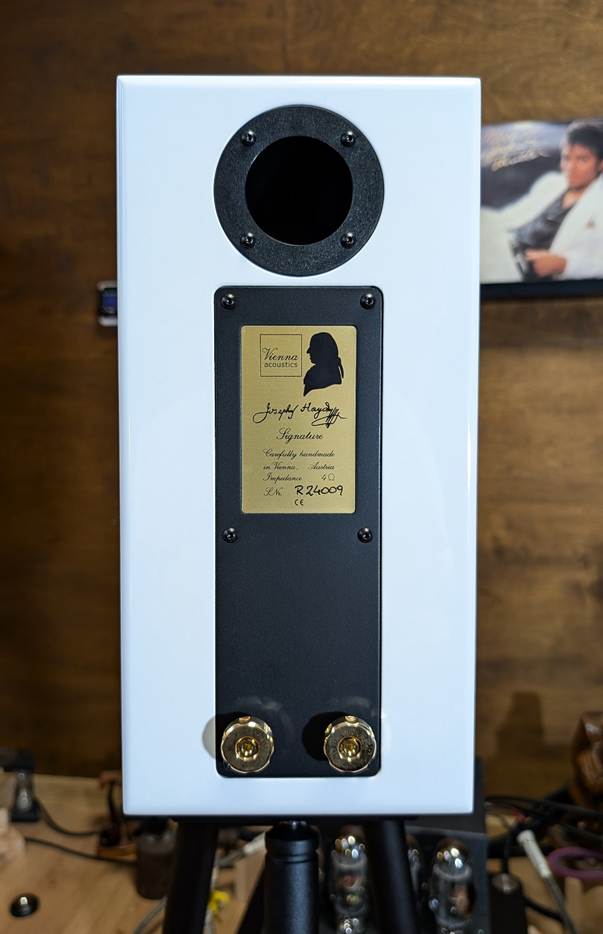
Going further with Haydn SE Signature’s technical details, these are 4ohm bookshelf speakers, with a response of 40Hz to 20KHz at a sensibility of 88.5dB, being rear-ported in a bass-reflex enclosure. Inside you will find a crossover that has MKP capacitors. A speaker weighs 10kg (22lbs). It’s nice that the speaker does not have double bindings. Here is the backside of the speaker where you can notice the good quality of the bindings and also the plaque that states the serial number and information about the speaker (Joseph Haydn’s signature included):
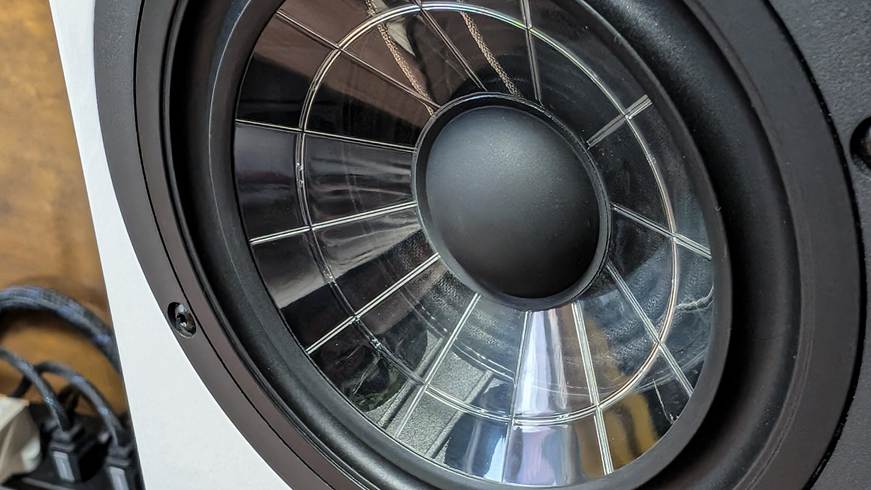
This speakers’ tweeter is custom made by Scanspeak in Denmark and had been hand impregnated and paired by Vienna at their factory. The bass/mids driver is also a Vienna Acoustics signature design, being completely transparent, if you get a torch you can look inside the speaker itself, neat, isn’t it? The woofer is custom made by Seas in Denmark and the unique spidercone named X3P is designed and built by Vienna Acoustics. Here is a picture with this special driver:
WHAT AMPLIFIER TO CHOOSE TO POWER THE HAYDN’S?
In terms of power, as a general rule, we know that smallish bookshelves need serious power behind. However, I did not feel this in the case of Haydn SE. I tried them with a few amplifiers, tube and solid state alike, and I concluded that they are not so thirsty after all. They can be driven without any hiccups by most amplifiers.
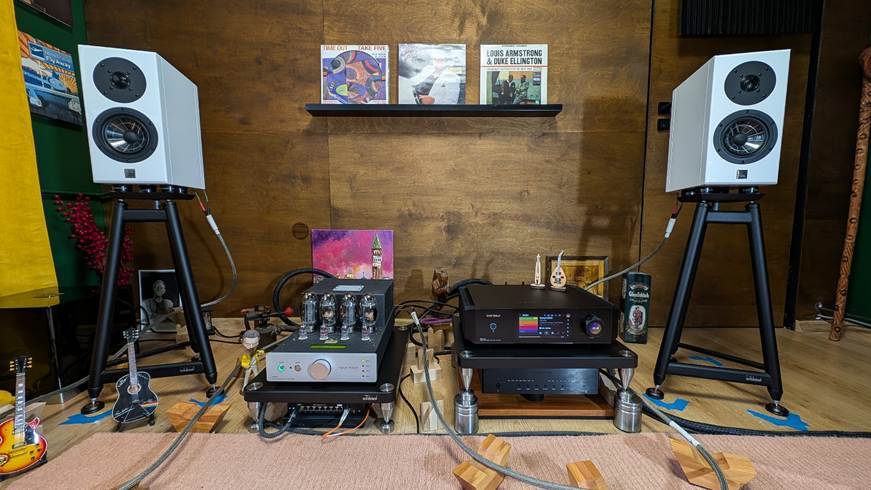
I tried the Haydn with Simaudio’s Moon 340i X and they worked together beautifully, but, also I tried them with a tube amplifier, the Tsakiridis Devices Aeolos Ultra and they sounded even better. I do not want to get into this tubes vs. solid-state kind of discussion, because I know that both are solid options, none of them is wrong, but none of the two is the right one, they can be differentiated only by the personal preference and choice. With solid-state Haydn’s sound is more precise, sharper, but a little bit too plain. When moving to the tube amplifier, Aeolos gives them a push further, making them sound more analog, deeper, the sound being more magical, bigger and warmer – known adjectives for tube amplifiers. Here is a picture of the whole system being run by Tsakiridis Aeolos Ultra:
My honest opinion regarding what amplifier to choose for these Vienna Acoustics Haydn SE, is to choose one that is to your liking regarding its voicing. Haydn SE Signature are not thirsty speakers, so you have plenty of amplifiers to choose from.
THE MUSIC OF THIS REVIEW
Listening more and more to these Haydn SE Signatures, I tend to understand that they are very good with classical music, and, generally, music that has a very big soundstage, being very airy and orchestral. This is where I remembered one of my favorite albums that fits all the above, the amazing “The New Four Seasons – Vivaldi Recomposed”, an album that is at the crossroads between classical music and electronic music, being composed by the legendary Max Richter.
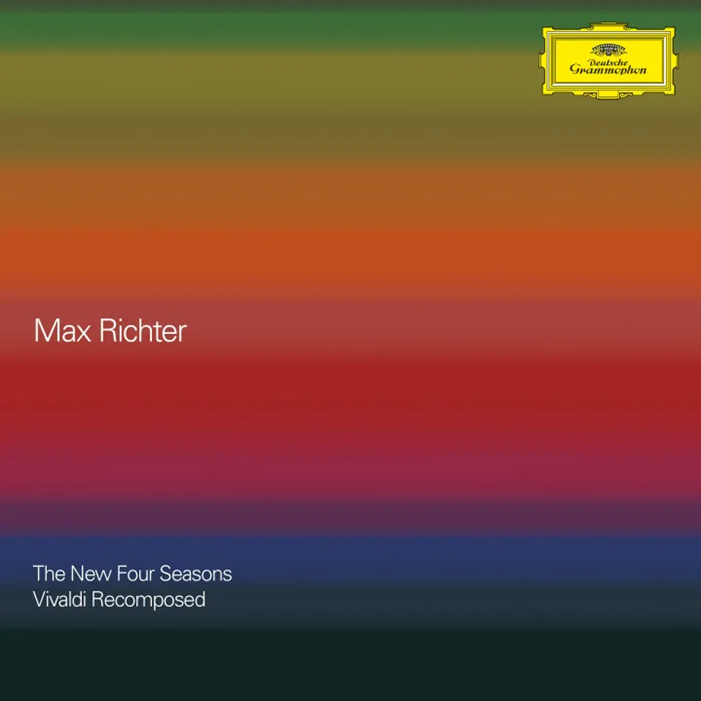
The New Four Seasons – Vivaldi Recomposed is an album that astounds me every time with its subtle details of interpretation that honorably modernize Vivaldi’s composition. The harpsichord atmosphere of Vivaldi’s score remains, but these new nuances are obtained with the help of modern music technology. Dear reader, don’t get me wrong, Vivaldi is clearly the core of this album, but the merit of adding a contemporary type of warm light on the great Venetian composer belongs unquestionably to Max Richter, this German British genius.
Regarding how it sounds, I will tell you that the first time I’ve listened to this disc it felt like a… struggle! A true struggle between old and new, between classical scores and modern music, between Richter and Vivaldi. The struggle is not won by Vivaldi, nor by Richter, but is undoubtedly won by us, the listeners, who have the honor of receiving a fresh version of The Four Seasons.
Haydn SE has superbly rendered this struggle between Richter and Vivaldi, from the first note of the album to its last. As I suspected, The SEs are great for classical music, but, nevertheless, The New Four Seasons is not just a classical album, but has also nuances of electronic music, with its very deep bass notes coming from synthesizers. This is when I realized that the Haydn SE does not stop at classical music, they are good also with great sounding classical electronic music like Jean-Michel Jarre and Tangerine Dream. Thus, I was lost for a few days, completely shut in the listening room, reconnecting myself with these amazing albums of the past.
HOW DO HAYDN SE SIGNATURE SOUND?
Now that all is clear, technical details, build information, company profile and even the music that I used for this review, an important question arises: how do they sound? Without further ado I will tell you. Dear reader, I listened for days and days on these Haydn SEs and each time I was surprised at how a 3000 EUR speaker can sound so good, so detailed, with such a foot-tapping effect. They are very enjoyable sweet-sounding speakers.
You can throw any music at these speakers, and it will sound cursive and correct, you can listen for hours and hours and feel no fatigue at all, that’s simply amazing. They have good bass for their size that goes down to 40hz, correct mids and open highs. In small to medium 14-24m rooms there is no need to add a subwoofer.
While writing these lines I was thinking about Vienna Acoustics’ philosophy, that they wanted to make speakers that reproduce the sound of the great concert halls in Vienna. Indeed, with the Haydn SEs they achieved that. This is the best way of describing how these speakers sound – exactly like classical music sounds in a good concert hall. I remember attending a few concerts at Musikverein and I must say that something from that sound I recognized in these Haydn SE Signatures. So, well done Vienna Acoustics, you are true to your philosophy.
Comparing these speakers with others in this price range, I will start with Bowers and Wilkins’ 705 S3, I would say that Haydn are more balanced, they sound not as open as BW but have serios bass reserves instead. Also, I will compare Haydn with Audio Solution’s Figaro B2, in the same way Haydn are more natural, more balanced, with more bass than Figaro, however equal in the openness of the highs. Lastly, I will compare Haydn with one of their direct competitors, Dynaudio’s Special 40. With these, the difference is more evident, the Dynaudio’s are definitely better in bass, different in mids, but on highs and upper mids Haydn are more balanced and more open compared to Special 40’s.
Choosing the Vienna Acoustics Haydn SE Signature is, at the end, a matter of taste, but, nevertheless, the previous comparison underlines that Haydn SE Signature wins each time in terms of balance, and, of course, it is important to say that balance is crucially important for music reproduction. Are there any complaints I can make about Haydn SE Signature’s sound? Well, absolutely, no. For 3000 EUR they sound amazing, what complaints can I really make?
THE AUDIOPHILE HINT – COUNTERSPIKES
Getting to the last chapter of this review, the Audiophile Hint, as always, I am giving you a small insight from my tons of tweaks and tests. Today, I will focus on the counterspike situation. In years of carefully tweaking High-End systems, I discovered that in general decoupling solutions like Isoacoustics’s Gaia work very well with stand floor speakers. But an important question arises: does that work also with bookshelf speakers placed on a stand? I discovered that placing Gaia or any kind of decoupling underneath bookshelf stands will not do good, and that it is better to couple the stands to the floor using spikes and counterspikes and decouple the speakers from the stand itself. Here is a picture of how I managed to decouple the speakers from the stand using Isoacoustics’ ISO-PUCK-MINI:
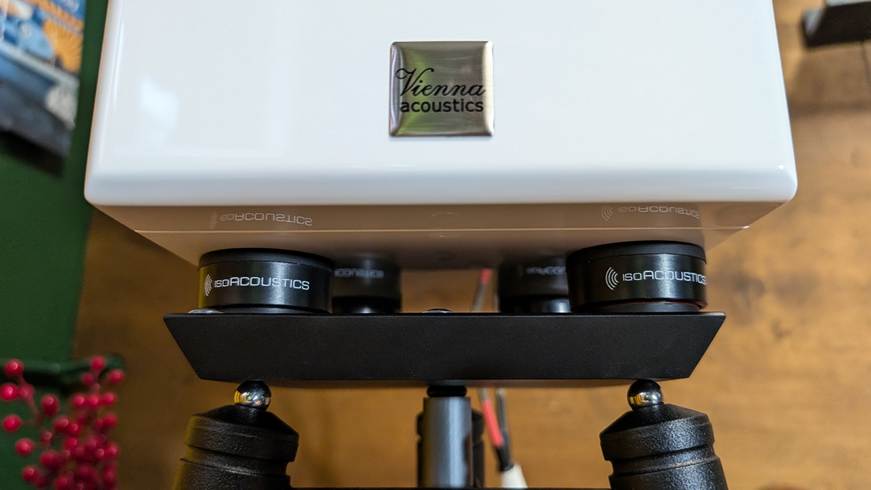
This works beautifully, the sound becomes more tridimensional, the pinpointing of the items in the soundstage is clearer, the bass comes to you by air and not by vibration, altogether the decoupling works and you should try it.
Now, what happens on the floor side where the stands sit on the ground? There I established that using Gaia will not be great, so another solution must be found. This is when I found out that using coupling does great. So, I coupled the stands to the floor using spikes, and, of course, counterspikes. But you know what I actually found out? Counterspikes change the sound more than the spikes themselves! So, a big quest has started – I needed to find out what counterspikes are the best. When I realized how much counterspikes change the sound I borrowed all the counterspikes I could find and I also bought a few sets, here they are:
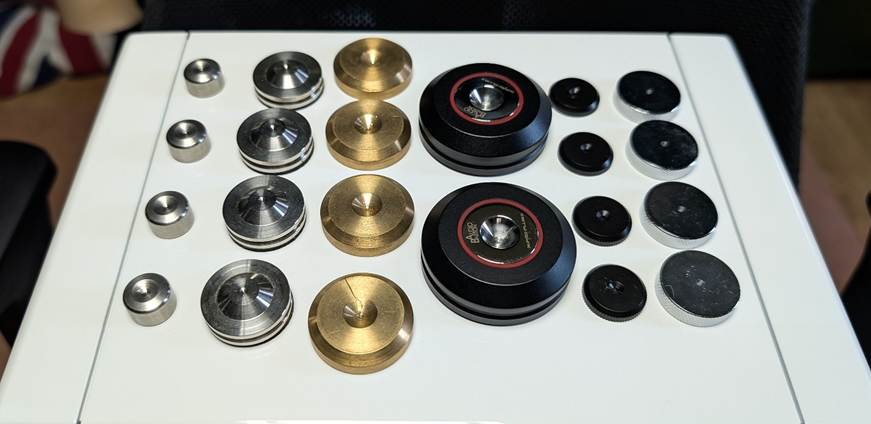
First from the left we have Solidsteel’s steel counterspikes, specially created for the Solidsteel stands, next we have some generic steel counterspikes, continuing with brass ones, the two sets on the right are made from aluminum. As you can see, I left the middle one at the end, as it was the one that has given the best results. These counterspikes are made by an American company named Audio Bastion and they are called X-Pad Plus II. Made of hand-polished stainless steel, T6061 aluminum, silicone and cork, they produced a great effect in my system, completely focusing the sound and making the soundstage amazingly bigger. It is completely amazing how much the sound changes with each counterspike set. I’ve spent many days testing all these sets and finally a big smile of relief could be seen on my face when I discovered these amazing Audio Bastion counterspikes. These solved all of my problems and effectively raised the level of quality of my audio system.
So, please keep in mind this simple yet very effective setup when it comes to bookshelf speakers: couple the stands to the floor and decouple the speaker from the stand.
TIPS & TRICKS
- Haydn SE Signature are not thirsty speakers, any powerful enough amplifier will do the job, just choose one with a voice that you love.
- The SEs are not hard to position, start from a position of 2m between the speakers with a toe-in of 30 degrees angle towards the listening spot.
CONCLUSION
Well, dear reader, what can I say more than the fact these speakers are made by music lovers and that they carry the name of Earth’s supreme City of Music – Vienna? These are people who live in this City of Music and they have the chance to attend concerts at the great Musikverein as often as they like. These people made speakers… That rests my case. To have the chance of bringing this classical sound of Vienna into your own home is indeed a magical thing that you can achieve with these special Vienna Acoustics Haydn SE.
Finally, before stepping away, I will answer another question: for whom are these Haydn SEs? They are for music lovers and audiophiles alike; they are not hard to set up and will work in most rooms and will integrate rapidly in any system. Finally, their most precious attribute: they bring you the joy of listening to music, you can have them singing for hours and hours and you will not feel fatigued or want to change something. Sincerely, at this price range they do not have any kind of competition, they are a hidden gem with an unapologetically great sound.
WHERE TO BUY: If you are making your purchase from Romania please go directly to eaudio.ro, if you are outside this area please go to vienna-acoustics.com for purchase information.
Silviu TUDOR
An article written in my sweet spot,
and this is what I’ve heard.