Dear melomaniac, this week I will be writing about an album that recalibrated the limits of commercial music when it was released in 1998, an album that opened new possibilities in music, proving that success does not have to rely only on simple hits filled with catchy lyrics and a lot of pink color.
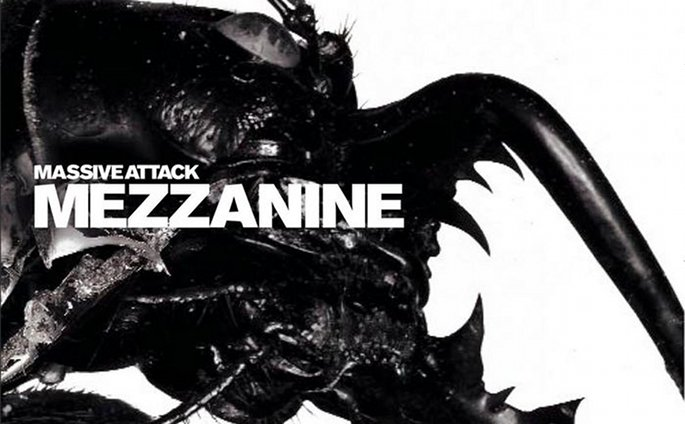
Mezzanine brought a new rhythm, it captivated us all with its deep, dark sound, but also with its white cover featuring a beetle, a cover that, even though it is white, I will always feel as being black, just like the music on this record. The cover features a macro photograph of a “black stag” beetle, shot by Nick Knight.
Why do I say “dark music” above? Well, this is the feeling this record gave me ever since I first heard it. It is certainly not the most positive album, but it is not something depressive either, it is rather something special, this record feels exactly like when you turn off all the lights in your house, shut down every device that makes noise and sit comfortably somewhere, listening to silence in complete darkness. Is this darkness something bad? Certainly not.
This is what this album was for the music of 1998, something different, maybe even strange, but something that proved that music was still evolving, that something new could still be created and that the idea of “modern” in music was still something that could be pushed further. So today I will tell you about all this, about a modern record that is now 26 years old.
I mentioned earlier the album cover, that white cover that feels black, with a large beetle placed in the middle, and now I will also refer to the album’s title which, just like the cover, stands in contrast with what was being released at the time, offering us a name that defines the album perfectly: “Mezzanine”, this “mezzanine” which, by definition, is a level that is not quite a floor, sitting between the ground floor and the first floor, with a lower height. In the same way, Mezzanine stands apart from all the music of the 90s, an album that does not feel like an album, a music that is simply different.
When you press play on Mezzanine, you will immediately feel a music built around bass and sub-bass, with looping and sampling techniques that were extremely refined and avant-garde for those years. One could say that Mezzanine is so avant-garde for the 90s that if you erased someone’s memory and had them listen to it for the first time in 2026, they could easily say it is an album that has just been released. Most likely, even in 100 years, Mezzanine will still sound modern.
I remember I was just a kid when the album was released and the track Teardrop was playing everywhere on the radio, while its video was running on MTV, both the track and the video being almost too much for all of us back then, which is why many of us were watching it breathless, learning something new each time from the musical notes and the imagery. Below, a still frame from the video that stayed with me over the years:
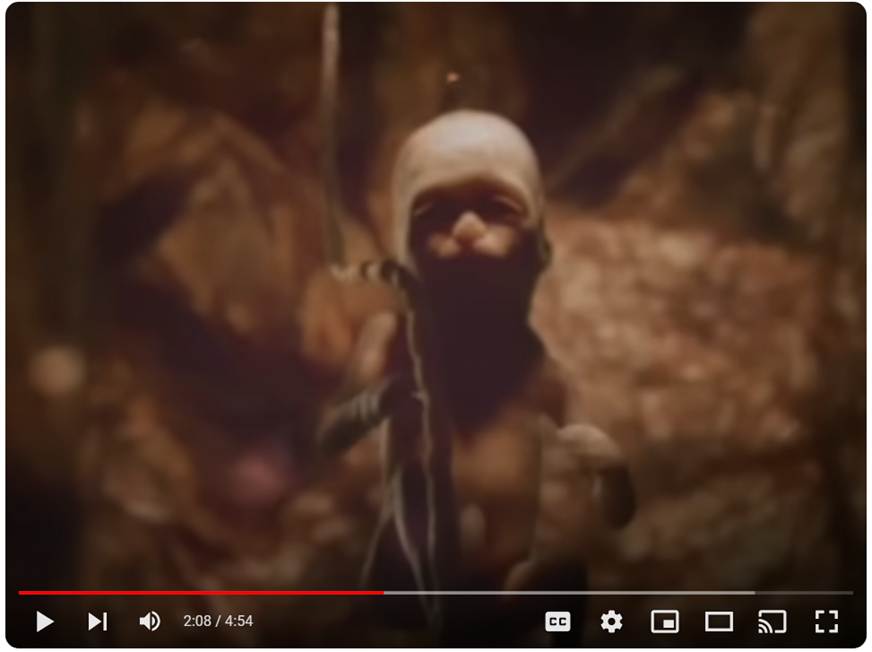
How could you ever forget something like this? How many had the courage to release a video that, throughout its entire 5 minutes, shows the stages of human development in the womb? I remember that, at the time, both the track and the video left me deeply thoughtful.
The concept of the video belonged to director Walter Stern, who also won an MTV Europe Music Award for his work. The fetus seen in the video was an animatronic puppet, created over the course of 6 weeks by a company specialized in film props.
It is interesting to know that the voice on Teardrop was initially meant to be Madonna’s, with whom Massive Attack had collaborated before. However, even though Madonna had already been contacted and had accepted the collaboration with great interest, Massive Attack ultimately chose the voice of Elizabeth Fraser, clearly less known than Madonna, but undeniably more suited to the sound of the album. So here it is, no compromises were made in the creation of this record.
Mezzanine was the third album by the British band Massive Attack, released on April 20, 1998, through Virgin Records. The album marked a departure from their previous work, their main goal being to explore darkness, with strong influences from post-punk, industrial music, hip-hop and dub.
Upon its release, Mezzanine immediately climbed to the top of music charts worldwide, becoming both a sensation and a phenomenon, widely regarded as one of the best albums of the 90s. The album spawned the singles Risingson, Angel, Inertia Creeps and, of course, Teardrop.
Massive Attack was formed in 1988 in Bristol, United Kingdom. The band’s official genre is trip-hop, with founding members Andrew “Mushroom” Vowles, Adrian “Tricky” Thaws, Grant “Daddy G” Marshall and Robert “3D” Del Naja. Below is an image of them from the 90s, from left to right Daddy G, 3D and Mushroom, with Tricky missing, as he rarely appeared in photos at the time, this lineup being the one most often presented:
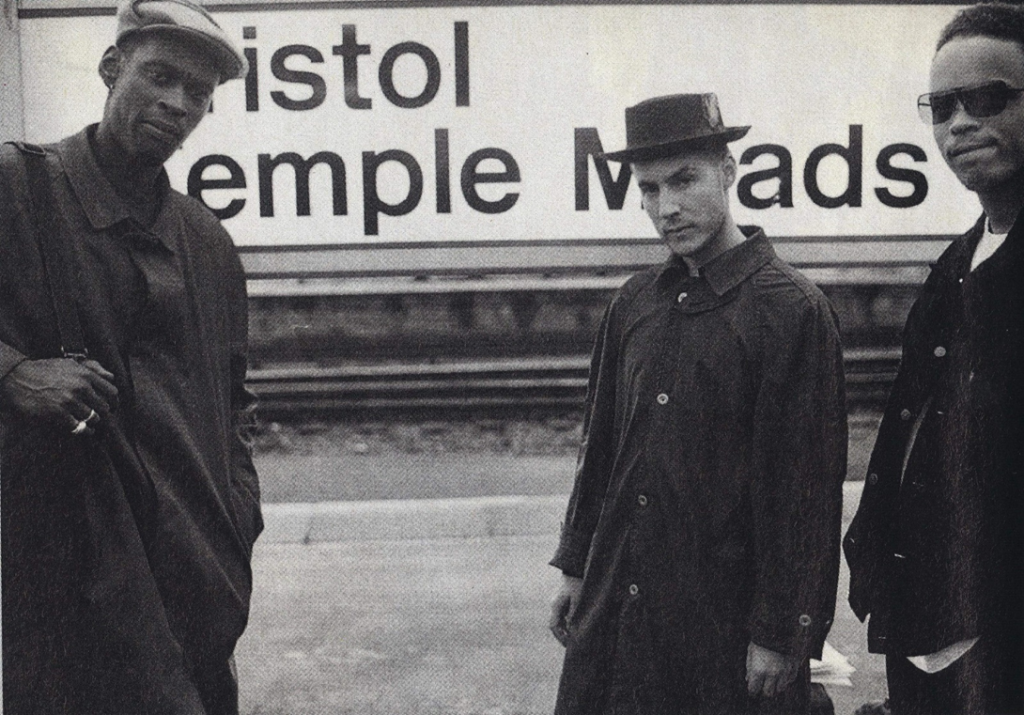
The four met on the Bristol music scene, with Daddy G and Mushroom both working as DJs, Tricky as a rapper, and 3D at that time being only a graffiti artist. Their manager and supporter was Cameron McVey who, together with his wife Neneh Cherry, financially backed several important projects at the time, Portishead, Tricky and, of course, Massive Attack. Tricky left the band in 1995, the first two albums being completely different from Mezzanine, as he no longer agreed with the band’s direction.
The mastermind behind Mezzanine was Robert “3D” Del Naja, completely transformed from a graffiti artist into a fully developed musician. The album’s creation process took quite a long time and was extremely difficult, filled with ups and downs. While Robert knew exactly what he wanted from this album, namely an exploration of darkness, the others were not equally convinced, which created significant tension within the band and even brought them close to breaking up several times. Andrew Vowles, one of the founding members, left the band immediately after the album was released.
The production process unfolded in a rather unusual way, with the members working separately, Robert spending entire nights alone, isolated, consumed by the struggles of creation. Meanwhile, Andrew and Grant worked independently on various parts requested by Robert, almost without having a clear vision of the whole, like programmers working on a module of software without fully knowing the final product.
Mezzanine did not stop evolving and, beyond the impact it left on our imagination, the album was reissued in a unique form in 2018, celebrating 20 years since its release. The reissue did not come as a remaster or a special vinyl edition, but as a matte black spray paint can. Yes, you heard that right. Below, an image of that very item:
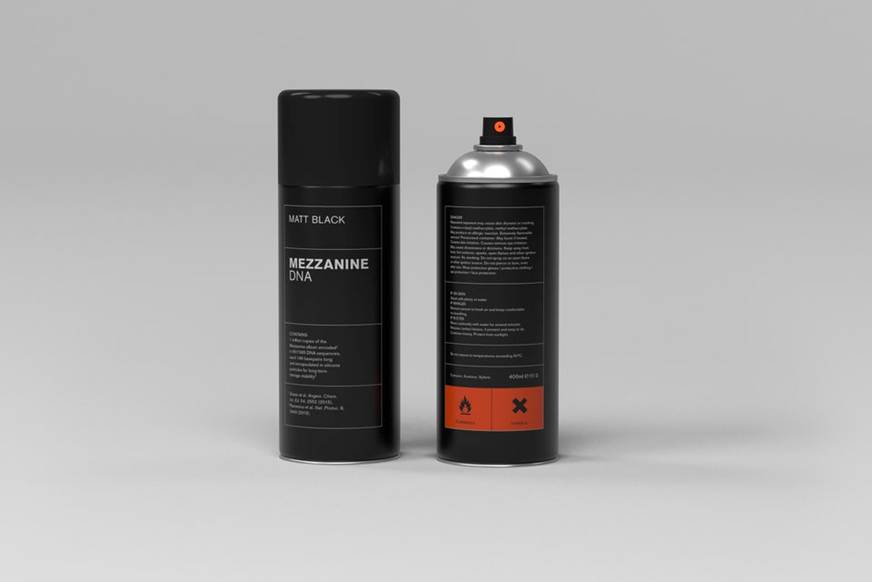
Massive Attack went even further and encoded Mezzanine into synthetic DNA with the help of TurboBeads laboratories in Switzerland, the audio information being stored in genetic form. 920,000 short DNA strands were used to hold this data, and the “liquid” was then transferred into 5,000 vials. From these vials came the spray cans mentioned above. Each can is said to contain approximately one million copies of the album.
Robert Del Naja’s idea was that you could spray this paint onto a wall, then peel it off, analyze it and eventually extract the album from it and listen to it. If this concept is not one of the most extraordinary I have encountered in music, then I honestly do not know what could take its place. Sometimes human imagination truly amazes me, in a good way.
Del Naja is deeply passionate about technology and believes that the future lies in genetic technology and its storage potential, the truth is that a single drop of synthetic DNA could store entire libraries. Personally, it makes me wonder what kind of “libraries” will be discovered within human DNA once it is fully understood and decoded, I am sure Del Naja thinks along similar lines.
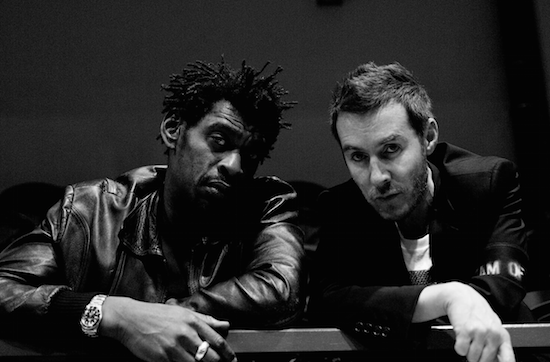
Returning to Massive Attack, please find below a photograph of the band in the present day, Tricky briefly rejoined the group in 2016, although he remains just as elusive in photographs, here we have Daddy G and 3D:
I will end this article with the hope that I have drawn your attention to one of the most unique albums of the 90s, an album best experienced in the dark, on a rainy March evening. Mezzanine feels like an album “received” by 3D from providence, only he truly knows what he went through while locking himself away and working on the tracks of this record. What is certain is that a part of those emotions can also be heard by us on this remarkable album, defined by its magical darkness and by a deep sub-bass driven by heavy drums.
Mezzanine has always told me that there is darkness within me, for a while this made me feel uncomfortable, as if the beetle on the cover was crawling on my skin, but now, many years after first hearing it, Mezzanine has made me completely at peace with that inner darkness. I can even say that it feels brighter because of this record and, in a rather amusing way, I now consider myself a good friend of the beetle on the cover.
Silviu TUDOR
An article written in my sweet spot,
and this is what I’ve heard.