Dear reader, the new version of the well-known Cambridge Audio EVO 150 has recently been released, this time in a special edition marked with the initials “SE”. The original EVO 150 was already highly regarded and well positioned in the High-End all-in-one category, yet it seems the British manufacturer has managed to refine it one step further, keeping the same proven concept while improving both the amplification stage and the software side. So, I invite you to follow me closely, today I will take a closer look at the EVO 150 SE and tell you how it compares to the previous version, while also trying to answer, through today’s Audiophile Hint, the question “is an all-in-one a real solution?”.
UNBOXING AND FIRST IMPRESSIONS
When you unbox the Cambridge Audio EVO 150 SE, you are greeted by a transparent print carefully placed over the unit, bearing the words “Made by Music” in large letters. The EVO 150 SE arrives in a double cardboard box, wrapped in a textile sleeve and accompanied by a power cable and, quite interestingly, a double set of interchangeable side panels:
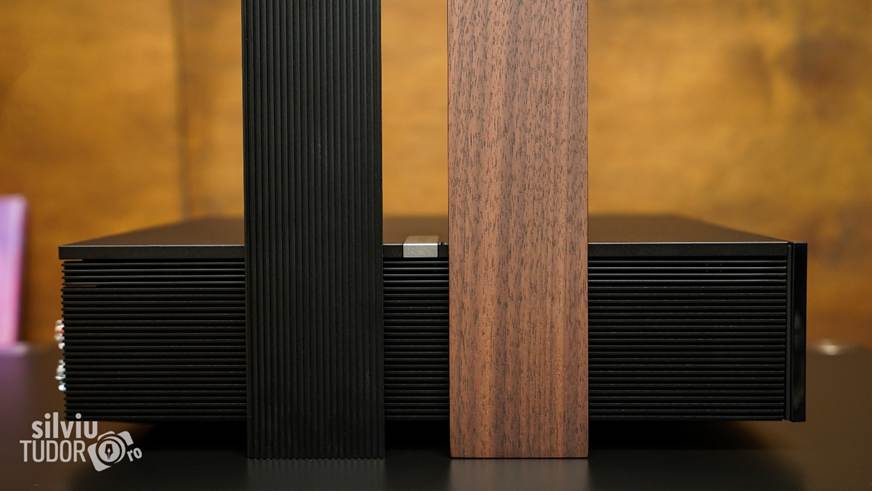
These can be swapped at any time, very easily, thanks to their magnetic attachment. This makes a big difference to the overall look of the unit, instantly transforming it either into a piece with a contemporary design, using the ribbed panels, or into something with a more vintage feel, with wooden side panels reminiscent of Hi-Fi gear from the 1970s. The wood-style panels were my favorite, bringing the EVO 150 SE closer to that warm aesthetic I personally prefer:
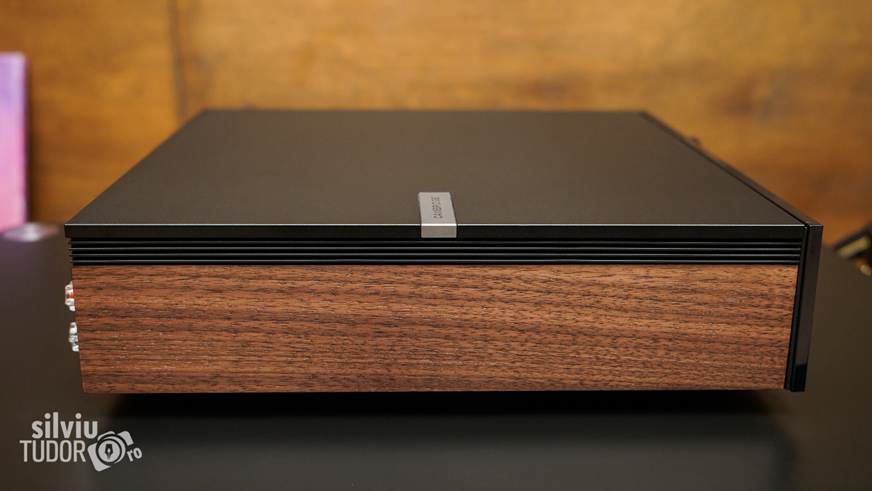
I’ll be honest, I haven’t come across this kind of feature on any other piece of gear, and I find it really interesting. The build quality and level of detail of the EVO 150 SE, and of Cambridge Audio products in general, feel flawless to me. We are living in a time where industrial design and manufacturing techniques have far surpassed what was possible in the past, giving us situations like this, who would have imagined 20 years ago that audio components could have interchangeable side panels? Cool!
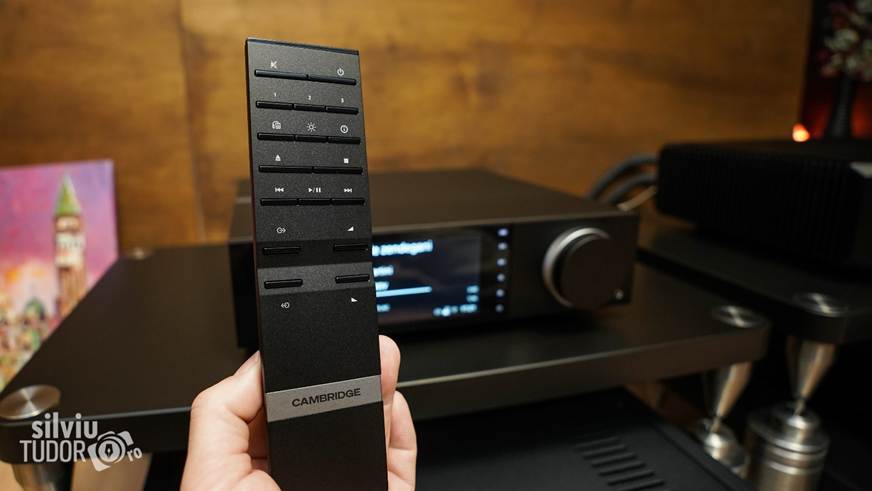
In the image above you can see the unit’s remote control, built from high-quality materials, just like the EVO 150 SE itself. It feels good in the hand, it does not come across as a cheap remote and, most importantly, it is not shared with other Cambridge Audio products but rather designed specifically for this series.
I cannot move on to the next section without praising the design of this unit and, more broadly, the design language of Cambridge Audio products. Recently, I was impressed by the build quality and the look of the EVO One soundbar, beautifully finished, with that walnut veneer on the top panel, and in the same way, the EVO 150 SE leaves a strong impression. Cambridge has managed to anchor it within a timeless design philosophy, a look that feels classic and enduring. Its simple yet refined exterior, combined with a highly complex interior, places the EVO 150 SE among the top tier of contemporary design. I truly believe this is the right way to develop products today, to successfully draw from the design language of the past, to take what was best from it and transform those elements into universal, timeless values that can be integrated into modern products without feeling outdated, on the contrary, giving the owner the confidence that such a classic design will remain relevant for many years to come.
TECHNICAL DETAILS
The EVO 150 SE is a chameleon, just like its predecessor. It is, in many ways, a hard-to-beat swiss army knife. It features “Tuned by Cambridge” amplification, built around Hypex NCOREx Class D modules, delivering 150 W per channel into 8 ohms, more than capable of driving a wide range of speakers without effort. Inside, we find a high-resolution ESS Sabre ES9018K2M DAC, compatible with modern audio formats, while on the streaming side it integrates the StreamMagic Gen 4 platform, offering direct access to services such as Spotify, Tidal, Qobuz, Amazon Music and internet radio. The app also provides a 7-band equalizer, along with room correction features.
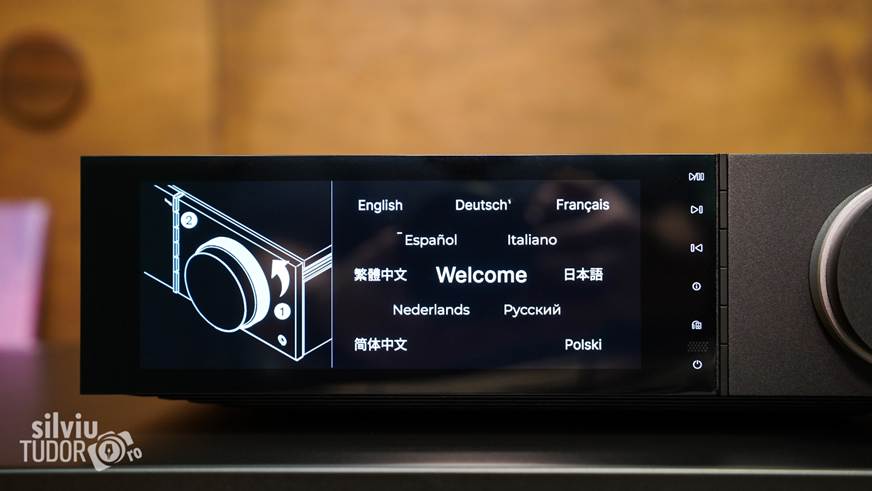
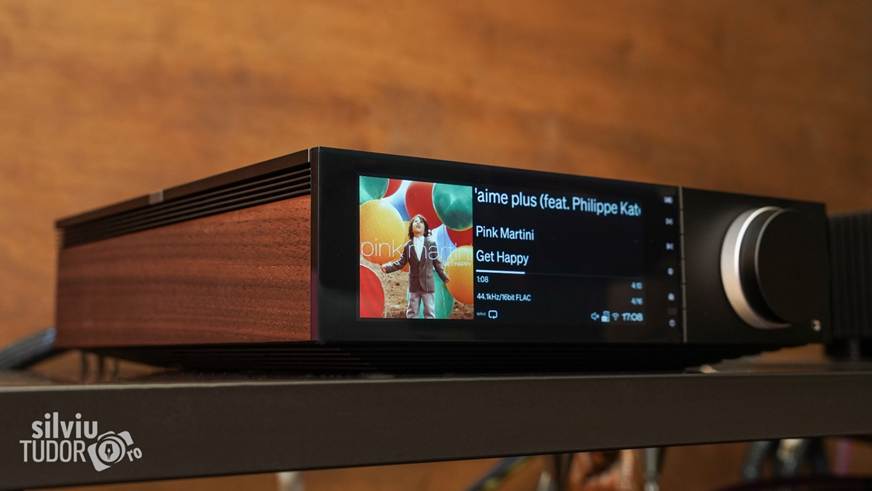
EVO 150 SE is equipped with a generous 6.8-inch color display, positioned on the left side of the front panel. The screen shows the album artwork, track information, title, artist and current source, but it can also display visual elements such as VU meters or a clock, offering both useful functionality and an additional visual layer with a retro-chic feel. The display is of very high quality, extremely bright and easy to read from a distance. Unfortunately, it does not feature touchscreen functionality.
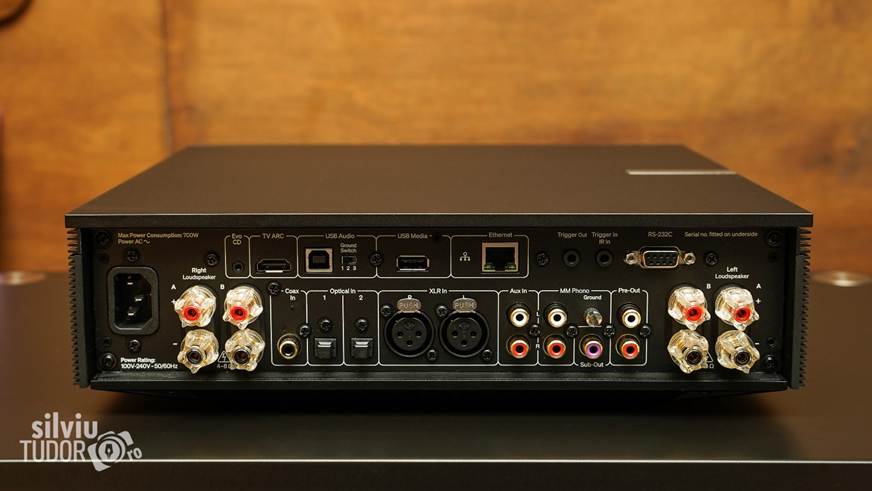
Connectivity is very rich and complete, with analog RCA and balanced XLR inputs, an MM phono stage for turntables, optical, coaxial and HDMI ARC digital inputs for modern sources, as well as a USB-B port. In addition, the EVO 150 SE supports Bluetooth aptX HD, AirPlay 2 and Google Cast, and is compatible with multi-room systems, such as Google Home and Roon, offering extended wireless flexibility. The unit also features Pre-Out outputs, including a dedicated subwoofer output. It is also worth noting the dual speaker terminals, which support either two pairs of speakers or a bi-wiring configuration.
HOW DOES EVO 150 SE COMPARE TO THE PREVIOUS EVO 150?
The Cambridge Audio EVO 150 SE is a refined evolution of the original EVO 150, a “Special Edition” upgrade reflected both in its hardware and in its sound. The main difference lies in the Hypex NCOREx “Tuned by Cambridge” amplification, a customized version of the NCOREx modules, delivering a warmer, more dynamic and more controlled presentation compared to the previous model, without changing the 150 W per channel output or the compact design. The EVO 150 SE retains all the elements that made the original EVO 150 such a complete streaming amplifier, the StreamMagic platform with access to modern services, extensive connectivity including Wi-Fi, AirPlay 2, Chromecast, Bluetooth aptX HD and Roon Ready, a wide range of analog and digital inputs, a high-resolution DAC and a phono stage, while bringing noticeable improvements in overall refinement. In many ways, this feels like an EVO 150 taken to the next level.
Comparing the two, I noticed a higher level of refinement in the amplification stage and a deeper, better-controlled bass, while the overall experience remains very close to that of the original version. Is it worth upgrading from the first to the second version? Without a doubt, yes, but only if you are looking for that extra layer of refinement.
WHAT MUSIC DID I LISTEN TO ON THE EVO 150 SE?
I don’t know why, but from the moment I took the EVO 150 SE out of the box, this album by Pink Martini immediately came to mind, one of my favorites when it comes to this wonderful American group. Get Happy is a colorful record, both in terms of its artwork and its sound, bringing together many musical styles and a wide range of accomplished musicians. It is a beautiful album that lays its colors perfectly onto the Cambridge Audio EVO 150 SE.

When you press play on this album, you are immediately drawn into a sense of well-being shaped by the sheer joy with which the band performs. You close your eyes and realize that the people playing are in a state of euphoria, that there is genuine pleasure in making music together. Pink Martini albums carry this unique feeling, a blend of live performance energy and the simple happiness of playing.
I noticed this joy especially on the final track, Smile, composed by the legendary Charlie Chaplin and performed here by the remarkable Phyllis Diller at the age of 95, who passed away just a few months after these recordings. Even so, old and unwell, Phyllis did not shy away from that sense of happiness, she sang with joy, the recordings taking place right in her living room. It becomes clear that this is the lesson we are meant to take from Get Happy. No matter what, we should allow ourselves to be more joyful, we have no excuse not to be.
It is also clear that the album is a celebration of that inner warmth within us, even if framed within a Bossa Nova aesthetic, it brings together classic love songs such as Ich dich liebe, Quizás, Quizás, Quizás, Je ne t’aime plus, and, as a true surprise, Până când nu te iubeam, a traditional Romanian song made famous by Maria Tănase. In their characteristic style, Pink Martini take this beautiful piece and make it their own, offering a reinterpretation of the highest level, one that truly does us Romanians proud.
HOW DOES CAMBRIDGE AUDIO EVO 150 SE SOUND?
Now that we have clarified what music I listened to on the EVO 150 SE, what specifications this chameleonic all-in-one brings to the table, and after praising its outstanding design, it is time to sit in silence and listen. The question “how does the EVO 150 SE sound?” slowly makes its way in and calls for an answer.
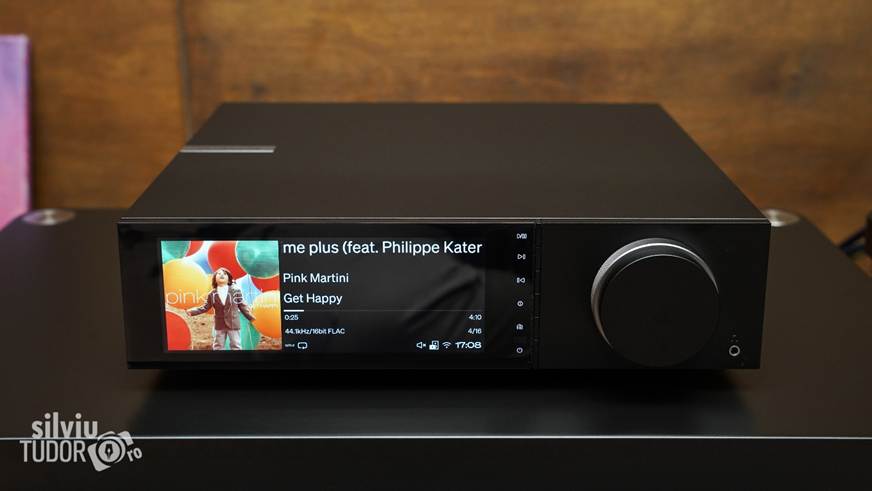
I tested the Cambridge Audio EVO 150 SE with several speakers, and I can tell you it will drive a wide range of speakers without any issues, only feeling limited when paired with truly demanding or hard-to-drive models, that is where I could sense its boundaries. Perfectly normal, of course.
I tested it with Bowers & Wilkins 606 S3, as well as with Dynaudio Special 40. With the 606 S3 it sounded analog and clean, forming a very good partnership, while with the Dynaudio it really had to work harder. The Special 40 are not easy to drive and, although it was not an ideal match with the EVO 150 SE, it still managed to keep them under control.
Returning to the 606 S3, I believe the EVO 150 SE makes a very strong pairing with them. In general, I would match it with slightly brighter speakers, B&W from the 600 and 700 series, Monitor Audio Bronze and Silver, Triangle, Focal, Audiovector, Audio Solutions and similar.
Its sound signature is analog in character, quite relaxed, non-aggressive, with a gentle attack and a deep yet controlled bass. It reminded me a lot of the signature of classic amplifiers, which means that the EVO 150 SE not only evokes the classic Hi-Fi design, but also carries a sound that points back to those times.
That said, the similarities with the 1970s stop here. The EVO 150 SE has no background noise, it runs on a smooth yet incredibly powerful engine, it sounds beautiful, and I truly believe it is remarkable for how compact it is and how much it delivers. Last but not least, I remain impressed by the potential of the Class D amplification stage, the Hypex NCOREx modules tuned by Cambridge Audio.
TESTING SCENARIOS
Below are a few conclusions I gathered during my time with the EVO 150 SE, perhaps they will help some of you find the ideal setup more quickly. So:
WIFI: it sounds very good over WiFi, noticeably better than many other devices, with no real sense of limitation.
ETHERNET: as soon as I switched to Ethernet, I noticed an increase in refinement across the board. However, things become more complicated here, as it depends heavily on your network equipment and the Ethernet cable you are using. One important note, if you are connected via WiFi and want to switch to Ethernet, you need to restart the EVO 150 SE, otherwise it will not switch properly. My conclusion is that Ethernet offers more refinement than WiFi but only use it if you have a well-sorted network infrastructure and a good-quality Ethernet cable, otherwise, stick with WiFi.
EQUALIZER: in the StreamMagic app you will find a simple but effective EQ. I tested it and did not feel that it degraded the sound, on the contrary, it proved helpful.
EXTERNAL STREAMER AND DAC: you might be wondering, if I connect an external DAC and streamer, will it improve things, how much do I gain? I tested it this way as well, although not in the most balanced scenario, more like putting a Mercedes engine into a Dacia. I paired the EVO 150 SE with a DAC and streamer that, combined, cost around six times more than the 150 itself. Naturally, it sounded better than using its internal DAC and streamer, but it is important to remember that the EVO 150 SE is an all-in-one unit, all its internal components, amplification, DAC, streamer, phono stage, are in the same performance class and designed to work together in a balanced way. The EVO 150 SE is an all-in-one and should be used as such.
THE “STREAMMAGIC” APP
From the unit’s screen and the remote control, you can only access part of the EVO 150 SE’s functionality, however, to unlock its full capabilities and music services, you will need the StreamMagic app, developed by Cambridge Audio specifically for their streamers and connected devices.
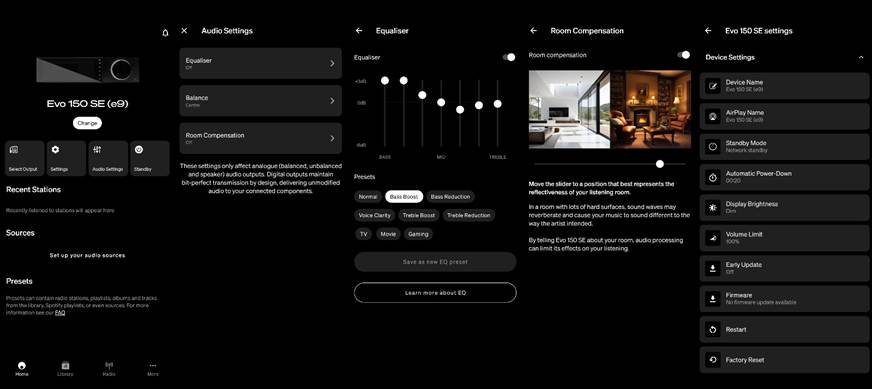
In the set of screenshots above you can see the Home page of the app, the sound settings section, including Equaliser, Balance and Room Compensation, as well as the general app settings.
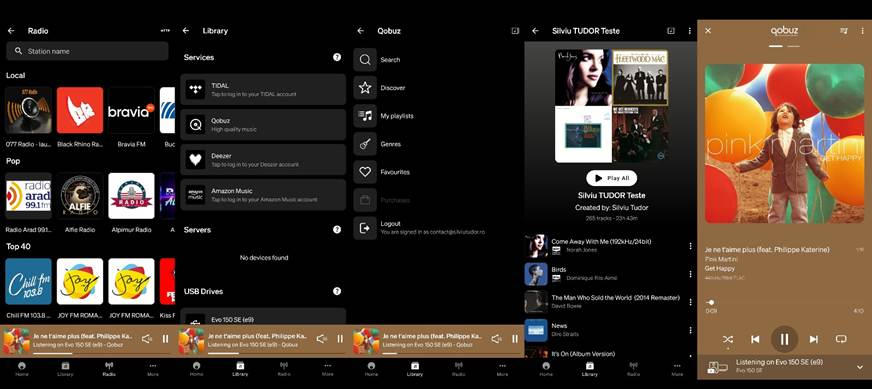
In the set of images above you can see the audio services available on the EVO 150 SE, a wide range of online radio stations, along with well-known streaming platforms such as Tidal, Qobuz, Deezer and Amazon Music. Further on, you can also see how Qobuz looks when accessed through the StreamMagic app.
AN AUDIOPHILE HINT – IS AN ALL-IN-ONE A SOLUTION?
Now that we have reached today’s Audiophile Hint, we can easily ask a fundamental question, is an all-in-one a real solution? It is true that a unit like the EVO 150 SE saves you a lot of trouble, replacing five essential components, a power amplifier, a preamplifier, a phono stage, a DAC and a streamer, saving you space, energy consumption and an entire maze of cables needed to connect all these components together. But is this single unit truly a solution? Is an all-in-one the answer?
It depends very much on who is asking. If the question comes from a music lover, or even a beginner audiophile, or from someone who builds their passion around music rather than equipment, then my answer is immediate, yes, an all-in-one is the perfect solution. This type of device brings you closer to music, significantly reduces variables, calms your mind and allows you to do what you love most, listen to music.
However, if the question comes from a dedicated audiophile, the kind of person who enjoys trying something new every week, a new cable, a new setup, constantly refining every detail, then an all-in-one might not be the right solution, because you will need separate components that give you the freedom to tweak and optimize the sound exactly the way you want.
TIPS & TRICKS
- If your setup allows it, go with Ethernet, under ideal conditions it sounds better than Wi-Fi.
- Choose slightly brighter speakers for the EVO 150 SE, this is how it pairs best.
- Forget about external DACs and streamers, the EVO 150 SE is an all-in-one and should be used as such.
- One important note, if you are connected via Wi-Fi and want to switch to Ethernet, you need to restart the EVO 150 SE, otherwise it will stick to Wi-Fi.
THE BRIGHT SIDE
- Absolutely stunning design, with a strong retro-chic presence.
- Those wooden side panels are beautiful. I love them.
- For what it offers in terms of sound and features, the price is genuinely very good.
THE DARK SIDE
- The display is not touch-enabled.
- I would have preferred a parametric EQ instead of the basic one.
- Directly from the unit, functionality is quite limited, you need the app to access all features and music services.
CONCLUSION
The British manufacturer Cambridge Audio has truly created something special with the EVO 150 SE, a unit that stands as a real design statement, likely one of the most visually appealing all-in-one systems available today. I really like how it looks, and I believe it integrates beautifully into a wide range of living spaces, from highly contemporary interiors to those with a more retro-chic feel. Those interchangeable side panels are worth every bit of it, giving EVO 150 SE that distinctive chameleon-like character.
In terms of features, the EVO 150 SE is equally impressive, offering an amplifier with a very analog-sounding character, along with a modern streamer and DAC that provide a complete set of capabilities, rich connectivity and a built-in phono stage for connecting an external turntable.
For this reason, I recommend the Cambridge Audio EVO 150 SE to those who put music first, who want to move away from multiple components and cables, as well as from the hassle of configuring and maintaining a complex audio system. EVO 150 SE solves all of these challenges and brings you very close to the pure enjoyment of music.
WHERE TO BUY: If you are making your purchase from Romania, please go directly to avstore.ro, if you are outside this area, please go to cambridgeaudio.com for purchase information.
Silviu TUDOR
An article written in my sweet spot,
and this is what I’ve heard.