Dear reader, this week I will feature a recently launched all-in-one from the Canadians at Simaudio, under their High-End brand, Moon. Moon 371 is therefore an entry-level all-in-one in the High-End segment, covering amplification, preamplification, phono stage, DAC and streaming functions. It is clear that a lot of functionality is packed into a single chassis and, without mercy, today I will analyze just how good it is and how it compares to its bigger siblings that it replaces, the well-known Moon 340i X and Moon ACE. Game on, Moon 371!
WHAT IS THE COMPASS COLLECTION AND WHO DOES MOON 371 ACTUALLY REPLACE?
Before continuing with my review, I will first tell you a few words about the new series called Compass Collection, whose first member is 371. The series was launched at the end of last year and, step by step, more new components are being introduced, set to replace the older models that will remain in production for a limited time. As core philosophy, the new Compass series keeps some of the positive elements of the older 300 series components, while bringing down into the entry-level High-End segment technologies from the fascinating North Collection, the flagship range of the Canadian manufacturer.
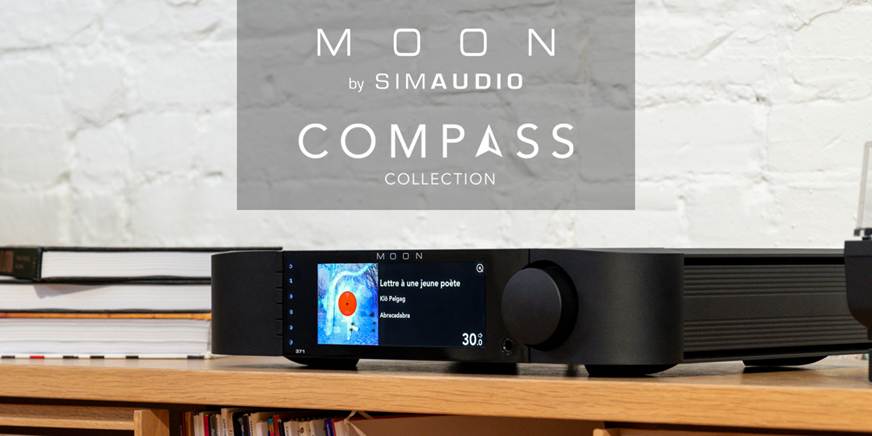
Given that I have written a comprehensive review of Moon 641, the integrated amplifier from the North series, I was able to easily notice similarities between the 371 and the 641, the philosophy and overall blueprint being somehow the same. The screen is similar to the one on the 641, perhaps even the same, the menu is quite similar, and the way you interact with the 371 feels closer to the North series than to the old 300 series. In practice, the 371 borrows elements both from the 641 and from the Moon 681 DAC-streamer.
Thus, Compass series gradually replaces all the components of the old 300 series: there will be no more ACE, no more 340, no more 390 and no more 330, all of them will be replaced by new members of this series. The truth is that the old 300 series needed an update, containing models with an impressively long lifespan. And, to answer the question “who does Moon 371 replace?”, I will tell you that it does not replace the 340, nor the 240, nor the ACE, but… all three. More about how 371 compares to the ACE, 240 and 340, I will share a few chapters later.
UNBOXING AND FIRST IMPRESSIONS
The packaging of Moon 371 is classic Moon, with a double-box setup, and the first thing you notice is the weight, the 371 being much lighter than its siblings, ACE, 240 and 340. This is mainly due to the absence of a traditional transformer, the unit being powered by a new supply called MOON Hybrid Power, a hybrid architecture developed in-house by Moon, combining switching and linear power. I will go into more detail about this in the “Technical Details” chapter.
Looking closely at the body of 371, I noticed a structure similar to the old 300 series. For example, as a former 240 user, I immediately recognized its side panels mounted on the 371, the same ones found on the 240/ACE and also on the 300D or 390. The top cover no longer resembles the one from the old 300 series, it features a new design and looks really nice. Visually, the 371 keeps the philosophy of the old 300 series, resembling the 340 and ACE in its overall design approach, while borrowing the generous display from Moon 641.
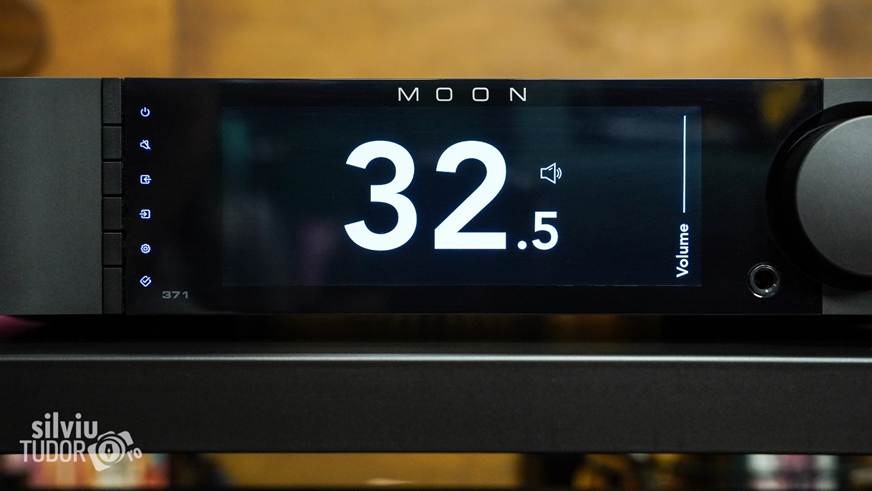
In the image above you can see this display, as well as the build details of the 371, which is much more modern compared to the older units, yet keeping the same design structure, which is really nice. The modern touch is also evident when you power up the 371, as the screen greets you with the message “The performance of a lifetime”.
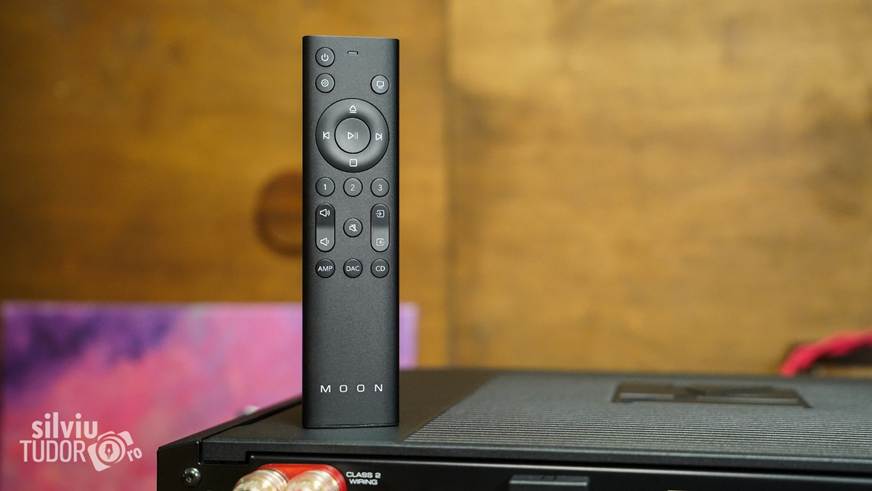
In the image above you can also see the remote control of 371, completely different from the one used in the old 300 series. I really liked this remote, it is more refined, more ergonomic than the previous one, a very welcome change. On top of that, it is made of metal instead of the plastic used before. Speaking of elements borrowed from the North series, Moon 371 is fully compatible with the already legendary BRM-1 remote from the North lineup, available as an optional accessory. In my opinion, the BRM-1 is one of the most beautiful remotes ever created. I will leave you below an image of it:
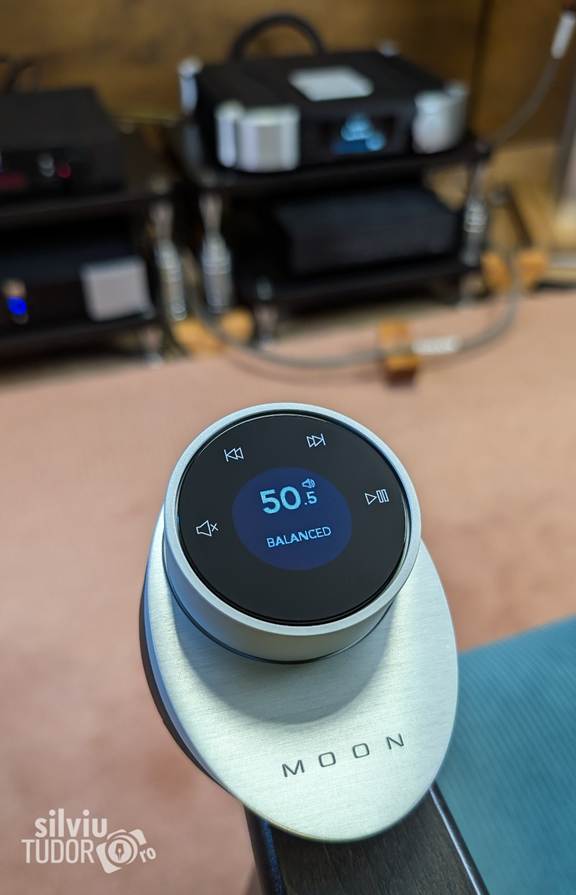
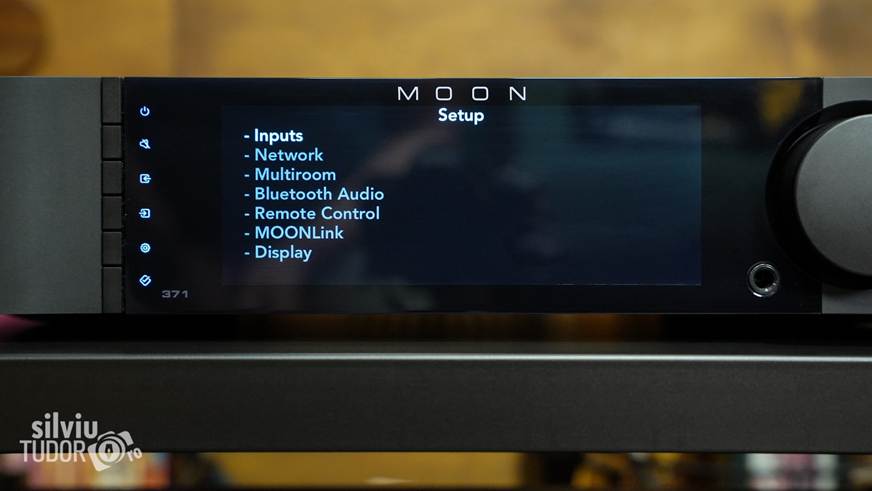
From here on, everything went smoothly, I connected the 371 to the network and to power and installed it in place of my preamp and power amp. In the image below you can see the settings section of the unit.
MOON MiND APP
The next step was, of course, to download and configure the MOON MiND app, Simaudio’s proprietary application when it comes to streaming or managing connected Moon devices. Given that I have used this app for a long time, it was easy for me to navigate its menus, however, for a newcomer, the app, even though it is 100% functional and completely stable, may require some extra time to get used to, as its ergonomics have room for improvement.
One specific feature of the MOON MiND app that I have always loved is the ability to create mixed local playlists with tracks located in multiple places, on the network, on USB, on Qobuz, on TIDAL, and so on. This is extremely useful, especially when you run a lot of tests like I do. Another beautifully implemented feature is the ability to use the app to control the volume of the unit.
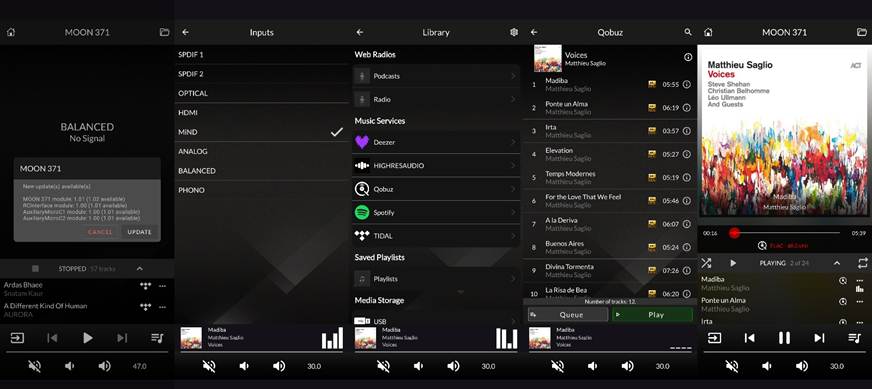
In the screenshot suite above you can see the update section of 371 in the first image, input selection in the second, the available streaming services in the third, and how an album looks inside the app in images four and five.
TECHNICAL DETAILS
The most impressive aspect of Moon 371 is the sheer number of functions it offers, this being truly remarkable. As mentioned earlier, at its core lies a proprietary power architecture called MHP (MOON Hybrid Power), a hybrid system that combines the advantages of a clean linear supply with the efficiency and stability of a switching one. This hybrid topology ensures extremely stable voltages across all internal sections, streaming, digital, analog and amplification, and is one of the reasons why the 371 delivers such impressive audio performance.
On the power side, the 371 uses MDCA (MOON Distortion-Cancelling Amplifier) technology, a proprietary amplification approach that does not rely on classic feedback to prevent distortion, but instead on a correction circuit that monitors both input and output signals and compensates deviations in a way that preserves purity and linearity. The 371 delivers 100W per channel into 8 Ohms and 200W per channel into 4 Ohms.
Also, the MiND 2 streaming module included in the 371 is the same as the one found in the higher models of the North series. I have used MiND 2 streaming modules for a long time, and I can honestly say they are among the best streamers out there; it is remarkable what Moon has achieved here. The module supports services such as TIDAL, Deezer, Qobuz and Spotify, both within the MOON MiND app and via “Connect” functionality directly from these apps. Compatible with Apple AirPlay and Bluetooth, the Moon 371 is also Roon Ready.
Moon 371 also offers a very good built-in phono stage, compatible with both MM and MC cartridges, worth noting that the older ACE, 240 and 340 only offered MM compatibility.
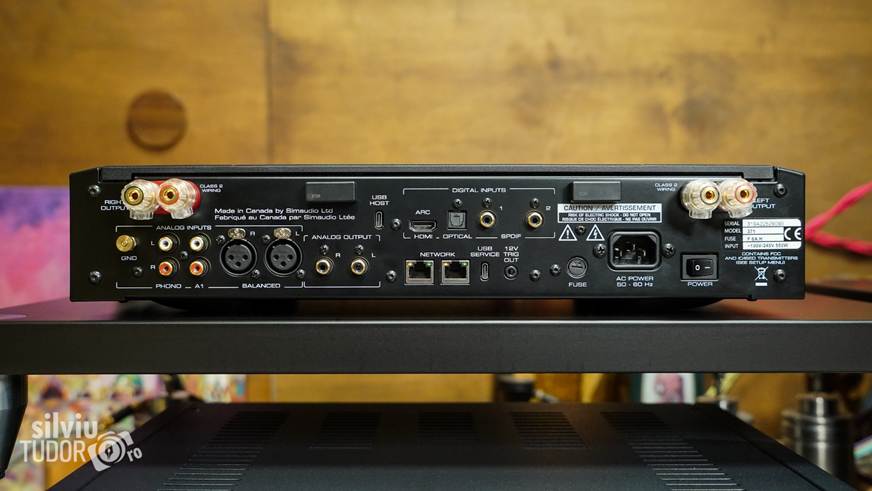
In the image above you can see the wide array of connections offered by Moon 371 – on the analog side we find a single-ended line input (RCA) and a balanced input (XLR), as well as a dedicated phono input, MM/MC compatible, with a configurable internal stage. The digital section includes inputs for external sources such as CD transport or other streamers, allowing the use of the unit’s internal DAC – here we have HDMI ARC, optical and two RCA SPDIF inputs. For system integration, the 371 features a preamplifier output (RCA), useful if you want to use an external power amplifier or as a dedicated subwoofer output. Speaker connection is handled via solid binding posts, compatible with banana plugs, spades or bare wire. The unit also includes network connectivity for streaming functions, control ports (trigger in/out, RS-232, IR) for integration into custom systems or automation setups, and a standard IEC power inlet.
Keep in mind that the unit does not use a standard-size fuse, but an uncommon one, based on the American 3AG standard, which is not easy to find on the aftermarket for replacement. In general, I do not recommend changing the stock fuses on Moon units, they are very careful with this aspect and even include spare fuses in the box.
An interesting detail is the presence of two RJ45 ports, the 371, similar to the components in the North series, includes a small built-in “switch” with two ports, the idea being that you can create a daisy chain of multiple devices without the need for an external switch. Interesting.
WHAT MUSIC DID I LISTEN TO ON MOON 371?
When it comes to the music I use to test a component, I run it through a good part of my test playlist, but I always look for one album to study it in depth. I usually listen to that album in full at least two or three times, this is how I best understand what a new piece of gear has to offer. This is how I ended up with this record, Voices, released by Matthieu Saglio in 2023. It suited 371 perfectly, as it brings a lot of color from many different musical genres, the blend of Voices was a perfect match for the chameleon-like Moon 371.
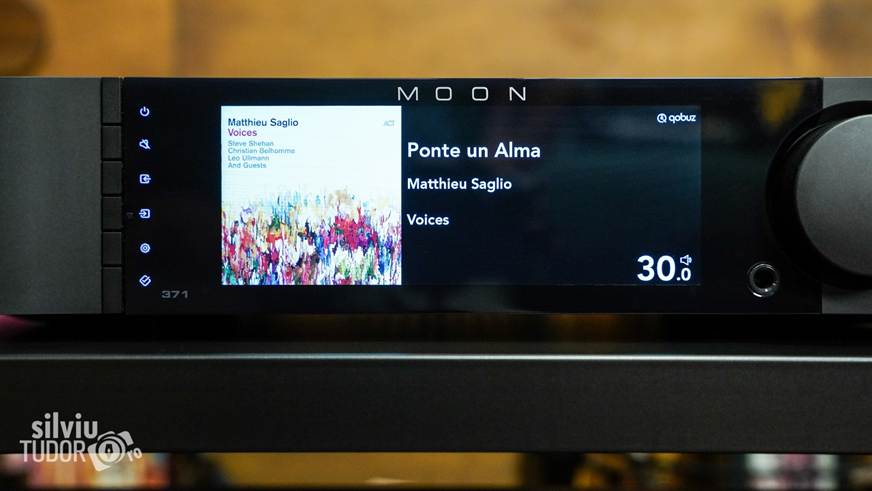
Once you press play on this record, you are immediately struck by the ease with which the music flows through the diversity of its tracks, with its many-faceted “voices” taking you on a journey far beyond the listening hour, from Egypt to Spain, from France to Azerbaijan and, why not, from Sweden to Senegal. On paper, this blend might lead you to expect something overly eclectic, but fortunately this is not reflected in reality, as soon as you start listening, you notice the diversity of the pieces, yet they are tied together by an interesting sense of unity, as if they were one. In the end, music is one, this is true, regardless of the geographical area it comes from or the musicians performing it.
The album opens strongly with the track “Madiba”, offering a kind of blend of all the tones we are about to hear, African, Arabic, Western and classical. Madiba tells the story of a perfect society where people coexist in harmony and have equal rights. These are values often found in the discourse of Nelson Mandela, whom we actually hear on the recording saying, “a democratic and free society in which all persons will live together in harmony and with equal opportunities”. Madiba is, in fact, an initiatory journey, it takes us from the gates of this album and carries us deep into its core, where the rest of the tracks unfold.
The second track is also my favorite on this album, a superb vocal jazz piece that feels instantly familiar, as if you had heard it somewhere before, perhaps on a remarkable jazz album by Diana Krall or Chantal Chamberland. But no, the piece belongs neither to Chantal nor to Diana, it is composed by Matthieu Saglio and performed by the Peruvian singer Susana Baca, a deep and rich voice, beautiful and vibrant, one that truly stays with you. The track is called “Ponte un al Alma” and it immediately made its way into my audio system test playlist. From the very first notes you will hear, on the left side of the stage, a large drum percussion that extends very low in frequency and is extremely difficult to reproduce with a conventional system.
HOW DOES MOON 371 SOUND? WHAT TESTS DID I RUN?
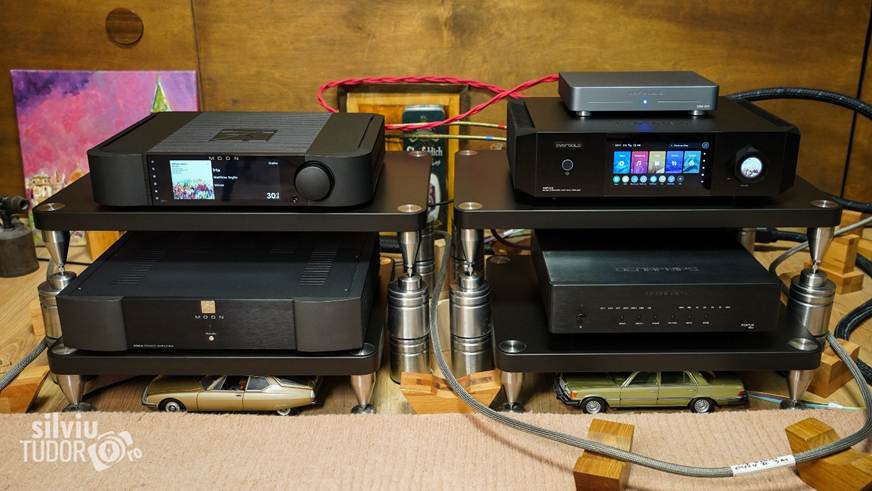
I introduced Moon 371 into my system, placing it next to the Eversolo DMP-A10 streamer, as you can see below. In the first phase, I tested the 371 as a complete all-in-one solution, then I connected it to an external DAC and streamer to observe how much the sound scales under these conditions.
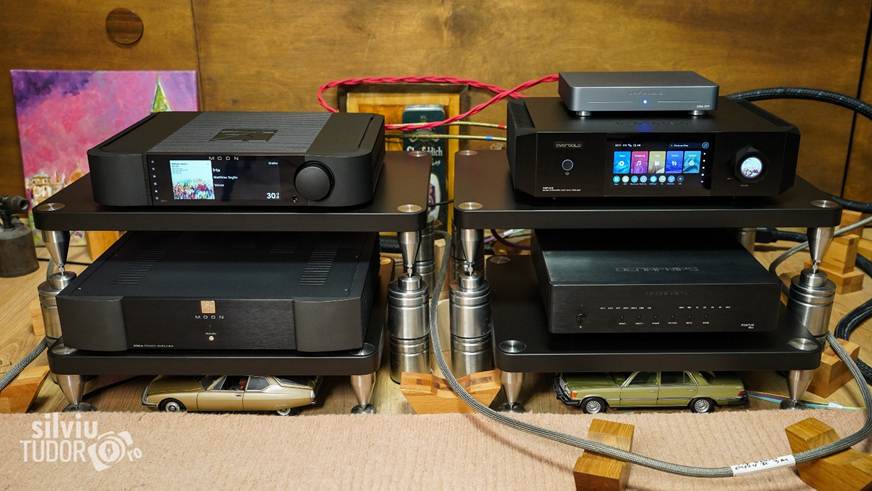
During the testing period, I noticed that the matching direction I knew so well from previously tested Moon components remains valid with the 371 as well, just like its bigger siblings, it prefers the same types of cables and the same approaches in terms of decoupling, placement and so on. In general, the 371 favors neutral or even slightly darker cables, the unit being extremely resolving and powerful.
From the very first listening session, I immediately recognized the typical Moon sound, preserved intact in the core of the 371, a large, expansive presentation, a very wide three-dimensional soundstage, typical of Moon, a distinct refinement built on plenty of air, precise placement of elements within the stage, and a tight, extremely well-controlled bass.
If the Moon 340i X had a slightly colored midrange, I would say the 371 no longer carries that trait, its sound leans more towards the philosophy of the North Collection, while still keeping some of the “fun” elements from the 300 series, but borrowing more refinement from the North range. I also noticed an interesting sense of authority at low volume levels, something the older components from the 300 and 200 series did not have.
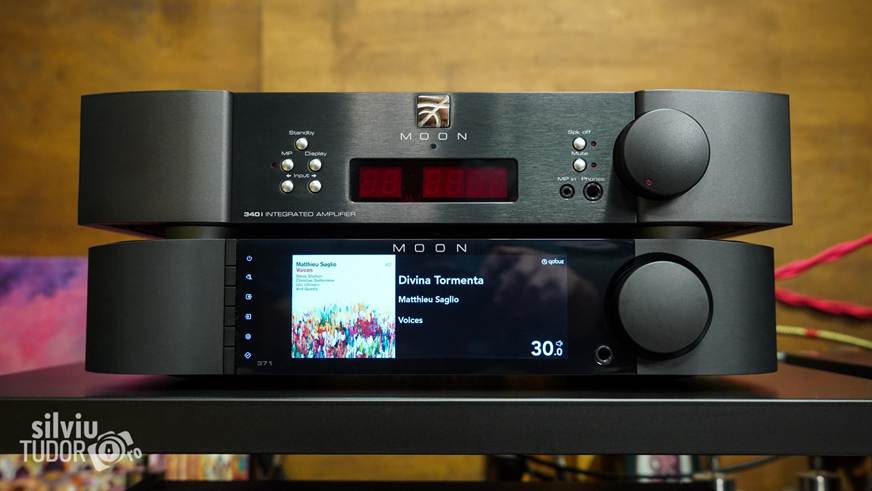
Also, if we compare it to the 240/ACE, those too had a slightly colored sound compared to Moon’s flagship series. The 240 and ACE did not have the authority of the 340, but they had an interesting kind of magic, different from the North series. In a way, we could say that the 371 keeps some of that character as well, although I would place it closer to the 340 than to the 240 and ACE.
In terms of power, 371 is a beast, the 340 was powerful as well, but the 371 surpasses it. I can tell you this because I fed it some very difficult speakers to drive, a pair of DIY speakers with very low sensitivity, and the 371 handled them effortlessly, something the 340 could not quite manage. I also paired it with a set of Bowers & Wilkins 606 S3 speakers, and it was really nice, a beautiful match.
Overall, listening to 371 as a complete unit, with its own DAC and streamer, was a truly enjoyable experience, the synergy between all its internal components being exemplary. A huge difference came from the network solution, I tested the 371 over both Wi-Fi and cable, and I can tell you that, just like previous models such as the MiND 2-based units and the Moon ACE, 371 offers a fantastic Wi-Fi connection. For less demanding users, it can be more than sufficient, as long as you have a dedicated access point or a well-configured Wi-Fi router.
However, once I moved 371 to Ethernet and fed it a proper cable, an audiophile switch and a dedicated connection, the sound scaled noticeably. This is the type of network setup I recommend if you really want to get the most out of the 371.
Another test I wanted to run was with an external DAC and streamer; I was curious to see how much it would scale compared to its internal ones. It is obvious that, when feeding it with a dedicated external DAC and a streamer that costs as much as the 371 itself, the sound improved immediately, but not as much as I would have expected, I would estimate a gain of around 30%. Spending more time with the 371, finding better matching solutions and refining the setup, that 30% will likely decrease, settling closer to a real difference of around 15%.
Under these conditions, I believe the 371 is perfect as it is and there is no need to complicate things with external DACs and streamers, it should be used as intended, as an all-in-one, this is its greatest strength.
AN AUDIOPHILE HINT – CHANGING FUSES IN AUDIO EQUIPMENT
Since today I mentioned the uncommon fuse used in Moon 371, I decided that in today’s audiophile tip I should talk about the practice of changing fuses in audio equipment, something often encountered in audiophile circles. Let’s see how important such a change really is and when it should be done.
A common misconception, a mistake I often see in the community, is that fuses are replaced right from the start, without actually listening to and analyzing the change, something that is extremely, extremely wrong.
You see, dear reader, a replaced fuse can indeed make a difference, however, statements such as “it sounds better just by changing the fuse”, “install X fuse and it will be 100 times better”, or “the stock fuse is worthless” are, most of the time, incorrect. A fuse is like a cable, like an accessory, it changes the sound primarily because of system matching and, secondly, because of its quality.

Most of the time, major manufacturers, such as Simaudio in this case, are very careful about the fuse aspect and include fuses in their products that will not handicap the unit, which is why you need to be extremely cautious when changing them. There are even manufacturers, such as Denafrips, that do not include user-accessible fuses in their components, thus eliminating a potential point of intervention. That said, there are also manufacturers, especially in the entry-level or Hi-Fi segment, that use lower-quality fuses which can clearly have a “choking” effect. In those cases, an aftermarket fuse can indeed make a significant difference.
So, if you decide to upgrade the fuse in your component, I recommend following these rules:
- Use a fuse with the same voltage and amperage ratings as the one you are replacing.
- Check whether the original fuse is Slow Blow or Fast Blow and make sure the new one matches this specification.
- When removing the original fuse, store it safely, do not throw it away.
- When removing the original fuse, mark its orientation with a marker (you will possibly need this information later).
- After installing the new fuse, listen carefully, observe how the sound has changed and evaluate whether it is truly an improvement, do not rush to conclusions.
What types of fuses are there? In general, in modern audio equipment we find two types: the most common is the “small” 5×20 mm fuse, found in most devices, and the American type, called 3AG, measuring 6.3×32 mm, as used in Moon components, for example.
Which fuses should you buy? HiFi-Tuning and Synergistic Research are among the most well-known manufacturers of audiophile fuses for audio equipment, in general, you cannot really go wrong with either of them. However, their lineups include many models and, just like with cables, you cannot simply pick one blindly, they need to be chosen based on system matching, through listening, testing and experience.
Perhaps the most important advice I can give you regarding fuses is not to rush into replacing stock ones, more often than not, they are the most balanced solution.
TIPS & TRICKS
- Like all Moon components, the 371 comes equipped with very good feet, I would not recommend adding aftermarket feet from the start, keep that as a final tuning step.
- Wi-Fi sounds good out of the box, if you want perfection, go with Ethernet, but be prepared to invest in a proper switch and high-quality network infrastructure, otherwise stick with Wi-Fi.
- Choose neutral or darker cables.
- Use the MOON app for playback, this is where it sounds best, “Connect” protocols also sound good, but the native app performs better in terms of sound.
THE BRIGHT SIDE
- It is a chameleon, works well with many speakers.
- Considerable power for an all-in-one.
- Rich connectivity, nothing feels missing.
- Plenty of features, I did not feel the lack of anything.
- The MiND 2 streaming module included in the 371 is one of the best.
THE DARK SIDE
- I would have liked the display to offer more advanced features.
- The app, even though fully functional, feels slightly dated, a refresh would be welcome.
- The DAC inside the 371 is not bad, but I would have liked around 20% more refinement.
CONCLUSION
The conclusion around Moon 371 is very easy to draw and, for that, I look especially at the past, at the previous models it replaces, the 240i, ACE and Moon 340i X. If we were to take all three and merge them into a single unit, then compare this Frankenstein with the 371, well, the 371 would resemble it closely. Even with its powers combined, this Frankenstein unit will still not beat the new 371.
The 371 comes with a fresh breath of air, it is more powerful, more refined, simply better. It has not forgotten its heritage, it kept what was best, but it also evolved. At the same time, the 371 offers a multitude of functions, preamp, amplification, phono stage, DAC, streamer, everything you could want, all at a very high level, while preserving the unmistakable Moon sound. On top of that, Moon still offers a 10-year warranty, something that is very hard to match in the High-End market.
So, a flawless all-in-one, one that takes you seriously into High-End territory, looks fantastic and will likely stay with you for a lifetime, just as the 240, ACE and 340 units still in existence probably will. Does Moon 371 pose any danger to you? Just one. The direction on its compass, the Compass Collection points North, towards the North Collection. I will leave you with this thought.
WHERE TO BUY: If you are making your purchase from Romania, please go directly to avstore.ro, if you are outside this area, please go to simaudio.com for purchase information.
Silviu TUDOR
An article written in my sweet spot,
and this is what I’ve heard.