Dear reader, today I bring you a review of a freshly launched DAC from the Norwegian High-End audio brand, Hegel Systems. The device in question is called the Hegel D50, released earlier this February. It is also nicknamed “The Raven,” with Hegel explaining that at first glance the unit may seem discreet and black, much like a raven, yet it should not be underestimated, as beneath this neutral appearance lies a device that encapsulates years of research invested by Hegel in the development of their DACs.
Hegel also reminds us that in Norse mythology, ravens played a very important role, with Hugin and Munin constantly informing Odin about the secrets of the world. Overwhelmed by this context, I found myself genuinely curious about what this new DAC from the Scandinavian manufacturer might deliver. So let the testing begin—stay close, as I will share all my conclusions with you.
HEGEL – COMPANY PROFILE
Before revealing what Hegel H50 has to offer, I would like to say a few words about this fascinating company that has been building audio equipment since 1988. The company’s founder, Bent Holter, then a student at the Technical University of Trondheim, decided to write his thesis on the transistors used in amplifiers.
The thesis proved to be truly remarkable, as it addressed many of the problems amplifiers were facing in 1988, the main issue being distortion. It proposed theoretical solutions that later became real-world technologies, now embedded in the design of Hegel amplifiers. For example, one of the thesis topics revolved around Bent’s desire to move away from conventional amplifier topologies, developing a new architecture that would later be patented under the name “SoundEngine Technology.” Below is a photo of Bent:

It is quite amusing where the company’s name, Hegel, actually comes from—though it should not be confused with the German philosopher Georg Wilhelm Friedrich Hegel. You see, dear reader, during his university years, Bent Holter was active in a band called… “The Hegel Band.” In need of amplifiers for their concerts, that became Bent’s moment to shine, as he offered to build them himself. From there, Hegel Audio Systems borrowed its name, somehow merging the need for amplification with the act of performance, music distilling all of this into a compelling new brand.
Thus, the ideas outlined in his thesis were given the chance to be brought into reality. The first steps included patenting the SoundEngine technology in the early ’90s, launching their first DAC in 1994 and their first CD player in 1996. Alongside SoundEngine, Hegel went on to introduce six additional proprietary technologies over the years. This is how the Hegel brand was born, becoming an important player on the global High-End market.
Today, Hegel offers several integrated amplifiers: H95, H120, H150, H190v, H400 and H600; preamplifiers: P20 and P30A; power amplifiers: H30A, C53, C54 and C55; a CD player: Viking; a phono preamplifier: V10; and, of course, a DAC: D50.
UNBOXING AND FIRST IMPRESSIONS
Unboxing the D50 you also discover a separate accessory box containing the remote control, a stock power cable, and the user manual. I was particularly impressed by the personal message at the beginning of the manual—you are welcomed by a few words written by Bent Holter himself, along with his photograph.
The Hegel D50 arrives in a cardboard box, carefully packed in foam and wrapped in a soft textile sleeve. The moment I took it out, I was struck by the minimalist design so characteristic of the Norwegian brand. The texture of Hegel components is unique; I have not encountered anything quite like it elsewhere. When you zoom in, you notice a very particular shade of black—continuing the earlier comparison, I would even call it “raven black.” The surface also features a subtle micro-porosity; it is not perfectly flat but carries a distinctive character I have only seen on Hegel equipment.
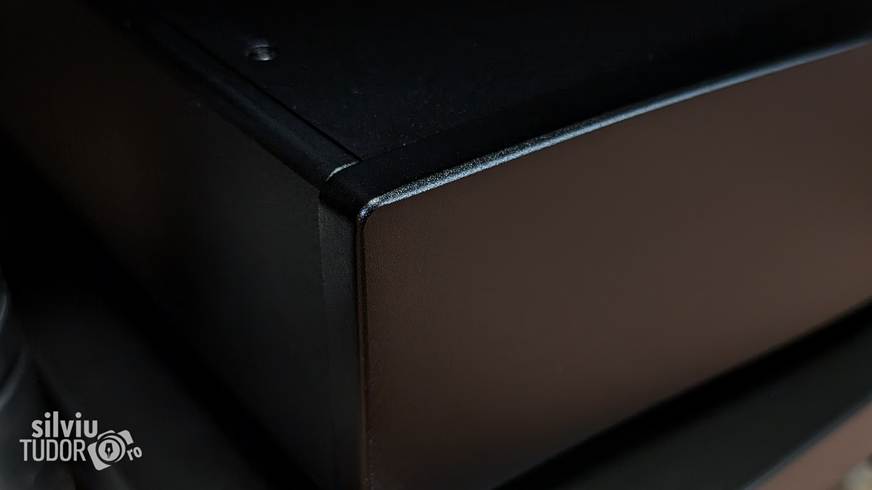
The presence of the unit is distinctly Scandinavian, defined by pure minimalism—flat surfaces, a clean and understated design, gently rounded edges, and a simple, no-nonsense display:
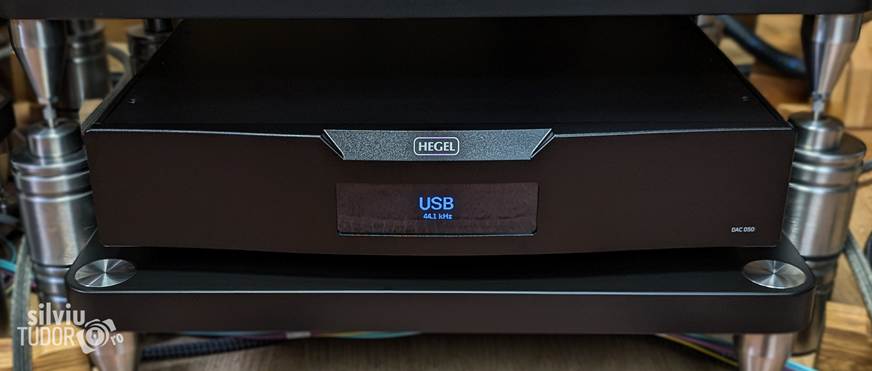
If we take a look at Hegel’s current lineup, it is interesting to observe that all of their components share a minimalist design, with completely straight front panels. Only a few of their products feature this specific design language similar to the D50—a subtly curved front panel with the logo placed centrally on a discreet bevel. Considering how minimalist Hegel’s design philosophy is, these small “departures” already feel like a bold statement.
This particular design can be found only on the DAC D50, the Viking CD player, the H30A power amplifier, and the P30A preamplifier. It almost feels as if Hegel has “marked” these models, subtly inviting us to place them together as a matching set. It is also worth noting that Hegel is one of the very few High-End audio brands that offers its components in white as well—a color very much in vogue these days.
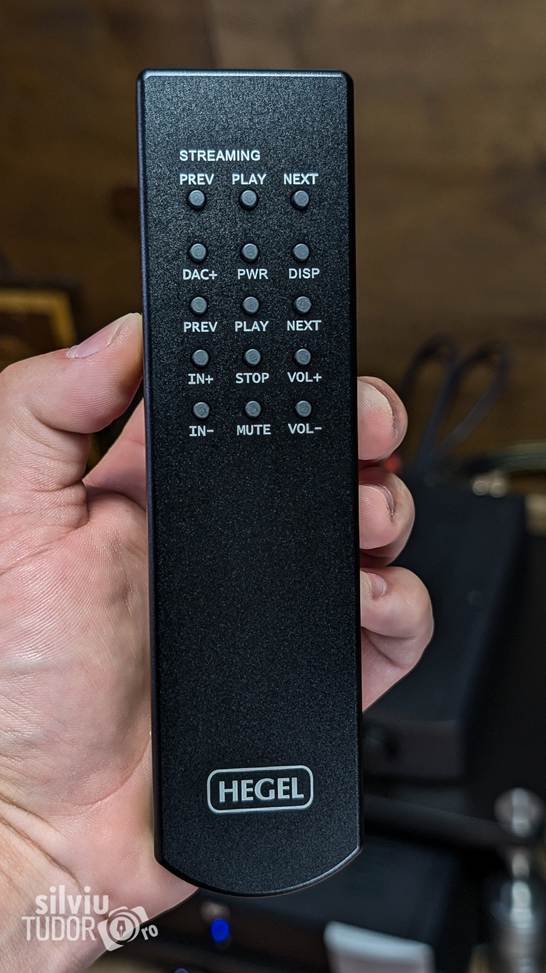
Above, you can see an image of the remote control supplied with the unit, finished in the same raven black and featuring the same intriguing micro-textured surface.
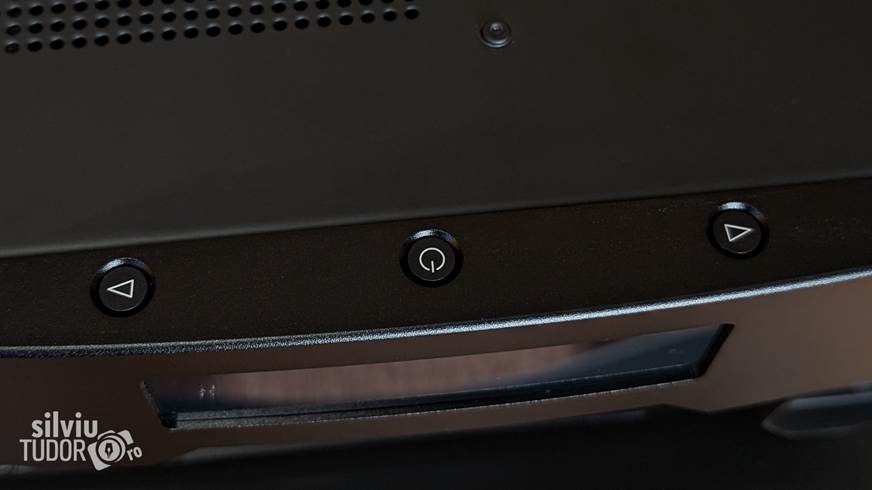
Another distinctive aspect within the Hegel universe is the way they position the power and menu buttons. As we can see on the D50, there are no buttons at all on the front panel. In true Hegel fashion, these controls are “hidden” beneath the front edge of the unit:
TECHNICAL DETAILS
First of all, it must be said that Hegel D50 is built around the ESS Sabre ES9039Q2M chip—one of the newest additions to the ESS family. This chip employs the HyperStream IV DAC architecture, which significantly improves dynamics while reducing jitter. The ES9039Q2M supports PCM up to 768 kHz / 32-bit and native DSD up to DSD512. Its distortion levels are extremely low, with a typical THD+N of -120 dB and a dynamic range of up to +130 dB.
The ESS chip is mounted on a separate board to reduce noise and interference, with extremely short signal paths. For power supply, the D50 uses a dual architecture with two independent toroidal transformers, each with its own filtering and voltage regulation, significantly lowering electrical interference. Digital synchronization is handled by three dedicated master clocks (for SPDIF inputs, USB 44.1 kHz and USB 48 kHz), minimizing jitter to the lowest possible level.
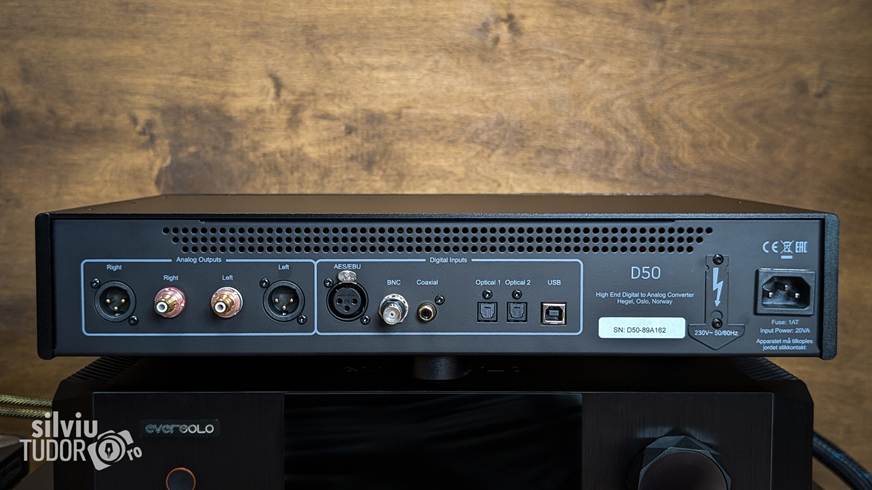
In the image above, you can see the rear panel of the Hegel D50, which features balanced XLR analog outputs as well as single-ended RCA. The digital inputs are plentiful: AES/EBU, BNC, Coax, 2x Optical, and USB. The maximum supported resolution depends on the interface as follows: Coax/BNC: 24/192 + DSD64 (DoP), AES/EBU: 24/192 + DSD64 (DoP), Optical: 24/96, and USB: 32/384 + DSD256 (DoP).
It is also worth highlighting the DAC-Loop function within the Hegel ecosystem, which allows a Hegel integrated amplifier to bypass its internal DAC and instead use an external one. This feature enables the amplifier to retain in use its streaming module while significantly improving performance by routing the digital signal through an external DAC. Clever and genuinely interesting! I wish more brands would offer such functionality.
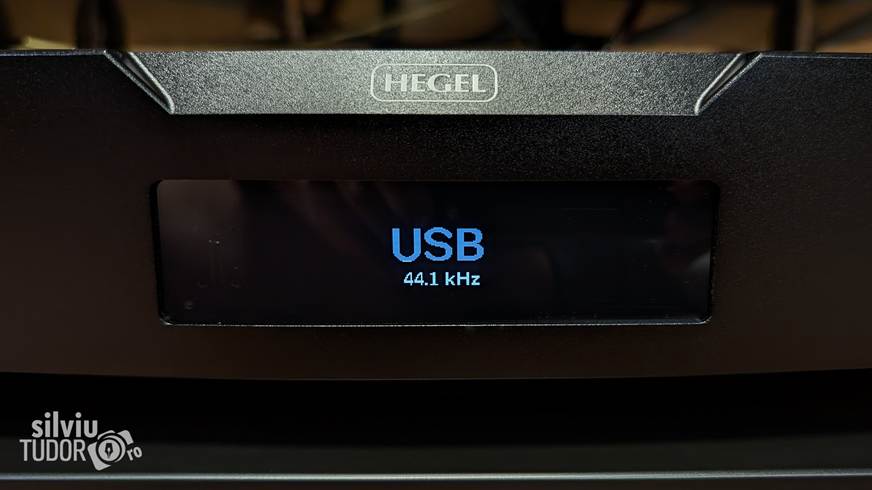
In the image above, you can see the unit’s display, which provides simple information about the selected source and the sampling rate. The menu offers details about the firmware version currently running on the device, allows you to set the standby time interval, and adjust the display brightness. It is also interesting to note that Hegel D50 does not offer selectable digital filters, unlike many other DACs.
WHAT MUSIC DID I LISTEN TO ON THE HEGEL D50?
Digging through my stash of great records, I was reminded of this wonderful album, After Hours, which feels like a perfect match for the Hegel D50. The record is somewhat atypical in George Duke’s discography, having been released late in the keyboardist’s career, in 1998.
The album enjoyed considerable success upon release, reaching top positions on the Billboard Top Jazz Albums and Billboard Top Contemporary Jazz Albums charts. You can sense that it is a work of maturity—there is no need to prove anything. Instead, the record captures a special joy of playing, along with the serene confidence of a seasoned George Duke.
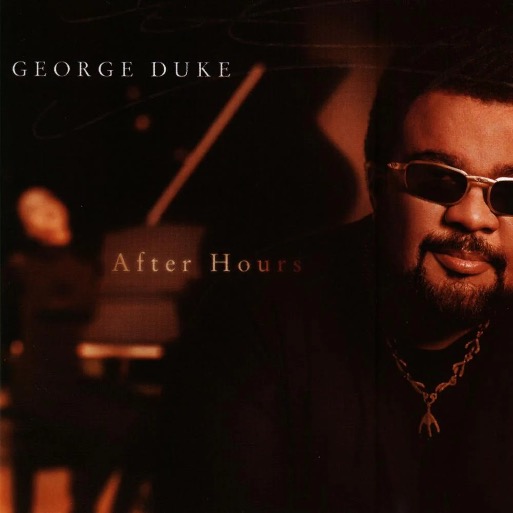
When you press play on After Hours, you are immediately greeted by a crystalline sound that comes alive from the very first moment. The bass is extraordinarily deep, yet tight and controlled at the same time; the drums are punchy and modern; and, of course, George Duke’s keyboards are irresistibly playful.
The album draws you in instantly and will pose a serious challenge to your audio system. It is one of those records that makes you want to upgrade your setup. You will sense the immense sonic potential embedded in this recording and realize—even if you have never heard it on another system—that there is always more to uncover: the kick drum could hit even harder, the bass could dig even deeper.
The synergy between After Hours and the Hegel D50 proved extremely interesting, both moving in the same direction and complementing each other almost to perfection. The D50 is more than capable of conveying the speed of the music on this album while keeping the magnificent bass delivered by Christian McBride firmly under control.
HOW DOES HEGEL D50 SOUND?
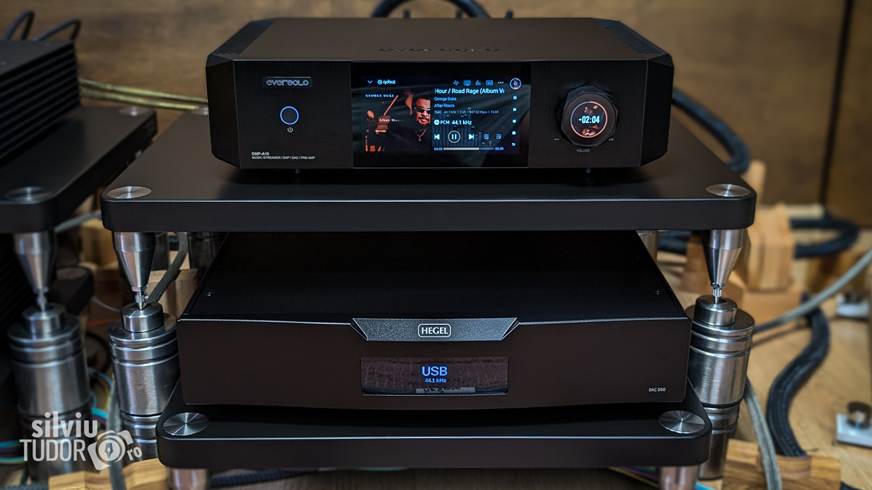
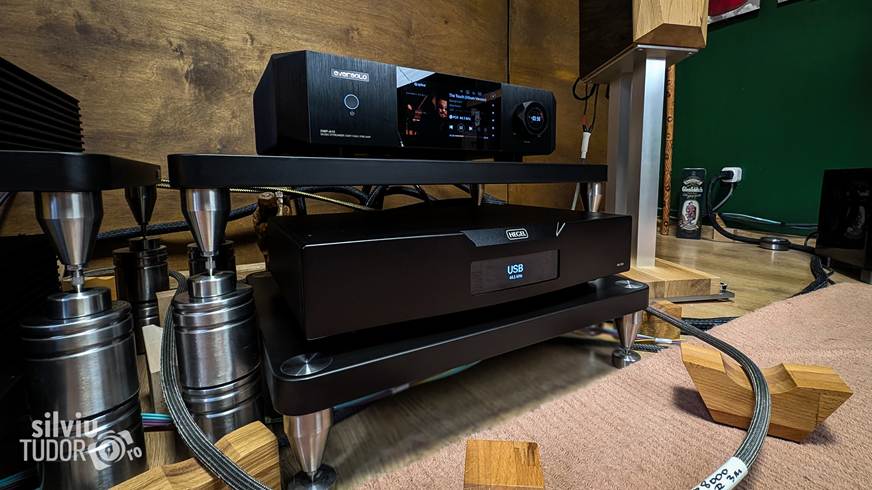
I tried the Hegel D50 with several streamers, but I liked it most with the Eversolo DMP-A10 used strictly as a streamer (connected to the D50 via USB). Overall, this proved to be the winning solution. I tested all of the D50’s inputs with the help of various streamers and CD transports and reached the conclusion that the USB input delivers the best overall results, also offering the highest resolution available on the unit.
The AES/EBU input is also very well implemented—it sounded delicious, slightly more analog in character compared to USB. Below is an image of the D50 together with the DMP-A10:
The sound of the D50 is somewhat unexpected—let me explain. I will be honest with you: I tend to have reservations when I see an ESS DAC chip inside a unit I am about to review. ESS chips are extremely widespread, found in thousands of devices, and sometimes we audiophiles may wonder whether an ESS chip—even the newest and most impressive one in the lineup—is truly enough for the High-End universe. Audiophiles are full of preconceptions, and that is exactly how I began my journey with the Hegel D50 and its ESS chip.
Yet my surprise was considerable once I installed it in my system and played the first tracks. The defining trait of this DAC is its sonic character, very much aligned with the Hegel house sound—authoritative, full of cojones, and driven by a lively bass foundation.
This DAC quite literally shook the dust off my speakers, bringing a fascinating vitality to the low end, a crispy, highly resolving and exciting presentation, all supported by a powerful sense of “live” energy. I was equally impressed by how it handles vocals, but also by bass-driven music. I listened to many records in that direction: Christian McBride – Conversations with Christian, Marcus Miller – Free, Nathan East – Reverence and, of course, George Duke – After Hours, which I mentioned earlier.
So once again, my preconceptions were dismantled by a simple listening test. In this case, the ESS implementation works brilliantly, delivering an extraordinary level of refinement. It seems that the well-known phrase “it’s not so much the chip that matters, but how it is implemented” proves absolutely true here.
THE AUDIOPHILE HINT – CABLE RESEATING
With such a High-End DAC under the microscope, I felt that the audiophile tip in this review should be just as High-End. Seemingly esoteric, cable reseating—or simply unplugging and reconnecting your cables—is a practice often encountered among more advanced audiophiles. The procedure involves disconnecting and reconnecting all cables (signal, speaker, and power) once every few months. Personally, I do this every six months. Before reconnecting, you may also treat the connectors with a dedicated contact cleaner such as DeoxIT or isopropyl alcohol.
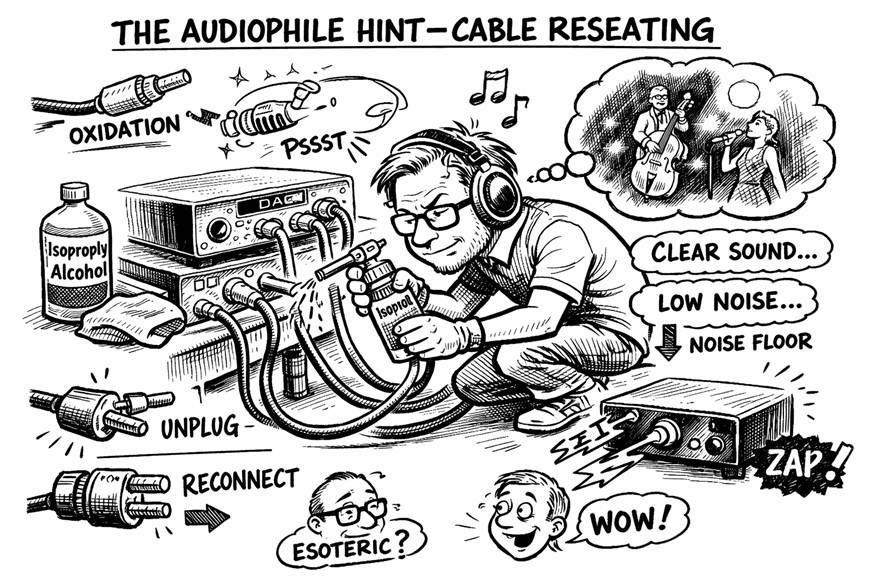
What do you hear after a cable reseating session? You hear improvement—that’s what you hear. The sound becomes clearer, the noise floor drops, and the presentation feels more open and holographic. You might easily laugh and ask: how is that even possible? There are, however, technical explanations.
Contacts oxidize over time, and disconnecting/reconnecting them helps prevent this. Micro-movements, vibrations, as well as temperature fluctuations in the room can slightly alter connector positioning, gradually leading to imperfect contact. Electrostatic charges may also build up, particularly affecting DACs.
For a beginner, this might sound like an esoteric tweak, but I first heard about it in serious audiophile circles—and when I tried it myself for the first time, I was genuinely amazed by the effect. So please, do not overlook it. Keep an open mind.
TIPS & TRICKS
- Use the USB interface whenever possible; it offers the highest resolution.
- If USB is not available on your source, opt for AES/EBU—it is superior to Coax and Optical.
- If your amplifier allows it, try the balanced connection; its implementation is superior to RCA.
THE BRIGHT SIDE
- High-resolution sound, highly refined, authoritative, with lively bass.
- DAC-Loop function.
- Superb minimalist design.
THE DARK SIDE
- I would not recommend it to those seeking an expansive, highly holographic presentation—this type of sound signature is not typically associated with Hegel.
CONCLUSION
The Hegel D50 is a highly refined DAC with a sense of authority that feels uniquely Hegel. I was particularly impressed by its bass performance—it is truly outstanding: lively, punchy, and beautifully rounded. I will fondly remember the weeks spent with the D50 and my favorite contemporary jazz records, all revolving so elegantly around crispy bass lines: Christian McBride – Conversations with Christian, Marcus Miller – Free, Nathan East – Reverence and, of course, George Duke – After Hours.
Its design is also a strong point. I can easily imagine the D50 alongside other Hegel components, whether in that special shade of black or in white, reigning discreetly like a… raven in the most modern and minimalist living rooms of today’s world.
So, in what systems would the Hegel D50 fit best? Naturally, it integrates perfectly into a system that already includes Hegel components, serving as an ideal upgrade for Hegel integrated amplifiers through the DAC-Loop function. This upgrade brings major sonic improvements while preserving the unmistakable Hegel sound signature, and at the same time saves you from purchasing a separate streamer, since you can continue using the streaming module built into your Hegel integrated amplifier. However, the utility of the Hegel D50 does not stop there—it can just as easily become part of a non-Hegel system, as it is a DAC that can elevate any setup seeking authority and exceptionally lively bass.
WHERE TO BUY: If you are making your purchase from Romania, please go directly to avstore.ro, if you are outside this area, please go to hegel.com for purchase information.
Silviu TUDOR
An article written in my sweet spot,
and this is what I’ve heard.