Dear reader, this autumn I visited the workshop and listening room of our friends at Rose-Handwerk, a solid-wood loudspeaker manufacturer located in the western region of Germany, whom I first met last year in Warsaw at the Audio-Video show.
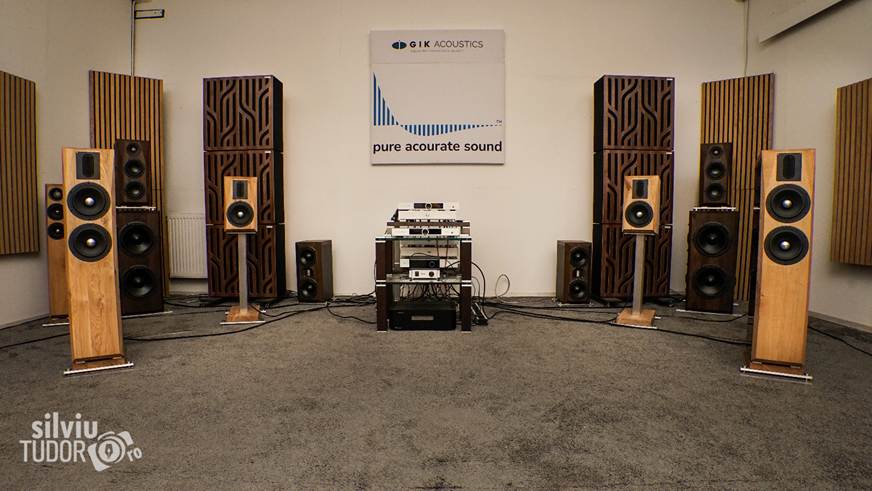
In my previous articles, I told you how, back in Warsaw, I fell head over heels in love with their speakers and how I later received a pair of Rose-Handwerk Vitesse Wave for review — speakers crafted for many years by Markus Grelka, the mastermind behind Rose-Handwerk. Once the Vitesse Wave arrived at my home, I unquestionably fell in love with them, and they have stayed here as my permanent loudspeakers. But today I won’t be telling you about the Vitesse Wave, because I’ve already done that in earlier articles, which you can find and read on my website, silviutudor.ro.
Today I want to tell you about the unexpected experience I had in the listening room inside the Rose-Handwerk workshop — a unique experience, in a room that doesn’t say much at first glance, but once the lights go down and the music begins, a kind of magic appears that is hard to put into words. The Rose-Handwerk listening room is one of the most special rooms I have ever listened in. And that is what I will be sharing with you today.
You can imagine, dear reader, that I didn’t have particularly high expectations at that moment. I already knew Markus built wonderful loudspeakers — after all, I had a pair at home — and I knew they carried the unmistakable Joachim Gerhard DNA, Markus’s mentor. As a woodworker myself, I had also realized that Markus’s speakers come remarkably close to works of art: exceptionally crafted, finished to perfection, and built only with premium materials. Yet even so, I had no idea what awaited me inside the Rose-Handwerk workshop and listening room. I was about to hear the most impressive listening room I have ever experienced — and believe me, I’ve heard a bunch by now.
Arriving with these modest expectations, we were greeted with a great coffee, a delicious breakfast, and a truly enchanting place. Everyone at Rose-Handwerk is wonderful — Markus, Daniela, Elisabeth, Carsten — and the location, set beside the small village of Freienohl, is fabulous: an oasis of calm in the middle of a small industrial area that includes the workshop, the showroom, and the Rose family home. I’ll tell you more about all of this, and about the tour of the Rose-Handwerk factory, in my next article. As I said, today we focus solely on the listening room.
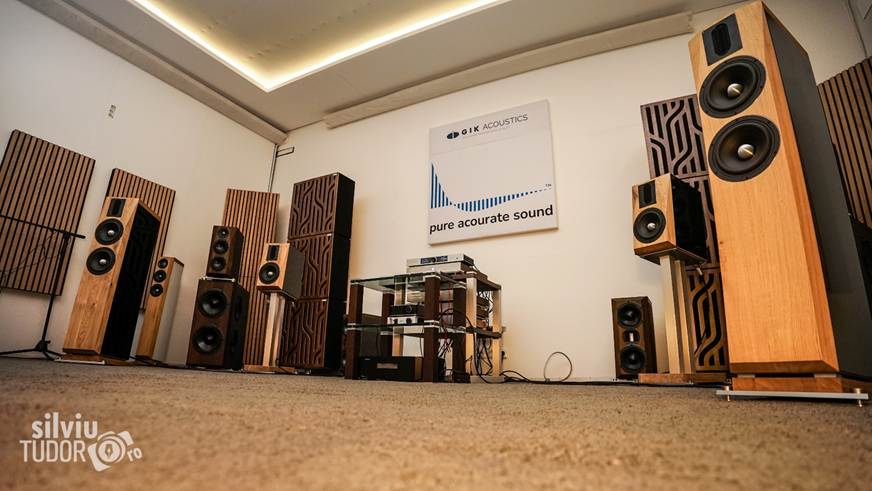
So, after the coffee had been enjoyed, the tour completed, and the stories exchanged, the moment finally came to listen to the Rose-Handwerk listening room. Following Markus, I discovered the room behind a massive sliding door that opened to reveal a space of roughly 40 square meters, about four meters high, with a peculiar ceiling, carpeted floor, simple walls, acoustic treatment from GIK Acoustics, and — the first thing that caught my eye — a nearfield-style setup, completely unusual for a room of this size.
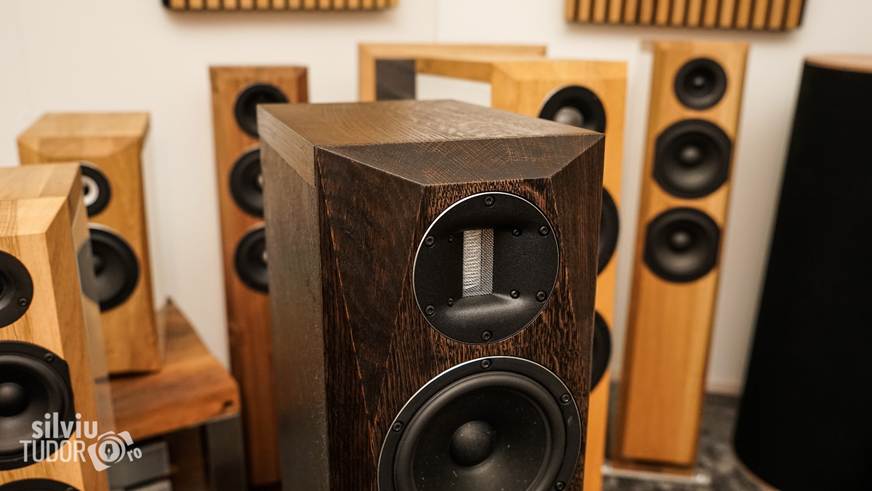
It didn’t matter which speakers we were listening to — the position was always the same: nearfield. I talked to Markus right away, and we realized we shared the same taste when it comes to soundstage: holography, which, in truth, can only fully shine in a nearfield setup. The speakers were positioned about two meters from the back wall, roughly three meters apart, forming an isosceles triangle with the listening position — though an unusual one, with the distance between the speakers and the listener smaller than the distance between the speakers themselves. Atypical, but fascinating. I would later learn that this placement enhances what Markus calls “the bubble” — something I will explain in detail a bit later.
We had only two listening chairs at our disposal: one placed perfectly in the sweet spot, and a second positioned right behind it — a seat from which the sound was still excellent, almost like being in the second row at a concert.
Naturally, I took the prime position, while Lucia sat in the “row two” seat. Markus smiled and walked toward the light switches, saying: “This is how we listen here — in complete darkness. It’s the best way to reach the music.” And, of course, in my mind I replied: “Bravo, Markus, that’s exactly what I’ve been doing all my life — only in darkness can I enter into full intimacy and communion with the music.”
In that perfect darkness, the music began, and we were genuinely taken by surprise. Quite literally, as Markus calls it, a huge bubble of sound enveloped us completely — a bubble that must have been four or five meters in diameter. A vast, magical sound that pushed you into a dreamlike state, a sensation I had never experienced before that moment.
After five or six tracks, Markus stopped the music and turned on the lights. Like moles disturbed in their burrow, we squinted toward him and told him that it sounded unbelievably good — we could hardly believe how impressive the sound was in that room full of speakers, without any spectacular design features or elaborate wooden constructions on the ceiling or the floor. Markus then asked us: “Which speakers do you think were playing?” It was an easy question for him to ask, given that several speakers were positioned in front of us, and you could easily have guessed wrong.
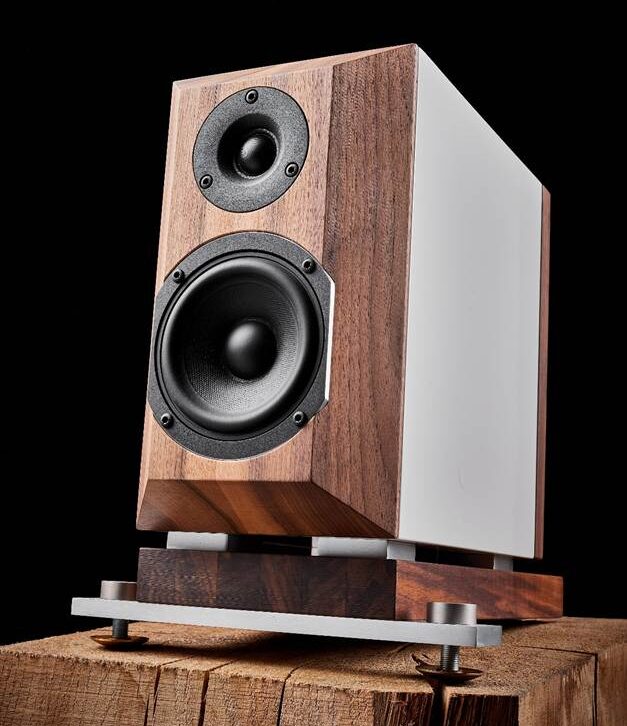
Well, these were the ones. The Rose Micro Classic — tiny little boxes, just 28 × 15 × 24 cm and under 8 kg — were the speakers that filled that huge room with sound. Markus hadn’t used any subwoofer, no tricks of any kind; these two small loudspeakers were the ones that flooded the room with so much impact, warmth, magic, holography, and that unmistakable “bubble” signature of Markus Grelka, something I haven’t heard anywhere else.
The Rose Micro Classic is a 2-way compact loudspeaker built in a resonance-damped, sandwich-constructed cabinet, featuring a 40mm solid baffle that minimizes sound transmission and significantly reduces edge diffractions through its carefully chamfered design. Its 22mm silk-dome tweeter sits in a dedicated waveguide to lower lateral reflections, while the 12cm paper-cone woofer is impedance-optimized and engineered for minimal mechanical losses. The speaker offers a 4-ohm impedance, 82dB efficiency, 50W power handling, and a remarkably linear frequency response of 50Hz to 30kHz (–3dB) within ±2dB.
Of course, we were left speechless that such small speakers could sound that way, so I immediately asked to hear something more serious. If the Micro Classic could create that kind of sound, I wanted to see what the upper models could do, knowing that the Micros are the entry-level speakers in the Rose-Handwerk lineup.
We continued straightaway with my own speakers from home — the Vitesse Wave — which I had only listened to in my small 12 m² listening room. Here, I was truly putting them to the test, given the size of the Rose-Handwerk listening room. The first thing that impressed me was that the same type of presentation from the Micro earlier was still present; that’s when I understood that Rose-Handwerk speakers have this unique “bubble” signature — a soundfield that embraces you and keeps you inside this magical sonic sphere.
The Vitesse Wave is a 2-way compact loudspeaker built in a resonance-damped, sandwich-constructed enclosure, featuring a 40mm solid baffle that minimizes sound transmission and reduces edge diffractions through precisely machined chamfers. At its heart lies a special coaxial tweeter combining a ceramic cone with a 22mm silk dome, paired with a 15cm paper–glass fiber woofer that is impedance-optimized and engineered for minimal mechanical losses. The Vitesse Wave delivers a 4-ohm impedance, 84dB efficiency, 60W power handling, and an impressively linear frequency response of 40Hz to 30kHz (–3dB) within ±2dB. With dimensions of 42cm in height, 18cm in width, and 24cm in depth, and weighing 12kg, the ROSE Vitesse Wave offers refined engineering and exceptional sonic precision in a beautifully compact form factor.
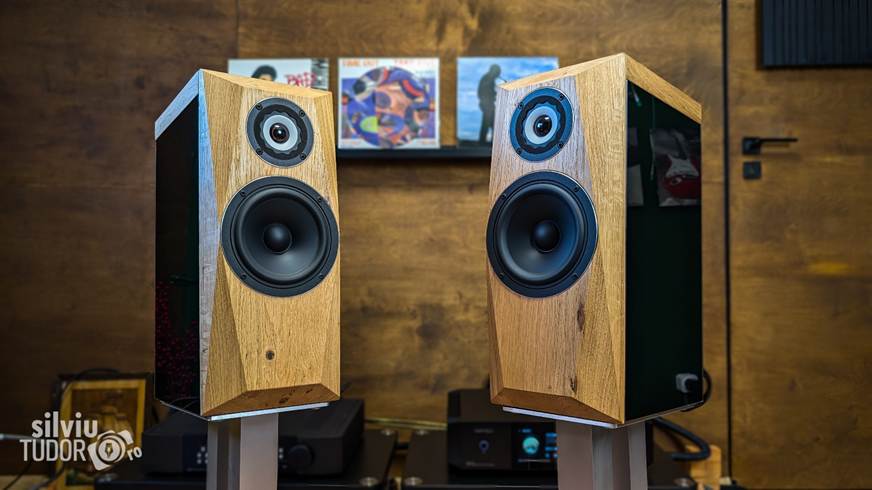
Listening to the Vitesse, I realized that everything had been preserved — but everything had also improved. The bubble became larger, the resolution better, yet I still remained impressed by the Micros, which offer an astonishing price-to-performance ratio. The next speakers we listened to were a higher-tier bookshelf model, the Rose Langerfeld, but presented here in an interesting configuration featuring Mundorf AMT (Air Motion Transformer) Maxi 2.5 tweeters.
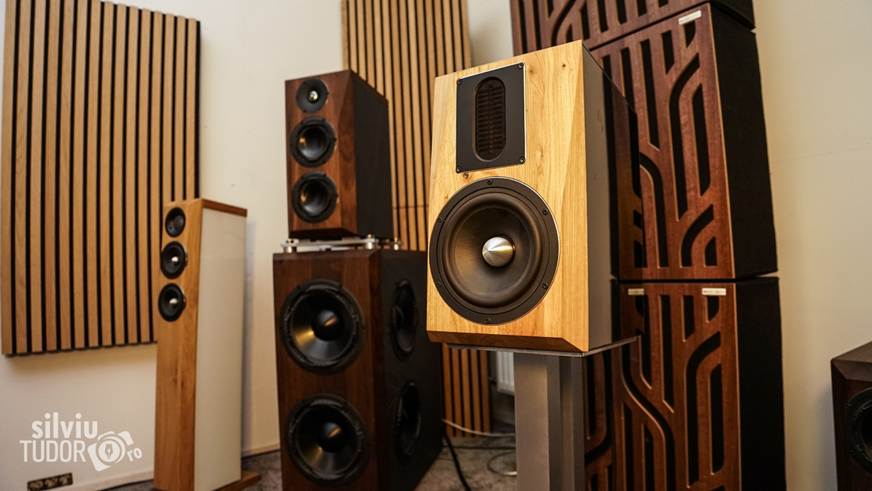
These clearly sounded above the Vitesse, while maintaining the same Rose-Handwerk sonic signature — holographic, balanced, and with that special sound bubble. The Rose Langerfeld is a 2-way compact loudspeaker featuring a resonance-damped, sandwich-constructed cabinet and a massive 40mm solid baffle that minimizes sound transmission while reducing edge diffractions through precisely machined chamfers. Its usual 30mm beryllium-dome tweeter sits in a dedicated waveguide to control dispersion and reduce lateral reflections, working together with an 18cm impedance-optimized phase-plug paper-cone woofer engineered for minimal mechanical losses. With an 8-ohm impedance, 84dB efficiency, 80W power handling, and a highly linear frequency response of 35Hz to 30kHz (–3dB) within ±2dB, the Langerfeld delivers remarkable extension and clarity. Measuring 38cm in height, 22cm in width, and 32cm in depth, and weighing 15kg, the ROSE Langerfeld embodies precision engineering and artisanal craftsmanship in a substantial yet compact form factor.
After finishing with the three bookshelf models, we moved on to the floorstanders. Here we tested two versions of the Rose Maxi Classic: the standard configuration and one equipped with the Mundorf AMT Maxi 2.5 tweeters. The two pairs sounded similar, with the AMT-equipped version standing out thanks to its even higher treble resolution. In a way, we were able to help Markus as well, since all AMT-based models are still in development, and we could offer feedback. For now, the Rose Maxi Classic in its standard configuration remains the more balanced version.
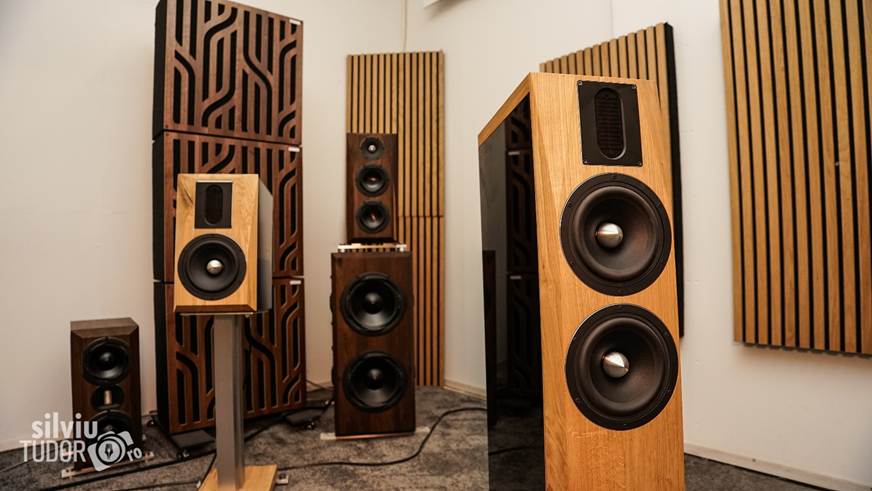
The ROSE Maxi Classic is a 2.5-way floorstanding loudspeaker built in a resonance-damped, sandwich-constructed cabinet, featuring a 40mm solid baffle designed to reduce sound transmission and minimize edge diffractions through carefully machined chamfers. Its 30mm silk-dome tweeter is housed in a dedicated waveguide to control dispersion and reduce lateral reflections, while two 18cm impedance-optimized paper/glass-fiber woofers provide authoritative low-frequency performance with minimal mechanical losses. The speaker delivers a 4-ohm impedance, 90dB efficiency, 160W power handling, and a highly linear frequency response of 30Hz to 30kHz (–3dB) within ±2dB. Standing 106cm tall, 20cm wide, and 32cm deep, and weighing 30kg, the ROSE Maxi Classic offers substantial presence, refined engineering, and exceptional acoustic capability in a beautifully crafted floorstanding design.
At this point we took a break from the listening sessions because we were genuinely overwhelmed by what we had heard in that hidden listening room at the heart of the Rose-Handwerk factory. This was the moment when I began asking more questions about the room itself, because I was very curious about the philosophy behind it — how much of it was “by chance” and how much was deliberately thought out.
I soon discovered that Markus had put a tremendous amount of work into building this room. It is a completely separate structure from the factory hall, positioned somewhere between the showroom and the workshop, and it “stands” freely in the middle of the building, which is essentially one large hall. In other words, Markus created what we would call a room-within-a-room, investing a great deal of effort into getting it right from the start, without relying heavily on acoustic treatment later on.
The room is built using wooden-frame walls, clad with drywall on both sides and filled with mineral wool on the inside. The ceiling, however, is essentially nonexistent — the room “breathes” freely into the factory hall above it. Instead of a traditional ceiling, there is a kind of textile material arranged in soft waves, acting as a dust barrier and preserving quietness and intimacy inside the room, while still allowing certain frequencies to escape. A highly successful listening room, extremely simple to build, and without huge costs.
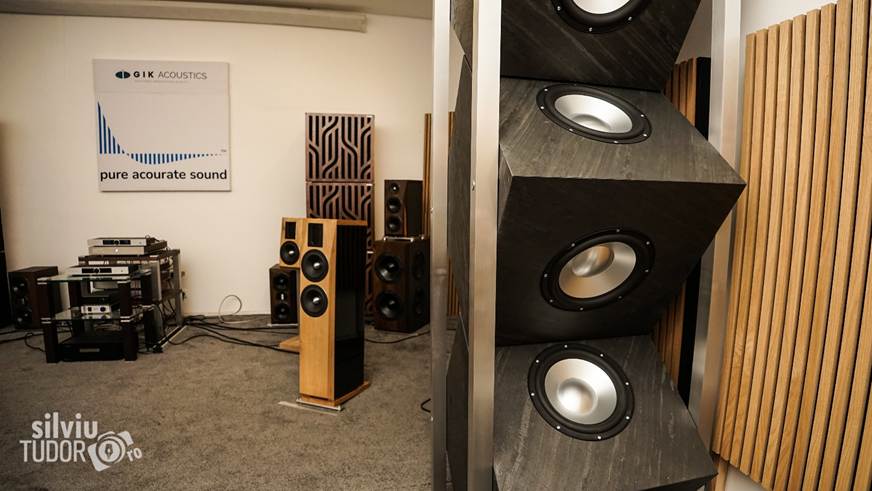
I also asked him about the acoustic treatment from GIK Acoustics, which Markus told me he is very pleased with, adding only as much as he felt was necessary: diffusion panels on the front and side walls, corner bass traps in all four corners, and a few absorption panels placed strategically. What stood out to me, however, was that nothing was used in excess — in fact, considering the size of the room, the acoustic treatment was applied with remarkable restraint.
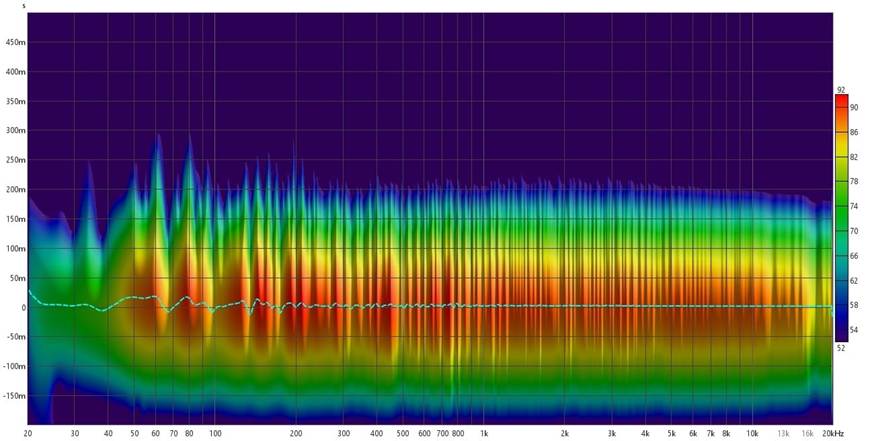
The capture above shows a REW measurement taken in the Rose-Handwerk listening room – and those familiar with such measurements will immediately notice that it is an outstanding result, very close to what you would expect from a professional studio or even a mastering room. In fact, this measurement fully explains many of the listening impressions I had already reached by ear.
From the graph we can see superb bass control, with fast decays and well-tamed room modes, without long tails that would create boominess or lingering bass. The measurement also shows excellent midrange behavior: the room adds no coloration to the human voice in the critical 200 Hz – 1 kHz region. Likewise, the treble region between 2 kHz and 12 kHz exhibits well-dissipated reflections, with no harshness or spectral coloring.
Finally, the reverberation time (RT60 – the light-blue curve in the center) is remarkably close to that of a mastering room: neither too dead (as in an anechoic chamber), nor too lively (as in a typical living room). It is effectively just right — exactly how a true music room should behave.
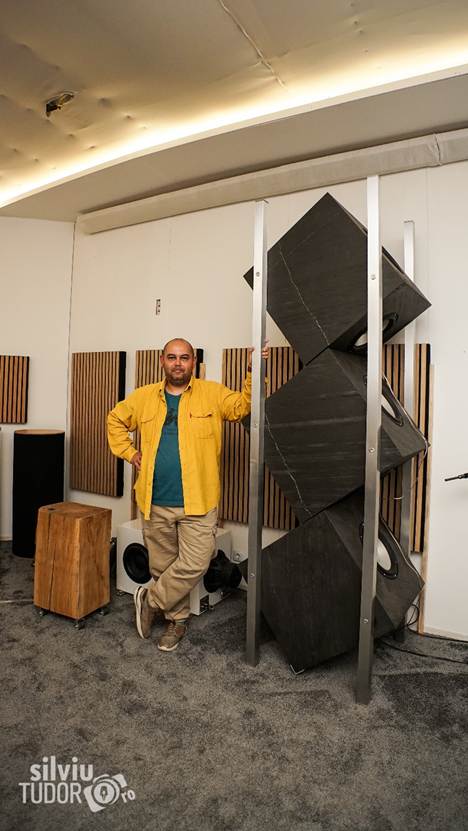
After these explorations, we returned to the listening sessions and brought into the setup Markus’s newly built subwoofers — massive 2×3 towers, far taller than I am, carefully placed on the left and right sides of the room’s midpoint. The subwoofers are called “Statement,” each tower housing six 12-inch drivers and six passive radiators in a push-push configuration, with every subwoofer enclosed in its own cabinet — a 60-centimeter cube. They are also finished in real stone veneer, a fascinating new construction technique Markus has introduced, now used on several of his loudspeaker models as well.
Listening again with these subwoofers engaged, I immediately felt an incredible bass — huge, thick, full-bodied — coming at you from every direction. It was a truly visceral experience, one I haven’t encountered anywhere else.
One last technical detail in this report concerns the electronics Markus uses together with these wonderful loudspeakers. And here I was genuinely impressed to learn that Markus is not obsessed with cables and electronics the way most of us audiophiles are. In his test systems and showroom setups he generally uses balanced interconnects, but not expensive ones — just solid, correct choices, often studio-grade. The same goes for power: no special grounding schemes, no ultra–high-end power distributors, simply decent, sensible components which, by audiophile standards, could even be considered “cheap.”
I asked Markus why he doesn’t choose high-end accessories, and he told me he prefers to refine things inside the loudspeakers themselves and doesn’t want to add extra “seasoning” through cables and gear. He leaves that to his clients if they wish, but he wants to listen to his speakers as naturally as possible — a clean, baseline sound, without frills — because his goal is to create loudspeakers that sound great right from the start, without needing expensive accessories, electronics, amplifiers, or DACs. I admire him greatly for this philosophy, and I can confirm from my own testing that his speakers do indeed sound good with inexpensive cables, budget amplifiers, and so on. Of course, when paired with high-end gear they scale beautifully in every respect, but it means a lot that they already sound excellent without any fuss. His speakers remind me of the fun, engaging designs of the ’80s and ’90s — far more joyful than many of today’s offerings.
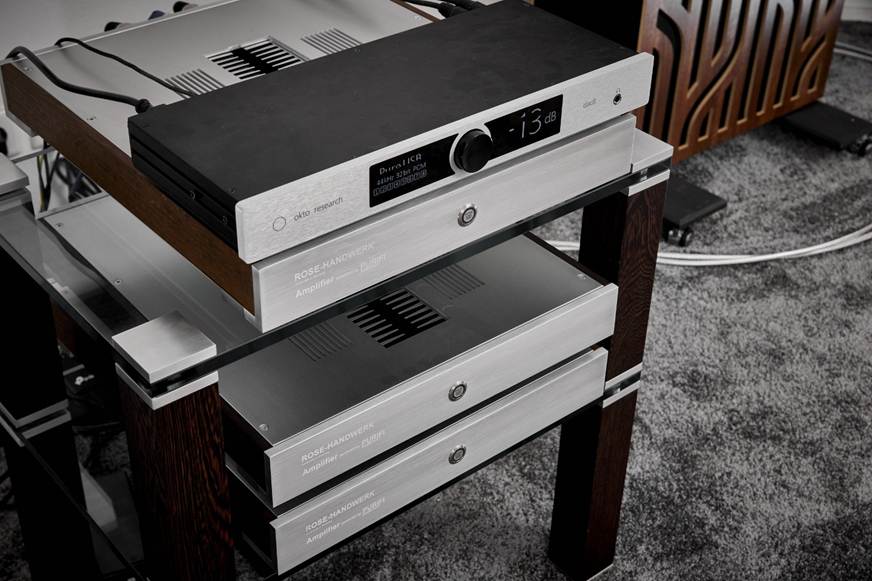
In his equipment rack you’ll find both very entry-level devices, which he uses for testing his speakers, as well as high-end components. For example, I spotted the new Eversolo AMP-F10 power amplifier — a unit I reviewed myself not long ago and concluded is exceptionally good. In the rack I also noticed the Okto Research dac8 PRO, an eight-channel D/A converter and desktop digital processor designed for maximum flexibility and serious multichannel or professional use. It offers eight fully routable analog outputs, per-channel volume control, and a powerful 8×8 internal routing matrix, making it ideal not only for stereo playback but also for multichannel systems, active speaker setups, PC-based crossovers, recording, and monitoring workflows. This DAC is part of the “Pure Acourate Sound” system, which I’ll discuss in a paragraph later on.
Markus also builds DACs and amplifiers in-house, which you can see in some of the photos (including the one below). He builds them out of pure passion, most often for internal use only, and to offer his speakers absolute neutrality. As I mentioned earlier, he doesn’t want his electronics to add any coloration — he wants his speakers to breathe freely, exactly as they were designed.
Returning to another one of Markus’s projects, Pure Acourate Sound, this system reimagines what high-end playback can be, shifting the focus from perfecting components in isolation to optimizing the entire signal chain as it actually behaves inside the listening room. Built around state-of-the-art Purifi drivers and amplifiers, Klippel-verified measurements, GIK room-tuning, and the powerful Acourate DSP engine, the system splits the stereo signal into six channels, applies ultra–high-resolution FIR filters, and performs precise room correction with linear-phase crossovers. Everything is calibrated individually — from each driver to the room itself — resulting in extremely low distortion, coherent dispersion, and a level of control and transparency that traditional passive loudspeaker designs simply cannot match.
I had the pleasure of listening to this system at last year’s Warsaw show, and I can tell you I was genuinely impressed. I sincerely wish for Markus Grelka, Joachim Gerhard, Purifi Audio, Okto Research, GIK Acoustics, and everyone else involved in this project that it truly takes off, because the approach is fantastic and capable of solving the problems of many audiophiles struggling with difficult listening rooms.
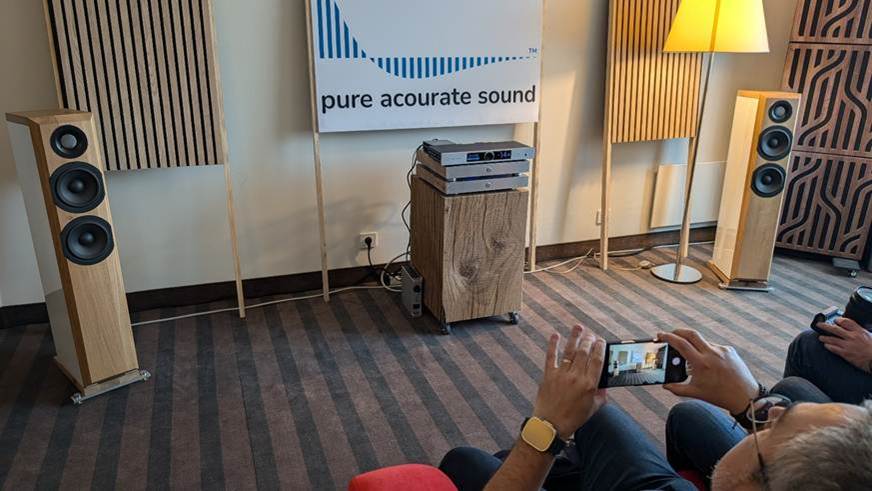
I couldn’t part ways with you without sharing a very funny moment that took place in this listening room. First, I should tell you that out of the two days we spent at Rose-Handwerk, we spent more than half of that time listening to music inside this room. And on one of those days, while we were listening in complete darkness and absolute silence, the door of the listening room suddenly swung open, all the lights came on at once, and Markus’s wife, Daniela, burst into the room together with a few other people — as if an air raid had just been announced:
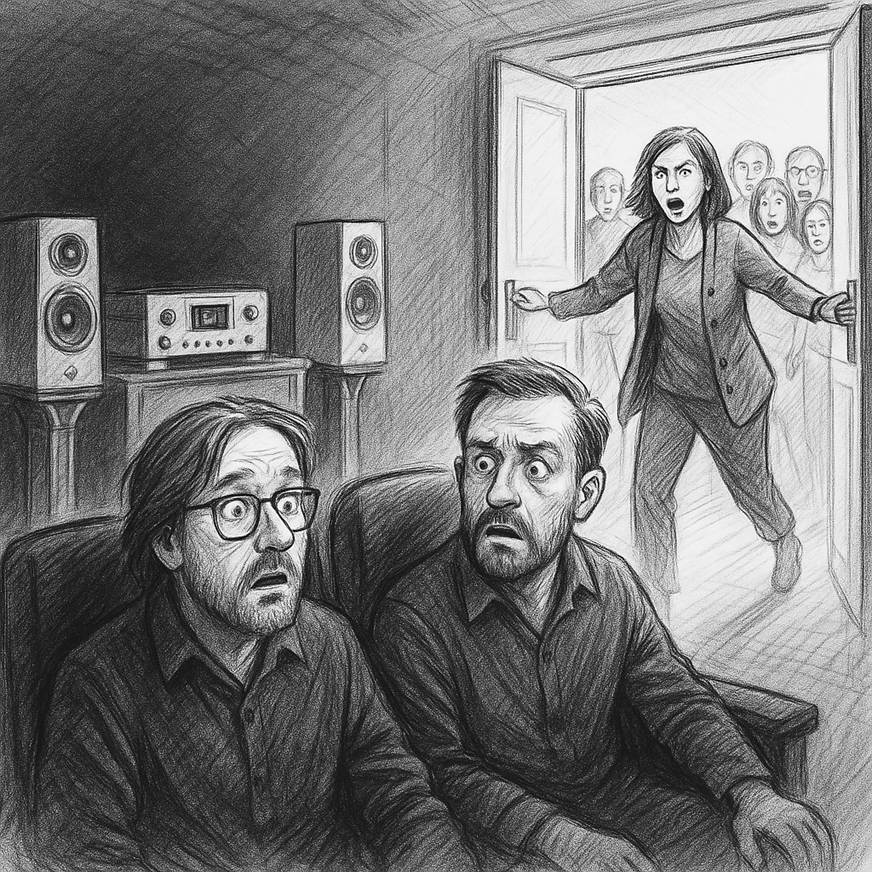
Daniela was bringing some clients to show them the listening room. The clients were clearly not audiophiles, and I can only imagine what they must have thought when they saw the three of us — fully grown adults — sitting there in total darkness, listening to strange, wordless music. I’m sure our faces must have been a sight, like Dracula rising from his coffin. So you see, this room gave me all kinds of emotions: exhilaration, joy, spirit, magic… and also a good scare. It was hilarious — I’ll never forget it. This will be one of those stories I’ll always carry with me, and every time I remember it, I know I’ll end up laughing from ear to ear.
So, if you ever find yourself in western Germany, make sure to put Rose-Handwerk on your list. It’s just a stone’s throw from Dortmund Airport, very easy to reach, and the experience is extraordinary — out of this world — worth it ten times over.
Markus and Daniela will greet you with a good coffee, and if you arrive early enough, they might even serve you breakfast. But one thing is certain: if you’re an audiophile, you will feel something you may have never felt before — “the bubble” — this unique concept created by Markus Grelka, for which I am deeply grateful, as I get to enjoy it every day in the comfort of my own home.
I’ll leave you with a comment made by a member of the German Hi-Fi community on my very first post about the Rose-Handwerk listening room — a comment that perfectly captured my own amazement at how spectacular this room sounds and how strongly the “bubble” effect comes through. He wrote: “The room is a highlight in Germany within the German HiFi community. An extraordinary experience. Unbelievable if you have not heard it. A room that simply shows the connections between space, acoustics, and emotions.” I will leave you with his words. Thank you, Oliver — you hit the nail on the head.
If you’ve missed my previous articles about Rose-Handwerk, here they are:
COMPANY PROFILE: ROSE-HANDWERK – Solid Wood Speakers Built to Perfection in Germany
INTERVIEW: MARKUS GRELKA – The Speaker Artisan of ROSE-HANDWERK
GEAR REVIEW: ROSE-HANDWERK – Vitesse Wave – These Speakers Are Alive!
And stay tuned — the Rose-Handwerk factory tour is coming soon.
PURCHASE & MORE INFO: If you are from Romania, contact me directly, if you are outside this area, please go to rose-handwerk.de for more information.
Silviu TUDOR
An article written in my sweet spot,
and this is what I’ve heard.